Understanding electricity: voltage, current and why water conducts
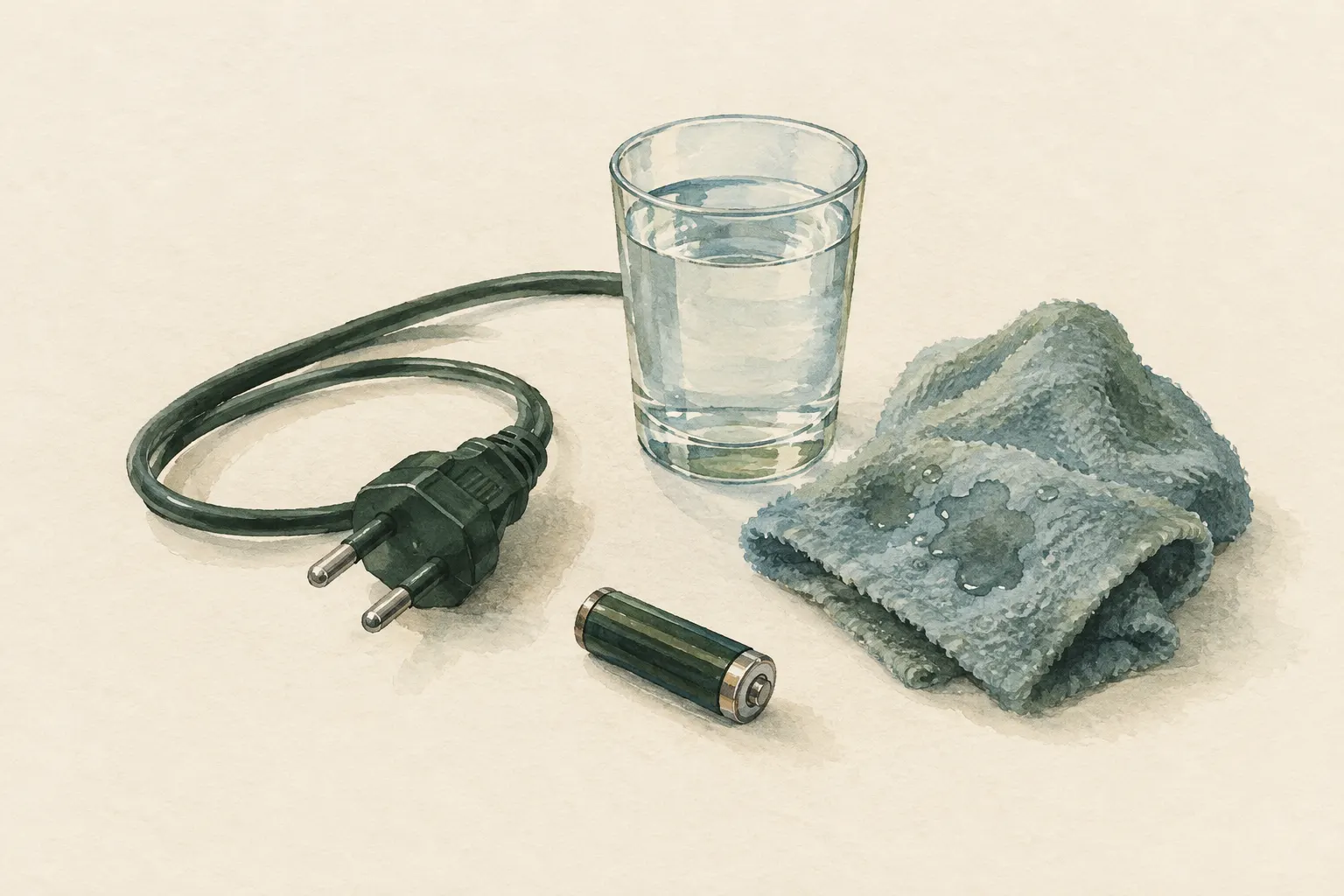
What is dangerous is the current that flows through the body. How much flows depends on the voltage and the resistance – and wet skin, water and earth greatly lower the resistance. That is why mains voltage in the home, flooded basements and fallen power lines are deadly, while a torch battery is harmless.
- Reading time
Explained simply
You can imagine electricity like water in a garden hose. Voltage is the pressure that drives the water. Current is how much water actually flows. And resistance is how narrow the hose is. High pressure and a wide hose mean: a great deal flows.
What is dangerous is the current that flows through your body. With a torch battery the pressure is so small that hardly anything gets through you. At a wall socket the pressure is much, much greater – enough to kill a person. Water makes everything worse: wet skin and puddles are like a wide hose through which current flows easily.
So the rule is: never touch power lines that have fallen down, do not go into flooded rooms if there could be power there, and do not touch anyone who is stuck to a power source – otherwise the current flows through you too. Call for help on the local emergency number (112 in the EU). Work on wiring and sockets in the home is always done by a qualified electrician.
How it works
Electric current is moving charge. In metal wires these are electrons; in liquids and in the body mainly dissolved ions, that is, charged particles of salts. For current to flow, there must be a closed circuit: from the source through a consumer back to the source. If a person becomes part of this circuit – for example between a live part and the ground – the current flows through them.
How much current flows is described by Ohm's law: current equals voltage divided by resistance. Double the voltage means double the current, and so does half the resistance. Dry skin has a fairly high resistance and slows the current. Wet, sweaty or injured skin hardly slows it at all. Anyone standing in water also has a very good connection to the ground.
Completely pure water, by the way, conducts poorly. Tap water, rainwater, floodwater and above all seawater, however, contain dissolved salts and other substances whose ions carry the charge. In practice you must treat all water as conductive.
Why current in the body is dangerous
The heart and muscles are controlled by tiny electrical signals. Current from outside throws this system into disorder. Even comparatively small currents can make muscles cramp so that you can no longer let go of an object you are gripping. If current flows through the chest, it can disturb the heart rhythm – that is the greatest danger to life.
How serious an electrical accident is depends not only on the current but also on its path through the body, its duration and the type of current. A path from hand to hand or from hand to foot runs through the upper body and so close to the heart. At high voltages there are also severe burns, including internal ones that cannot be seen. That is why every person who has had an electrical accident needs to see a doctor, even if they feel fine at first.
Mains voltage is 230 volts in Europe and 120 volts in North America. Both are considered potentially fatal. A 1.5-volt or 9-volt battery, on the other hand, cannot meaningfully overcome the resistance of dry skin. Birds can sit on a high-voltage line because they touch only one wire: there is no voltage difference between their feet, so no current flows through them.
Safety: power lines, floods and accidents
Fallen or damaged power lines must always be treated as live – even if they lie still, do not spark and do not hum. Keep well away, warn others and call the grid operator or the local emergency number (112 in the EU). If a line touches the ground, the voltage spreads out in rings through the soil. A dangerous step voltage can then exist between your two feet – the longer the step, the bigger the difference. Fences, puddles and wet ground nearby can also be live.
In floods: do not go into a flooded basement or room while the power there could still be on. You may only switch off the power if the fuse box can be reached dry and safely. Otherwise call the fire service or the grid operator. Appliances that have got wet are checked by a qualified electrician before they are used again.
If a person is stuck to a power source, do not touch them until the power has been switched off – otherwise you become part of the circuit yourself. If it can be done safely, switch off the fuse or the main switch, and call emergency services. With high voltage, such as railway or overhead lines, stay far away and wait for the professionals.
What matters in everyday life
Many household installations have a residual current device, RCD for short. It compares the current flowing out with the current flowing back. If some is missing – because it is leaking to earth through a person or through water – it switches off within a fraction of a second. It has a test button you can use regularly to check that it trips. Whether one is present or should be retrofitted is for a qualified electrician to assess.
Do not use electrical appliances with wet hands or while standing in water. Extension leads do not belong in puddles or under carpets. Cable reels are fully unwound under high load, because coiled cable can get very hot. Outdoors: no kites, fishing rods or long ladders near overhead lines.
Emergency generators must never simply be “back-fed” into a socket of the household wiring. That is only allowed via a transfer switch professionally installed by a qualified electrician. Otherwise voltage can get into the public grid and endanger people who are working on the lines there.
Good to know
Whether laypeople may do anything at all on household wiring differs between countries. This entry therefore only explains why electricity is dangerous – not how to work on wiring. For anything beyond plugging in an appliance or operating a switch, a qualified electrician is responsible.
Electric fences are an interesting special case. They work with short pulses of high voltage but very limited energy. This is painful and meant to deter animals, but is designed so that it is normally not life-threatening. You should still not touch them, and children should know why.
A car battery also deserves respect even though its voltage is low: it can deliver very large currents. If a spanner or a ring gets between the terminals, the metal can become red-hot and throw sparks.
Step by step
Respect mains voltage
Mains voltage is 230 volts in Europe and 120 volts in North America – both can be fatal. Do not operate appliances with wet hands or while standing in water.
- 1
Respect mains voltage
Mains voltage is 230 volts in Europe and 120 volts in North America – both can be fatal. Do not operate appliances with wet hands or while standing in water.
- 2
Know your protective switches
Residual current devices (RCDs) switch off when current leaks via the wrong path. Test them regularly with the test button.
- 3
Keep your distance outside
Stay away from damaged lines, pylons and substations; never fly kites or use fishing rods near overhead lines.
- 4
Connect generators safely
Never feed a generator directly into household wiring except via a professionally installed transfer switch – otherwise back-feeding endangers line workers.
Common mistakes
- Assuming a fallen line is switched off
- Wading into a flooded basement to switch off the fuses
- Touching a person in contact with a power source
- Leaving extension leads lying in water
Quick view
Suitable for
- Understanding hazards in floods and storms
- Safe use of generators and extension leads
- Talking with children about electricity
Not suitable for
- Instructions for electrical work
Safety
- Work on household wiring is for qualified electricians; what laypeople may do differs between countries – check local rules.
How it works
Voltage is the drive, resistance the brake, current the result: the higher the voltage and the lower the resistance, the more current flows (Ohm's law). Pure water conducts poorly, but tap water, rainwater and floodwater contain dissolved salts and other ions that carry charge. Dry skin slows the current, wet skin hardly at all. Around a line that touches the ground, the voltage spreads through the soil – a dangerous step voltage can then exist between your two feet.
Advantages
- A few basic concepts explain most electrical hazards
Disadvantages
- Electricity is invisible – you cannot tell by looking whether a line is live
Deep knowledge
Background
Textbooks such as Halliday/Resnick/Walker explain voltage, current, resistance and the conductivity of electrolyte solutions. FEMA's "Are You Ready?" guide advises staying away from fallen power lines and not touching electrical equipment when flooded.
How dangerous a shock is also depends on the path through the body, duration and type of current; that is why any mains voltage is treated as potentially fatal.
Variants
- Electric fences
- Electric fences use short pulses of high voltage but very limited energy. They are painful and meant to deter; you should still not touch them.
Common mistakes
- Assuming a fallen line is switched off
- Wading into a flooded basement to switch off the fuses
- Touching a person in contact with a power source
- Leaving extension leads lying in water
Limits and risks
- No instructions for electrical installation
- No medical treatment after electrical accidents
Sources
David Halliday, Robert Resnick, Jearl Walker – John Wiley & Sons: Fundamentals of Physics
Voltage, current, resistance, conductivity of solutions
U.S. Federal Emergency Management Agency (FEMA): Are You Ready? An In-Depth Guide to Citizen Preparedness
Distance from fallen lines, electricity during flooding
European Commission: 112 – the European emergency number
European emergency number 112