Tripped breaker or blown fuse: resetting safely – and when not to
What laypeople may and should do with electrics is narrowly limited: switch a tripped circuit breaker or residual-current device back on, replace a screw-in fuse with an equivalent one, and narrow down the cause – usually a faulty appliance or overload. If it trips repeatedly, smells burnt or something has got wet, it stays off and a qualified electrician is called.
- 5–15 minutes
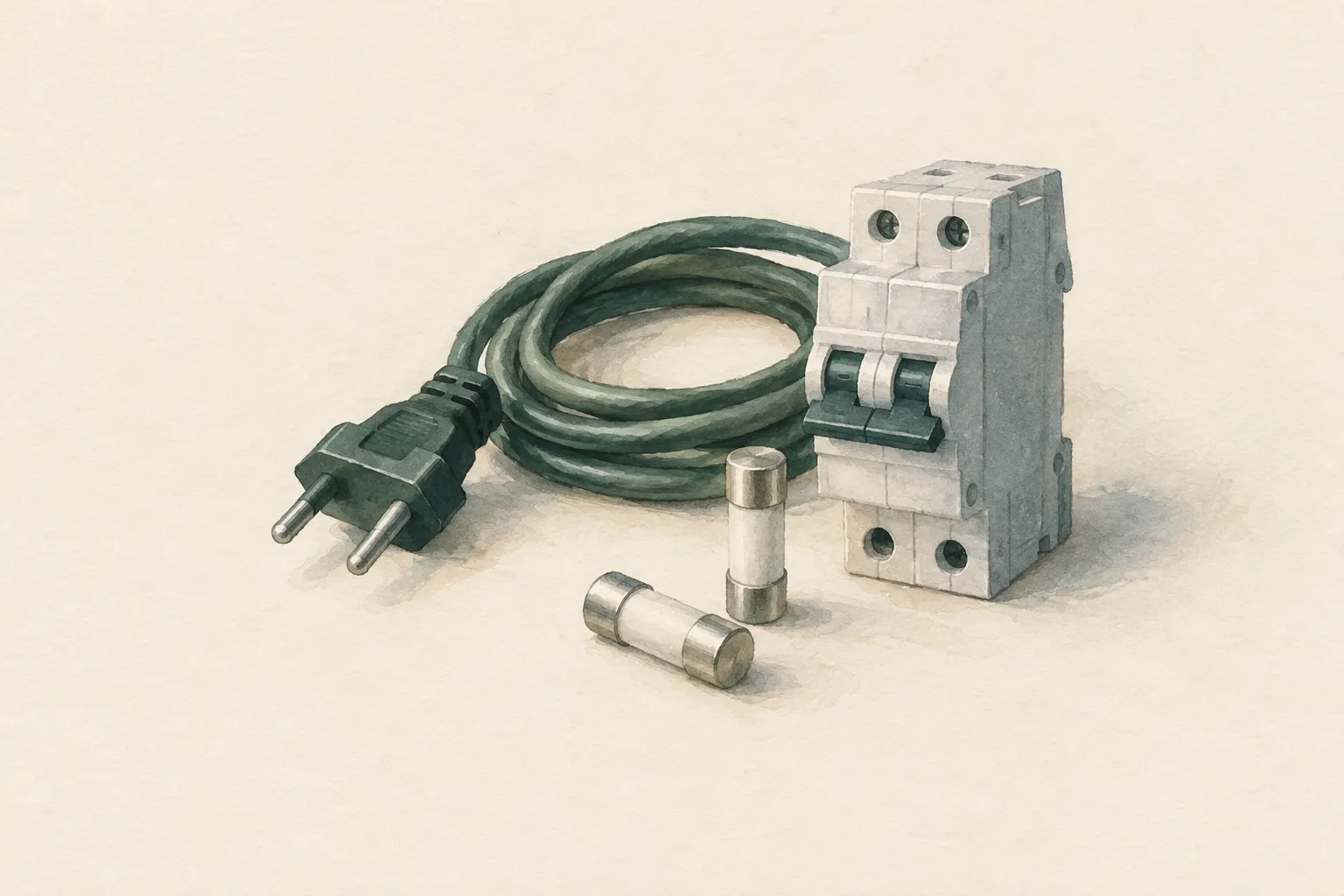
Explained simply
In the consumer unit there are small switches that watch over the power lines in the home like guards. If too much current flows through a line – for example because the kettle, hair dryer and fan heater are running at the same time – or if an appliance is broken, they switch off in a flash. Then the lights suddenly go out in part of the home. That is not a disaster but protection: without these guards, cables could get hot and a fire could start.
What you are allowed to do is very little – and that is a good thing. You unplug the appliances in the affected area, switch the tripped switch back on with dry hands, and then plug the appliances back in one after another. If the breaker trips with a particular appliance, that appliance is probably faulty.
Very important: if the breaker keeps tripping, something smells burnt or water has got in somewhere, it stays off. Then an adult calls a qualified electrician. You never open the consumer unit, sockets or cables yourself.
How it works
Current heats every wire it flows through – the more current, the warmer. Wiring in the walls is designed for a certain load. A fuse contains a thin wire that melts through when there is too much current and breaks the circuit; it then has to be replaced. A circuit breaker does the same mechanically and can be switched back on. It responds to two things: a sustained overload and, very quickly, a short circuit.
The residual-current device (RCD, called GFCI in some countries) watches for something else. It compares the current flowing out to the appliances with the current coming back. If they are not equal, current is leaking along a wrong path somewhere – through a faulty appliance, through moisture or, in the worst case, through a person. Then it switches off very quickly. That makes it an important protection against electric shock.
So when such a switch trips, it is a warning, not a fault in itself. It has done its job. The question is not “How do I get it back on?” but “Why did it trip?”.
What you may do – and what not
What is allowed and sensible is a small, clearly limited routine: first check whether only your home or a single circuit is affected. If the whole neighbourhood is dark, it is not your consumer unit – then do not switch anything and wait for information from the network operator. If only one circuit is out, switch off and unplug the appliances in that area, especially those just switched on or that have got wet.
Then, with dry hands, push the tripped switch fully down and back up again. A screw-in fuse may only be replaced with an equivalent one, and only where the holder is designed for this. Then plug the appliances back in one at a time. If it trips with a particular appliance, stop using it and have it checked.
Not allowed and dangerous: unscrewing consumer-unit covers, opening sockets, switches or wiring, bypassing a fuse or fitting a higher-rated one. Which tasks laypeople may do differs from country to country; in many countries fixed electrical installations are legally reserved for qualified people. Anything beyond resetting belongs to a qualified electrician.
Safety: what to watch out for
A higher-rated fuse or a bypass switches off the guard. The wiring in the wall can then overheat without anything cutting out – invisibly, behind plaster and wallpaper. That is how fires can start. So the rule has no exceptions: if it trips repeatedly, do not force it.
After flooding or water ingress, do not switch the power back on yourself and do not approach the consumer unit while standing in water. Contact the network operator or a qualified electrician. Never switch anything with wet hands or barefoot on a wet floor.
If something smells burnt, sockets are warm or discoloured, there is crackling, or the breaker trips even with nothing plugged in: leave it off and call a qualified electrician. If there is smoke or fire, get everyone out of the building and call the local emergency number (112 in the EU).
How to prepare
You should know where the consumer unit is before the lights go out. Keep a torch or head torch within reach nearby. If the unit is not labelled, a qualified electrician or the landlord can help identify the circuits – then you can see at a glance which switch is for the kitchen and which for the bathroom.
Note the phone number of an electrician or the landlord somewhere you can find it without power. Many residual-current devices have a test button. How often to press it is stated in the instructions or local recommendations; when pressed, the switch must trip, otherwise it should be checked by a professional.
Typical situations
A classic case: in winter the kettle, toaster and a fan heater are all running in the same kitchen – the circuit breaker trips. That was overload. After resetting, it is better to spread the appliances out or use them one after the other.
Another case: after a rainstorm the RCD keeps tripping as soon as the outdoor socket or garden lighting is switched on. Moisture is probably involved here. The affected part stays off until a professional has looked at it. An RCD that “keeps tripping” is not an annoying component; it is pointing to a real fault.
Step by step
Check the situation
Is only your home or one circuit affected? If the whole neighbourhood is out, do not switch anything; wait for the network operator's information.
- 1
Check the situation
Is only your home or one circuit affected? If the whole neighbourhood is out, do not switch anything; wait for the network operator's information.
- 2
Unplug appliances
In the affected circuit switch off and unplug appliances, especially ones just switched on or wet ones.
- 3
Switch back on
With dry hands push the tripped switch fully off and then on again. Only replace screw-in fuses with equivalent ones where the holder is designed for this.
- 4
Narrow down the cause
Plug appliances back in one at a time. If it trips with a particular appliance, stop using it and have it checked.
- 5
Call an electrician
If it trips even with nothing plugged in, smells burnt, or sockets are warm or discoloured: leave it off and call an electrician. With smoke or fire: local emergency number (112 in the EU).
Common mistakes
- Fitting a higher-rated fuse
- Bypassing a fuse
- Switching with wet hands or while standing in water
- Ignoring an RCD permanently because it keeps tripping
Quick view
Materials
Headlamp / flashlight
Suitable for
- A single circuit fails
- Residual-current device trips after switching on an appliance
Not suitable for
- Opening consumer-unit covers, sockets, switches or wiring
- After water ingress, a burning smell or visible damage
- A power cut across the whole neighbourhood
Prerequisites
- Consumer unit known and labelled
- Torch to hand
- Contact for a qualified electrician or the landlord
Safety
- Which tasks laypeople may do differs by country – check local rules. Anything beyond resetting belongs to a qualified electrician.
How it works
Fuses and circuit breakers cut the circuit on overload or short circuit so wiring does not overheat. Residual-current devices (RCD/GFCI) trip when current leaks along the wrong path, for example through a faulty appliance or moisture. Tripping is therefore a warning, not a fault in itself – the cause has to be found.
Advantages
- Resolve common small faults yourself
- A clear boundary protects against fire and shock
Disadvantages
- The cause sometimes remains unclear – then professional help is needed
Deep knowledge
Background
In its guide "Are You Ready?" FEMA describes where and how to shut off electricity at the main switch and advises calling professionals when wiring is damaged or wet.
In many countries work on fixed electrical installations is legally reserved for qualified people. Rules differ – check local rules.
Variants
- RCD test button
- Many residual-current devices have a test button. How often it should be pressed is stated in the instructions or local recommendations.
Common mistakes
- Fitting a higher-rated fuse
- Bypassing a fuse
- Switching with wet hands or while standing in water
- Ignoring an RCD permanently because it keeps tripping
Limits and risks
- No work on the consumer unit itself, sockets or wiring
- No statement on national regulations
Material alternatives
Derived from material properties: a substitute must have all relevant properties. Observe the notes on the substitute.
- Headlamp / flashlight
- Mobile phone (The battery drains quickly in cold and with continuous screen and GPS use.), Battery lantern / LED light
Results come exclusively from structured entries. No improvised instructions are generated.
Sources
U.S. Federal Emergency Management Agency (FEMA): Are You Ready? An In-Depth Guide to Citizen Preparedness
Shutting off electricity at the main switch; calling professionals when damaged