Fire behaviour: wind, slope and fuel
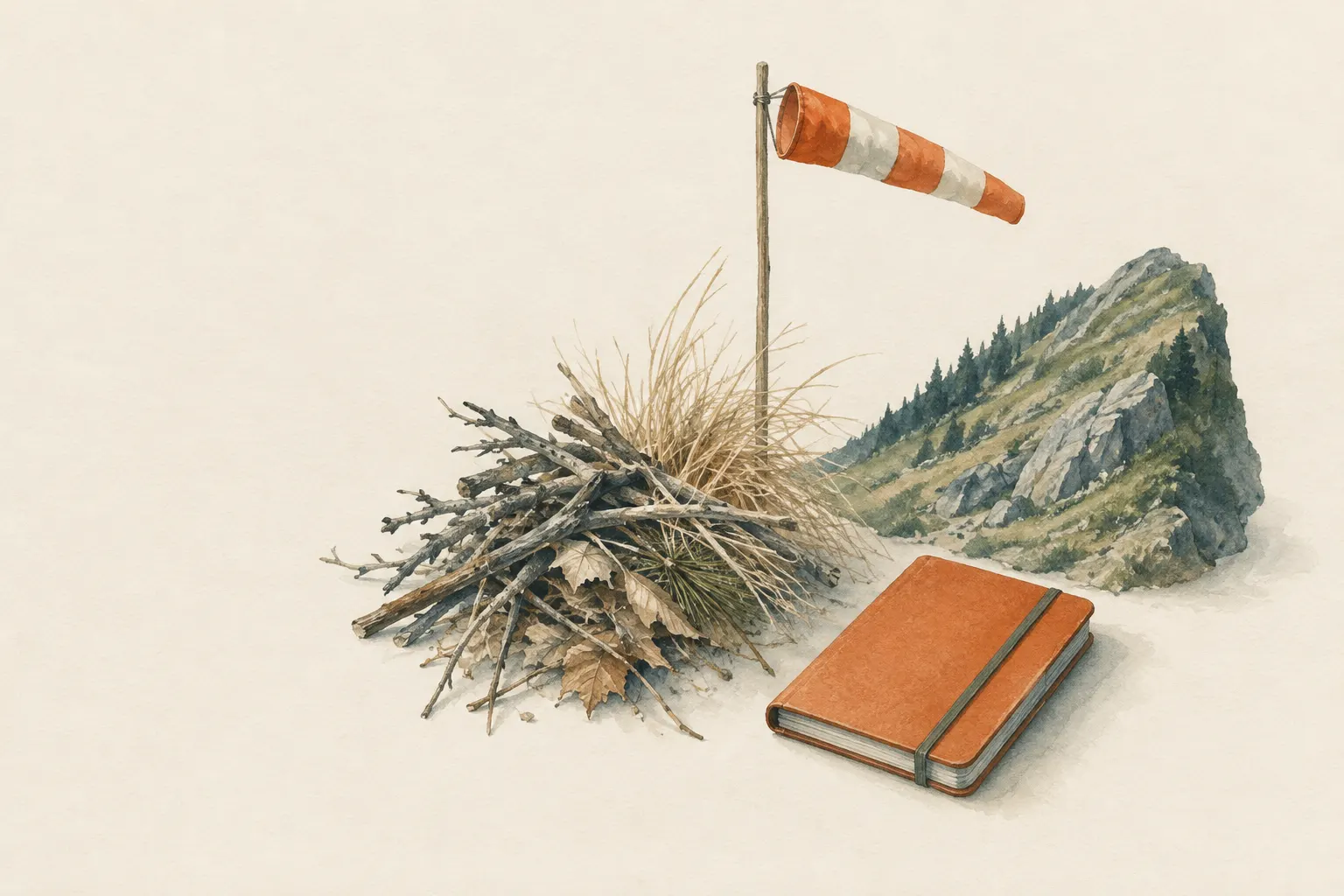
How fast and in which direction a fire spreads is determined by three factors: fuel, weather and terrain. Wind and slope tilt the flames onto unburnt material and preheat it; fine, dry fuels ignite most easily. Understanding this helps you choose fire sites better and recognise why vegetation fires escalate so suddenly.
- Reading time
Explained simply
For something to burn it needs three things: fuel, oxygen and heat – just as a stool needs three legs. How a fire then spreads depends again on three things: the fuel, the weather and the terrain.
A fire moves by heating whatever lies in front of it until that catches fire too. Wind and slopes help it do this. Hold a burning match tilted downwards and the flame climbs the wood quickly. Hold it upright and it hardly makes progress. In just the same way, a fire on a slope runs much faster uphill than downhill. Wind pushes the flames forward onto the dry grass and carries sparks far ahead.
Fine, dry material such as grass, needles and thin twigs burns most easily. That is why a dry, windy summer afternoon is the most dangerous time. The most important point: before any fire, check the local rules and fire bans. And never flee uphill from a wildfire – leave early and call the local emergency number (112 in the EU).
How it works
Wood and plants do not burn directly. When they get hot enough, they release flammable gases, and these gases burn in the flame. A fire therefore spreads by heating the fuel ahead of it until that fuel gives off gases and ignites. The heat gets there in three ways: as radiation, which you feel on your face, as rising hot air and gases, and through direct contact with flames and embers.
Wind and slope tilt the flames forward. As a result the flames come closer to the unburnt material, the radiation hits it harder, and hot gases sweep directly over it. The fuel ahead of the front is preheated and dried before the fire reaches it. That is why fires in wind and on slopes become not just a bit faster but often dramatically faster.
A large fire also creates its own wind. The hot air rises strongly and fresh air flows in from the sides. That is one reason why large fires sometimes behave differently from what the weather report for the area would suggest.
Fuel, weather, terrain
Fuel: what matters is how fine, how dry and how continuous it is. A match burns immediately, a thick log hardly at all – both are wood, but the match has far more surface in relation to its mass. That is why grass, needle litter, dry leaves and thin twigs dry out again within a few hours after rain, thick trunks only after days or weeks. If the fuel is continuous, from the ground through shrubs into the tree crowns, a fire can climb upwards as if on a ladder.
Weather: warmth, low humidity and wind are the dangerous mix. Over the course of a day it is usually warmest and driest in the afternoon – fine fuels are then at their driest and fires most active. At night and in the early morning humidity often rises again and fires calm down. Gusty or shifting wind, for example ahead of thunderstorms, makes a fire unpredictable.
Terrain: slopes, gullies, ravines and saddles act like chimneys that draw hot air and flames upwards. Slopes facing the sun are usually drier than shaded ones. Rock, water, paths and freshly worked ground interrupt the fuel and can slow a fire down.
Safety: what to watch out for
Fires run considerably faster uphill than on the flat, especially in gullies and ravines. So never flee uphill ahead of a fire. Anyone who notices smoke or fire leaves early, heading if possible towards open, non-flammable areas and paths, and calls the local emergency number (112 in the EU). Always follow the instructions of the fire service and authorities.
Wind carries embers and sparks, sometimes far ahead of the flame front. This is called spotting. New fires start there, sometimes behind you or on the other side of a path. A path or stream is therefore not a safe boundary.
For your own fire this means: first check the local rules, fire bans and wildfire danger levels. Do not light a fire in wind or great dryness, not at the foot of a vegetated slope and not under overhanging branches. Choose mineral soil, not peat or thick humus, because embers can smoulder on unnoticed in it. Never use petrol or other accelerants. Put your fire out completely with plenty of water, stir the ashes and check with the back of your hand that nothing is still warm.
Typical situations
A campfire on a calm evening seems harmless. If the wind picks up the next morning, ashes that are still glowing can flare up again and carry sparks into the dry grass. Many vegetation fires start exactly like this – with a fire someone thought was out.
In spring, old dry grass from the previous year is often dangerous even though the landscape already looks green. In high summer long dry spells, heat and parched needle litter add to this. Even after a rainy day, fine material dries quickly in sun and wind – a wet morning is no licence for the afternoon.
Wildfire danger indices, such as those published by the German Weather Service, combine weather data such as temperature, humidity, wind and precipitation into a warning level. They are a good guide, but they do not replace local rules and your own look at the wind and the ground.
Good to know
Experts distinguish two triangles. The fire triangle – fuel, oxygen, heat – explains whether something burns. The fire behaviour triangle – fuel, weather, terrain – explains how a fire spreads. Knowing both, you understand most fires, from a campfire to a wildfire.
Even so, real fires often behave unpredictably. This entry explains the basics, deliberately gives no spread rates and is not a guide to firefighting. Fighting vegetation fires is a job for trained emergency services.
Step by step
Read the fuel
How fine, dry and continuous is the vegetation? Dry grass, leaves and needle litter accelerate ignition; wet soil and rock slow it down.
- 1
Read the fuel
How fine, dry and continuous is the vegetation? Dry grass, leaves and needle litter accelerate ignition; wet soil and rock slow it down.
- 2
Read the weather
Pay attention to wind, humidity and temperature. Gusty and shifting wind, for example ahead of thunderstorms, is especially dangerous.
- 3
Read the terrain
Slopes, gullies and saddles act like chimneys. Sun-facing slopes are usually drier.
- 4
Apply it to your fire site
Place a fire on mineral soil, sheltered from wind, not at the foot of a vegetated slope, with distance from trees and overhanging branches.
Common mistakes
- Lighting a fire in wind
- Placing a fire at the foot of a slope under dry vegetation
- Underestimating flying embers
- Ignoring afternoon heat and dryness
Quick view
Suitable for
- Choosing fire sites safely
- Assessing vegetation fire danger
- Understanding wildfire warnings
Not suitable for
- Firefighting or prescribed burning
Prerequisites
- Basic knowledge of the fire triangle
Safety
- Wind carries embers and sparks, sometimes far ahead of the flame front, starting new fires there. Even a seemingly small campfire in wind is a risk – observe fire bans.
How it works
A fire spreads by heating the fuel ahead of it until that fuel releases gases and ignites. Wind and slope tilt the flames forward so that radiation and hot gases heat the fuel ahead of the front much faster. Fine fuels such as grass, needles and thin twigs have a lot of surface relative to their mass: they dry quickly and ignite easily. Low humidity and afternoon warmth dry them out further. Continuous fuel – on the ground and up into the crowns – lets the fire run on without interruption.
Advantages
- Three factors explain most fire behaviour
- Helps choose safe fire sites
Disadvantages
- Real fires often behave unpredictably
Deep knowledge
Background
The textbook "Introduction to Wildland Fire" by Pyne, Andrews and Laven describes fuel, weather and topography as the factors that determine the spread and intensity of vegetation fires, including spotting and slope effects. Fire danger indices from weather services such as the German Weather Service combine weather factors into a warning level.
The chemistry of combustion itself is explained in the combustion chemistry entry.
Variants
- Fire behaviour triangle
- While the fire triangle (fuel, oxygen, heat) explains whether something burns, the fire behaviour triangle (fuel, weather, terrain) describes how a fire spreads.
Common mistakes
- Lighting a fire in wind
- Placing a fire at the foot of a slope under dry vegetation
- Underestimating flying embers
- Ignoring afternoon heat and dryness
Limits and risks
- No spread rates
- No firefighting
Sources
Stephen J. Pyne, Patricia L. Andrews, Richard D. Laven – John Wiley & Sons (1996): Introduction to Wildland Fire (2nd edition)
Fuel, weather, topography; spotting and slope effect
Deutscher Wetterdienst (DWD): Waldbrandgefahrenindex (WBI)
Fire danger index from weather data
European Commission: 112 – the European emergency number
European emergency number 112