Solar radiation and UV
UV radiation is invisible and cannot be felt, but it causes sunburn, eye damage such as snow blindness and, in the long run, skin cancer. It is strongest around midday, in summer, at altitude and near the equator; snow, water and sand add to it by reflection, and clouds block it only partly. The UV index shows when protection is needed.
- 5 minutes reading
Explained simply
Sunlight is made of more than you can see. Part of it is called UV radiation – “ultraviolet”, meaning “beyond violet”, because your eyes cannot detect it. UV does not warm you either. So you do not notice when it becomes too much. Only hours later is the skin red and burning: sunburn.
UV is strongest at midday, in summer, high in the mountains and near the equator. Snow, water and bright sand act like a mirror and throw the radiation back, so it hits you from above and below. Even through clouds a large part gets through. A cool, cloudy day on a glacier can therefore cause more sunburn than a hot day in the city.
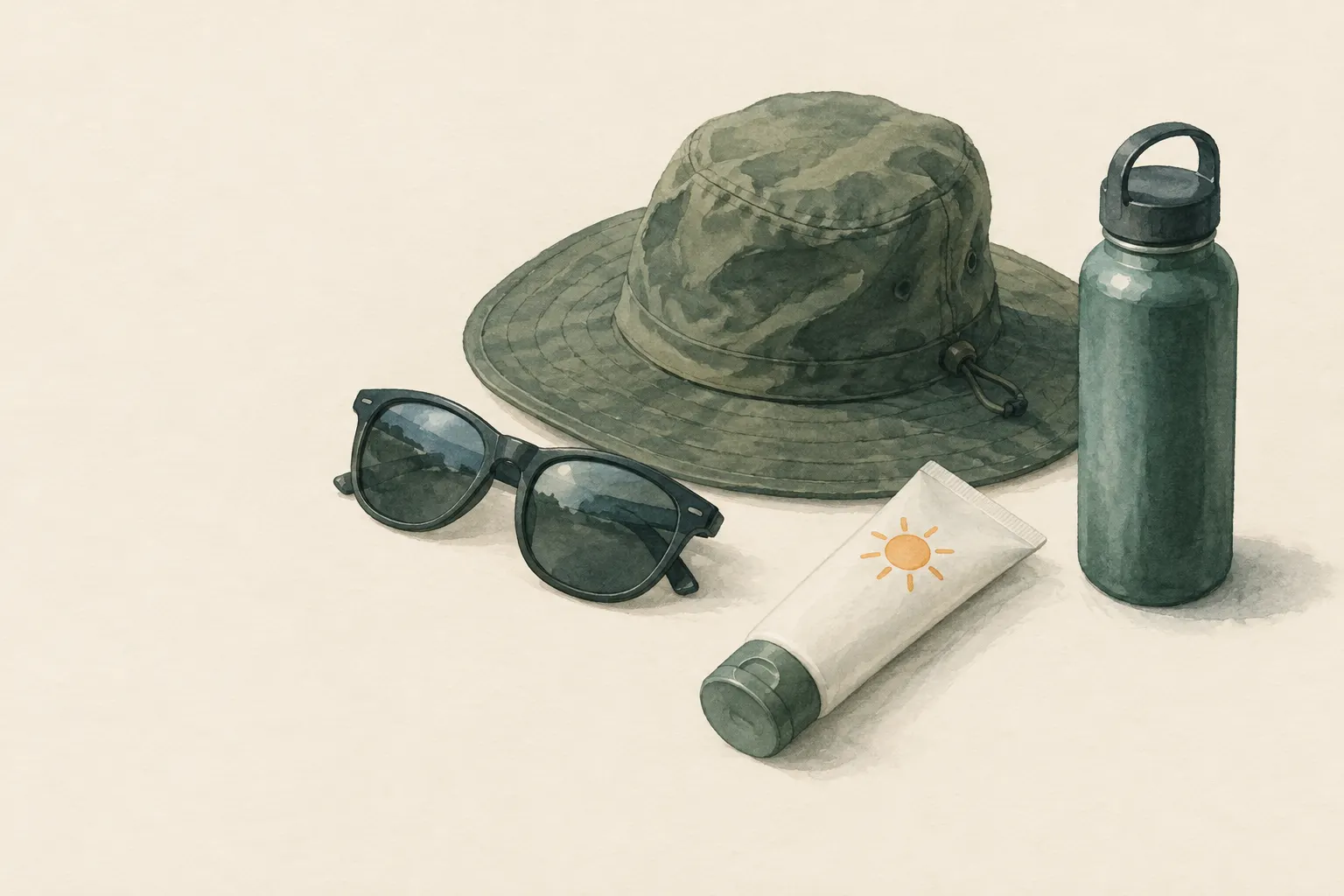
The best protection is shade, a wide-brimmed hat, clothing and sunglasses with UV protection. Sunscreen adds to this on bare skin. On snow the sunglasses are especially important, because the eyes can “burn” too.
How it works
Light is a wave, and its wavelength determines what it does. Red light has long waves, violet shorter ones, UV radiation shorter still. The shorter the wave, the more energy each particle of light carries. UV has enough energy to change building blocks in skin cells directly, including the genetic material. Sunburn is the skin's inflammatory reaction to this damage.
Roughly, UV-A and UV-B are distinguished. UV-B carries more energy and is mainly responsible for sunburn. UV-A penetrates deeper into the skin and contributes to skin ageing. Both are regarded as causes of skin cancer. The sun's even shorter-wave UV-C radiation is stopped in the atmosphere, mainly by the ozone layer.
How much UV reaches the ground depends on its path through the air. When the sun is high, the path is short and a lot arrives. When it is low – morning, evening, winter – more is filtered out. At altitude there is less filtering air above you, so radiation rises with every metre of height.
The UV index
To judge the strength, there is the UV index, a worldwide uniform measure introduced by the WHO together with other organisations. The higher the number, the faster sunburn develops. From about 3, the “moderate” range, protection is recommended; at high values you should spend the midday hours in the shade if possible.
Weather services publish the UV index in their forecasts, and many weather apps show it too. Go by this number, not by how warm it feels. The warmth comes mainly from other light and from warm air – UV can still be high in a fresh wind and cool air.
A simple rule of thumb without technology is the shadow rule: if your shadow is shorter than you are, the sun is high and UV radiation is usually strong.
What really matters
Protection starts with behaviour: seek shade, avoid the midday hours, wear long sleeves and a hat with a broad brim. Tightly woven fabric blocks more than thin, see-through fabric. A neck flap on the hat protects a spot that often burns.
Sunscreen is an addition for bare skin – face, hands, ears, neck. It only works if enough is applied, and it must be reapplied after sweating, swimming or wiping. Typically forgotten spots are the ears, lips, the underside of the chin and the nostrils, which are irradiated from below on snow.
Reflection greatly increases exposure. Fresh snow throws back a large part of the UV radiation – according to the WHO up to about 80 percent. Water and bright sand reflect less, but noticeably. Anyone out on snow, on the water or on the beach therefore needs particularly good protection.
Safety: protecting your eyes
The eyes can get a “sunburn” too. Snow blindness is a painful inflammation of the cornea. It often shows only hours after exposure: the eyes feel full of sand, water, are sensitive to light, and vision can be greatly reduced. On a trip this can become dangerous because you can no longer see the way safely.
On snow, glaciers and water, sunglasses with UV protection and side shields are therefore compulsory kit – even when it is cloudy. If the glasses are lost, improvised slit goggles made of cardboard, cloth or bark help: less light reaches the eye through narrow slits. Anyone with symptoms should rest in a darkened place and seek medical advice.
Children's skin and eyes are particularly sensitive. Sunburn in childhood is regarded as a risk factor for later skin cancer. For children, shade, clothing and a hat are therefore even more important.
Good to know
Ordinary window glass blocks most UV-B radiation but lets part of the UV-A through. You therefore hardly get sunburnt behind a car window, but the radiation is not entirely without effect.
The energy of UV light can also be put to use: in solar water disinfection (SODIS) it damages pathogens in clear water. Strict rules of its own apply, though – more in the solar disinfection entry. The same property that hits germs also hits your skin.
Step by step
Check the UV index
Weather services publish the UV index. From moderate values protection is recommended; at high values avoid the midday sun.
- 1
Check the UV index
Weather services publish the UV index. From moderate values protection is recommended; at high values avoid the midday sun.
- 2
Shade and clothing
Seek shade, wear a wide-brimmed hat and long sleeves – these protect more reliably than sunscreen alone.
- 3
Sunscreen
Apply generously to exposed skin and reapply after sweating or swimming.
- 4
Protect the eyes
Sunglasses with UV protection, with side shields on snow. If lost, improvised slit goggles can help.
Common mistakes
- Skipping protection on cloudy or cold days
- Taking off sunglasses on a glacier
- Forgetting chin, ears and neck
- Applying sunscreen only in the morning
Quick view
Materials
Wide-brimmed sun hat
Suitable for
- Trips in mountains, on snow and by water
- Children outdoors
Not suitable for
- Medical advice on skin changes
Prerequisites
- None
Safety
- On snow, glaciers and water wear sunglasses with UV protection and side shields – snow blindness often appears only hours later.
- Cool temperatures or clouds do not mean low UV. Go by the UV index, not by warmth.
How it works
Besides visible light and heat radiation, sunlight contains ultraviolet radiation. The atmosphere filters part of it; the higher the sun stands and the less air there is above, the more UV reaches the ground. That is why UV rises with altitude and around midday. Bright surfaces such as fresh snow reflect a large part, so you are exposed from above and below. Because UV does not warm, the warning signal of heat is missing.
Advantages
- Simple protective measures are very effective
Disadvantages
- UV cannot be felt
Deep knowledge
Background
The WHO, together with WMO, UNEP and ICNIRP, introduced the Global UV Index as a uniform measure and in the accompanying guide describes influencing factors such as sun elevation, altitude, cloud cover and ground reflection, as well as protective measures.
Children's skin is particularly sensitive; sunburn in childhood is regarded as a risk factor for later skin cancer.
Common mistakes
- Skipping protection on cloudy or cold days
- Taking off sunglasses on a glacier
- Forgetting chin, ears and neck
- Applying sunscreen only in the morning
Limits and risks
- No product recommendations
- No medical advice
Sources
World Health Organization (with WMO, UNEP and ICNIRP) (2002): Global Solar UV Index: A Practical Guide
UV index, influencing factors and protective measures