Sound and light in signalling
Signals get weaker with distance because their energy spreads over an ever larger area. A whistle carries further than the voice because it produces a loud, high-pitched tone with little effort, in a range where hearing is particularly sensitive. Light needs a clear line of sight but is visible from far away at night and as a reflection of sunlight. Wind, terrain and vegetation shorten both.
- 10 minutes reading
Explained simply
When you shout or whistle, the sound spreads out in all directions, like ripples when you throw a stone into water. The further the ripples travel, the bigger the circle and the weaker the ripple. In the same way, a shout gets quieter with every metre. Trees, hills and wind swallow even more sound.
A whistle is a little marvel here: with very little breath it makes a very high, loud tone – right in the range where our ears hear particularly well. Shouting, on the other hand, quickly makes you tired and hoarse. Light, in turn, needs a clear view, but can be seen very far at night. And in the daytime, a small mirror can send sunlight a long way as a bright flash.
The most important point: signals help you get found, but they do not replace an emergency call. If you can, call the local emergency number first (112 in the EU). And never look directly at the sun when using a mirror.
How it works
Sound is a pressure wave in the air; light is an electromagnetic wave. Different as they are, they have one thing in common: when they spread out in all directions from a small source, their energy is distributed over an ever larger spherical surface. That area grows with the square of the distance. Double the distance therefore means only a quarter of the intensity, triple the distance a ninth. This is called the inverse square law.
Damping adds to this: air, foliage, fog and obstacles absorb and scatter part of the energy. Sound travels through air at about 340 metres per second, light so fast that on Earth it arrives practically instantly. Light travels in straight lines; it cannot reach what lies behind a hill. Sound, on the other hand, can bend a little around obstacles, low tones better than high ones.
Why a whistle, a mirror and a lamp
Human hearing is most sensitive in the range of a few thousand vibrations per second, that is a few kilohertz. That is exactly where the tones of a signal whistle lie. It produces a loud, piercing tone with little breath that stands out clearly from wind, water and birdsong. Shouting, by contrast, costs a lot of energy, quickly makes you hoarse, and the voice's basic tones are lower, where hearing is less sensitive. The drawback of high tones: obstacles shadow them more than low ones.
A signal mirror uses the sun as its light source. It does not send the sunlight in all directions but directs it in a narrow beam one way. For someone standing right in that beam it therefore appears very bright. But the beam has to be aimed deliberately at the helpers – waved around at random, it usually misses them.
At night even a small lamp is enough, because the contrast with the darkness is great and eyes have adapted to the dark. Flashing signals attract more attention than steady light, because our perception reacts particularly to change.
What really matters
Location matters a great deal. From open, raised spots, sound and light carry further than from a hollow, a narrow valley or dense forest. A rushing stream or waterfall can drown out your whistle. Wind carries sound with it: downwind it is heard further, upwind it can be strongly weakened.
The temperature layering of the air also plays a part. Sound is bent when the air is at different temperatures at different heights. On calm, cool nights or over a still lake, sound therefore often carries remarkably far, while on hot days it sometimes carries less well.
Patterns turn a noise into a distress signal. Rhythmic signals, such as groups of three or the alpine distress signal, stand out from random noise and are understood as a call for help. Which patterns exist and how to give them is covered in the signalling entries.
Safety: what to watch out for
Signals complement an emergency call but do not replace it. If at all possible, first call the local emergency number (112 in the EU), give your location, and then use signals to help rescuers find you on site. Save energy and battery: signal at regular intervals rather than non-stop.
When using a signal mirror, never look directly at the sun; that can damage your eyes. And distress signals are serious: anyone giving them for fun can trigger unnecessary rescue operations and endanger helpers.
Good to know
This entry deliberately gives no ranges in kilometres. How far a signal carries depends on weather, terrain, background noise, daylight and whether someone is attentively looking or listening in your direction. Figures from advertising or stories usually apply only to ideal conditions.
For visual signals by day, size and contrast with the surroundings count more than colour alone. A large, bright area on a dark forest floor, or a dark one on snow, stands out more than a small, colourful object. Movement helps too, because the eye notices moving things faster than still ones.
Step by step
Whistle instead of shouting
Shouting is exhausting and soon makes you hoarse; a whistle stays loud with little breath and stands out from natural sounds.
- 1
Whistle instead of shouting
Shouting is exhausting and soon makes you hoarse; a whistle stays loud with little breath and stands out from natural sounds.
- 2
Use patterns
Rhythmic signals (groups of three, the alpine distress signal) stand out from random noise and are understood as distress signals.
- 3
Choose a position
Signal from open, raised spots, not from hollows or dense forest; consider wind and the noise of streams.
- 4
Use light deliberately
By day use a mirror with the sun, at night a lamp towards possible helpers; flashing signals attract more attention than steady light.
Common mistakes
- Shouting yourself hoarse
- Signalling from a hollow
- Shouting into a strong wind
- Waving a mirror without aiming
Quick view
Materials
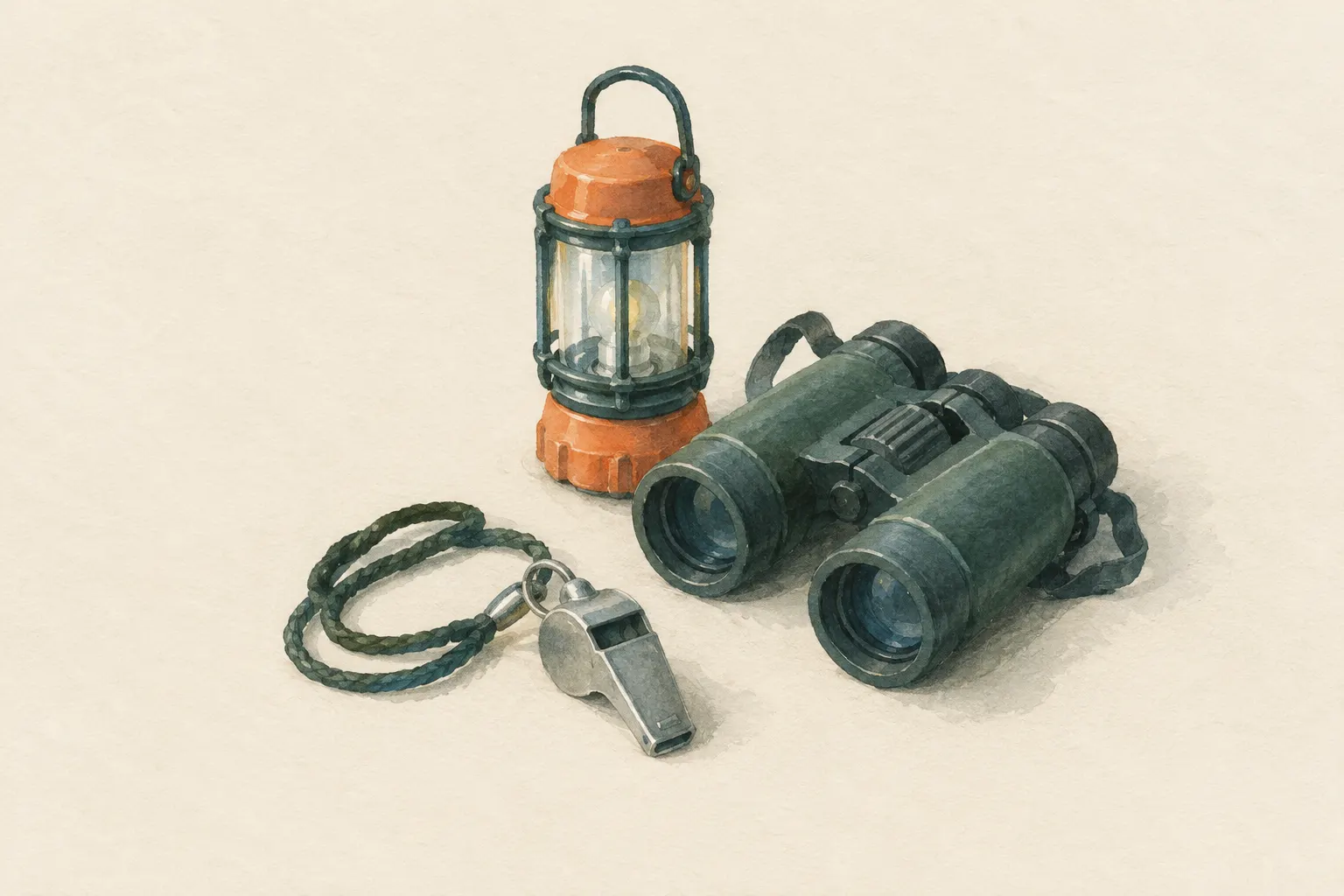
Signal whistle
Carry within easy reach, not deep in the pack.
Do not blow right next to other people's ears.
Signal mirror
Do not flash into the eyes of people nearby or of drivers.
Glass mirrors can break – risk of cuts.
Headlamp / flashlight
Suitable for
- Understanding why distress signals look the way they do
- Choosing signalling devices
Not suitable for
- Range figures for specific devices
Prerequisites
- None
Safety
- Signals complement an emergency call but do not replace it. Where possible call the local emergency number (112 in the EU) first.
How it works
In free space the intensity of sound and light falls with the square of the distance (inverse square law): double the distance, a quarter of the intensity. Damping by air, vegetation and obstacles adds to this. Human hearing is most sensitive in the range of a few kilohertz – where whistle tones lie. High tones are, however, shadowed by obstacles more than low ones. Wind carries sound with it and can weaken it strongly upwind. Light travels in straight lines; the curvature of the Earth, terrain and haze limit visibility. A mirror concentrates sunlight into a narrow beam, which is why it appears very bright.
Advantages
- Explains the choice of whistle, mirror and lamp
Disadvantages
- Ranges depend strongly on conditions
Deep knowledge
Background
Physics textbooks cover the inverse square law, sound propagation and the sensitivity of hearing. The survival manual FM 3-05.70 describes audio and visual signals and the convention of three for distress signals.
Ranges in kilometres are deliberately not given here: they depend on weather, terrain, noise and the attention of searchers.
Variants
- Colour and contrast
- For visual signals by day, contrast with the surroundings and size count more than colour alone – see signal panels.
Common mistakes
- Shouting yourself hoarse
- Signalling from a hollow
- Shouting into a strong wind
- Waving a mirror without aiming
Limits and risks
- No range figures
- No radio or satellite technology
Material alternatives
Derived from material properties: a substitute must have all relevant properties. Observe the notes on the substitute.
- Signal mirror
- Emergency blanket (Tears easily once punctured; short-term shelter only.), High-visibility vest (Keep within reach inside the cabin, not in the boot/trunk.), Warning triangle (Whether warning triangles are mandatory, or should be placed at all on certain roads (e.g. motorways), differs between countries – check local rules.), Aluminium foil (heavy-duty) (Edges can be sharp; conducts heat and electricity.)
- Headlamp / flashlight
- Mobile phone (The battery drains quickly in cold and with continuous screen and GPS use.), Battery lantern / LED light
Results come exclusively from structured entries. No improvised instructions are generated.
Sources
David Halliday, Robert Resnick, Jearl Walker – John Wiley & Sons: Fundamentals of Physics
Inverse square law, sound propagation, hearing sensitivity
Headquarters, Department of the Army (USA) (2002): FM 3-05.70 Survival
Audio and visual signals, convention of three
European Commission: 112 – the European emergency number
European emergency number 112