Seasoning and storing firewood
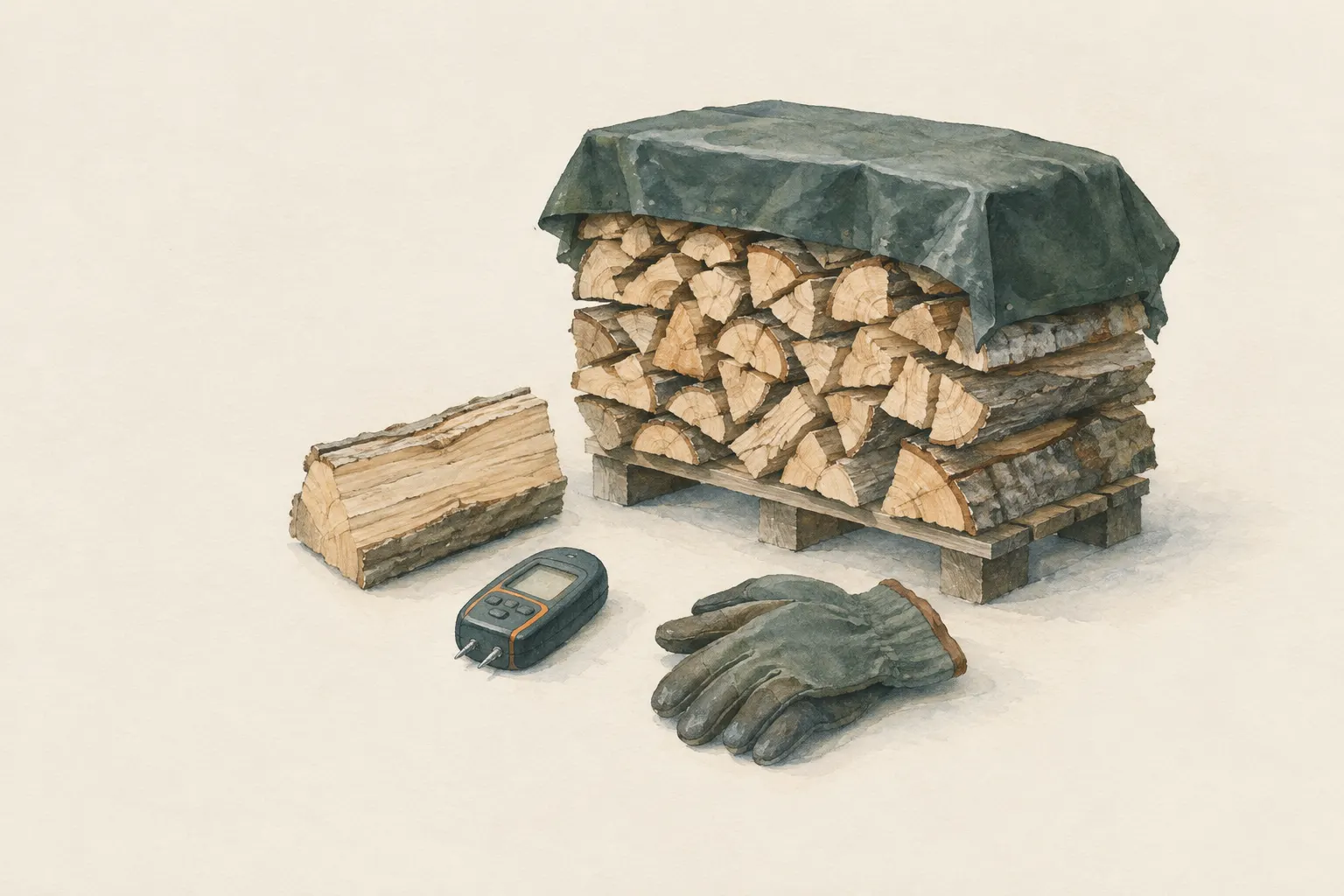
Freshly cut wood contains a lot of water. It burns poorly, smokes heavily and soots up the stove and chimney. Split, stacked with airflow, covered on top and raised off the ground, it dries over many months. A moisture meter shows when it is ready – common recommendations give values below about 20 percent.
- A few hours to stack; many months to dry
Explained simply
A freshly felled tree is full of water – almost like a sponge. If you put such wood on the fire, the fire first has to boil off all that water. That takes a lot of energy. The wood hisses, smokes and does not get properly hot. Sticky soot also settles in the chimney and can even catch fire.
That is why firewood is left to dry before it is burned. This takes many months. The wood is split into logs so it has more surface – just as wet washing dries faster when you spread it out. Then it is stacked loosely so wind can blow through, placed on bearers off the ground and covered only on top so no rain falls on it.
Important: even dry wood produces carbon monoxide, an invisible gas, when it burns. That is why you only heat in inspected stoves with a chimney, with a carbon monoxide alarm keeping watch.
How it works
When wood burns, the water it contains must first evaporate. That takes energy which then does not go into the room as heat. At the same time the steam cools the firebox. At lower temperatures the gases from the wood do not burn completely: more smoke, more soot and more tar form, and the tar settles on cold surfaces in the stove and chimney. These deposits can ignite – a chimney fire is dangerous.
Drying is basically a race between water moving out of the wood and the air carrying it away. Splitting increases the surface area and shortens the path the water has to travel. Airflow carries the damp air off, sun warms the stack, a roof keeps rain off and space above the ground stops moisture being drawn up from below.
How long wood needs to dry depends on species, log size, climate and storage site. Dense woods generally take longer than light ones. So fixed times cannot honestly be given – measuring is better than guessing.
What really matters
Ideally the wood is cut to stove length and split soon after felling. Whole rounds with bark dry much more slowly, because the bark acts like a jacket. The storage site is ideally sunny and windy. The wood rests on pallets, timber bearers or stones, with some distance from the house wall so air can circulate behind the stack too.
Stack loosely in rows and leave the sides open. Stabilise the ends of the stack with pieces laid crosswise. Cover only the top – with a small roof or a tarp. A stack wrapped completely in a tarp does not dry; it sweats and can go mouldy.
Measure with a moisture meter on a freshly split inner face, not on the dry outside. Common recommendations give values below about 20 percent as dry enough. Without a meter there are clues: dry wood is lighter, sounds sharp rather than dull when knocked together and often shows cracks at the ends. But these signs are only rough indications.
Safety: what to watch out for
Even well-seasoned wood produces carbon monoxide when it burns. Only heat in stoves approved by professionals whose chimney is regularly inspected and swept. A carbon monoxide alarm belongs in the room with the stove. If several people have headaches, dizziness or nausea, get outside immediately and call the local emergency number (112 in the EU).
Woodpiles can topple and cause serious injury. Stack stably and not too high, secure the ends and keep children away from the pile. Sawing and splitting have their own safety rules for axe and saw – sturdy shoes, gloves, distance from others.
Treated, painted or preserved wood, chipboard, pallets of unknown origin and rubbish are not burned. They can release toxic substances. Large woodpiles directly against the house wall may be restricted by local fire rules – check local rules.
From the stack to the stove
Bring only a small supply indoors, ideally a few days before use. That way surface moisture can still dry off and the wood reaches room temperature. Keep it at a distance from the stove, not right beside or underneath it.
Large amounts of wood do not belong in living spaces. They bring in moisture, sometimes insects and dust, and they add to what could burn. A woodshed with a roof and open slatted walls is the long-term solution for larger amounts.
Good to know
Taking wood is not allowed everywhere. In the forest, all wood belongs to someone, even what lies on the ground. Only take wood you are allowed to buy or collect – check local rules. Some countries also have rules on wood moisture and on emissions from small stoves.
Dry wood is better not only for warmth but also for the neighbourhood: it makes less smoke and fine dust. And it saves work, because you need less wood for the same warmth. Anyone preparing for a possible heating failure therefore builds up the supply early – freshly bought wet wood is of little use the same winter.
Step by step
Split and cut to length
Saw to stove length and split, as soon as possible after felling. Split wood dries much faster than whole rounds.
- 1
Split and cut to length
Saw to stove length and split, as soon as possible after felling. Split wood dries much faster than whole rounds.
- 2
Choose the site
Sunny and windy, on pallets, timber bearers or stones, with some distance from the house wall.
- 3
Stack with airflow
Stack loosely in rows, bark up, sides open. Stabilise the ends with crisscrossed pieces.
- 4
Cover the top
Roof or tarp on top only, leave the sides open. Wood wrapped completely does not dry.
- 5
Check
Measure on a freshly split face with the meter. Dry wood is lighter, sounds sharp when knocked together and often shows cracks at the ends.
- 6
Day supply
Bring only a small supply indoors a few days before use, at a distance from the stove.
Common mistakes
- Burning green wood
- Wrapping the stack completely in a tarp
- Stacking directly on the ground
- Burning treated wood or rubbish
Quick view
Materials
Dry firewood
Collect only where permitted.
Wood moisture meter
Tarp
Sturdy work gloves
When handling flood mud or chemicals, also wear waterproof gloves.
Suitable for
- Households with a wood stove or wood heating
- Preparing for heating failure
Not suitable for
- Treated, painted or preserved wood, chipboard, pallets of unknown origin – do not burn
- Storing large amounts inside living spaces
Prerequisites
- A suitable storage place with airflow
- Only wood you are allowed to take or have bought – check local rules
- Stove and chimney approved or inspected by professionals
Safety
- Tall stacks can topple. Stack stably, not too high and secured against tipping; keep children away.
- Do not store large woodpiles directly against house walls with windows or vents where local fire rules restrict this – check local rules.
How it works
Water in wood must evaporate before the wood burns. That costs energy, lowers the firebox temperature and leads to incomplete combustion with lots of smoke and tar deposits. Splitting increases the surface area, airflow carries the moisture away, a roof keeps rain off, and space above the ground prevents moisture rising from below.
Advantages
- More heat per log
- Less smoke and soot
- Lower risk of chimney fires
Disadvantages
- Long lead time
- Needs space
Deep knowledge
Background
The EPA "Burn Wise" programme recommends burning only well-seasoned wood, storing it split, covered and raised, and checking moisture with a meter. How long wood needs to dry depends on species, climate and storage.
Some countries regulate wood moisture and emissions from small combustion appliances – check local rules.
Variants
- Woodshed
- A shelter with a roof and open slatted walls is the long-term solution for larger amounts.
Common mistakes
- Burning green wood
- Wrapping the stack completely in a tarp
- Stacking directly on the ground
- Burning treated wood or rubbish
Limits and risks
- No drying times per species
- No stove or chimney work
Material alternatives
Derived from material properties: a substitute must have all relevant properties. Observe the notes on the substitute.
- Dry firewood
- Tinder (Carry in waterproof packaging.), Char cloth (charred cotton) (Store dry in a tin.), Finest-grade steel wool (Store separately from batteries – fire risk.), Fatwood (resin-rich wood) (Collect only dead wood where permitted.), Stove fuel (canister, liquid fuel, alcohol) (Store fuels apart from food and in original containers or bottles intended for them.), Petroleum jelly cotton balls (Use only pure cotton.)
- Tarp
- Plastic sheet / large bin bag (Tears easily; never pull over the head (suffocation risk).), Emergency blanket (Tears easily once punctured; short-term shelter only.), Document folder (waterproof) (Store securely – contains sensitive personal data.), Rain poncho (When used as a shelter, it no longer protects your body from rain.), Bivy bag (Never fully close off the face.), Tent (Do not cook or heat inside the tent (fire and carbon monoxide danger).), Heavy-duty bin bag (large) (Suffocation risk: never pull plastic bags over the head or face and keep them away from small children.), Group shelter bag (Airtight – ventilate regularly.)
Results come exclusively from structured entries. No improvised instructions are generated.
Sources
U.S. Environmental Protection Agency (EPA): Burn Wise – wood-burning best practices
Burn only dry wood; store split, covered and raised; measure moisture
Centers for Disease Control and Prevention: Carbon Monoxide Poisoning – Prevention guidance
Carbon monoxide hazard from fuel-burning appliances, CO alarms