Group shelter bag and huddling
A group or emergency shelter ("bothy bag") is a light cover without poles that several people pull over their heads and bodies and then sit on. In minutes it creates a windproof space in which body heat warms the air. It is for waiting and caring for someone, not a tent for the night.
- Under a minute to a few minutes
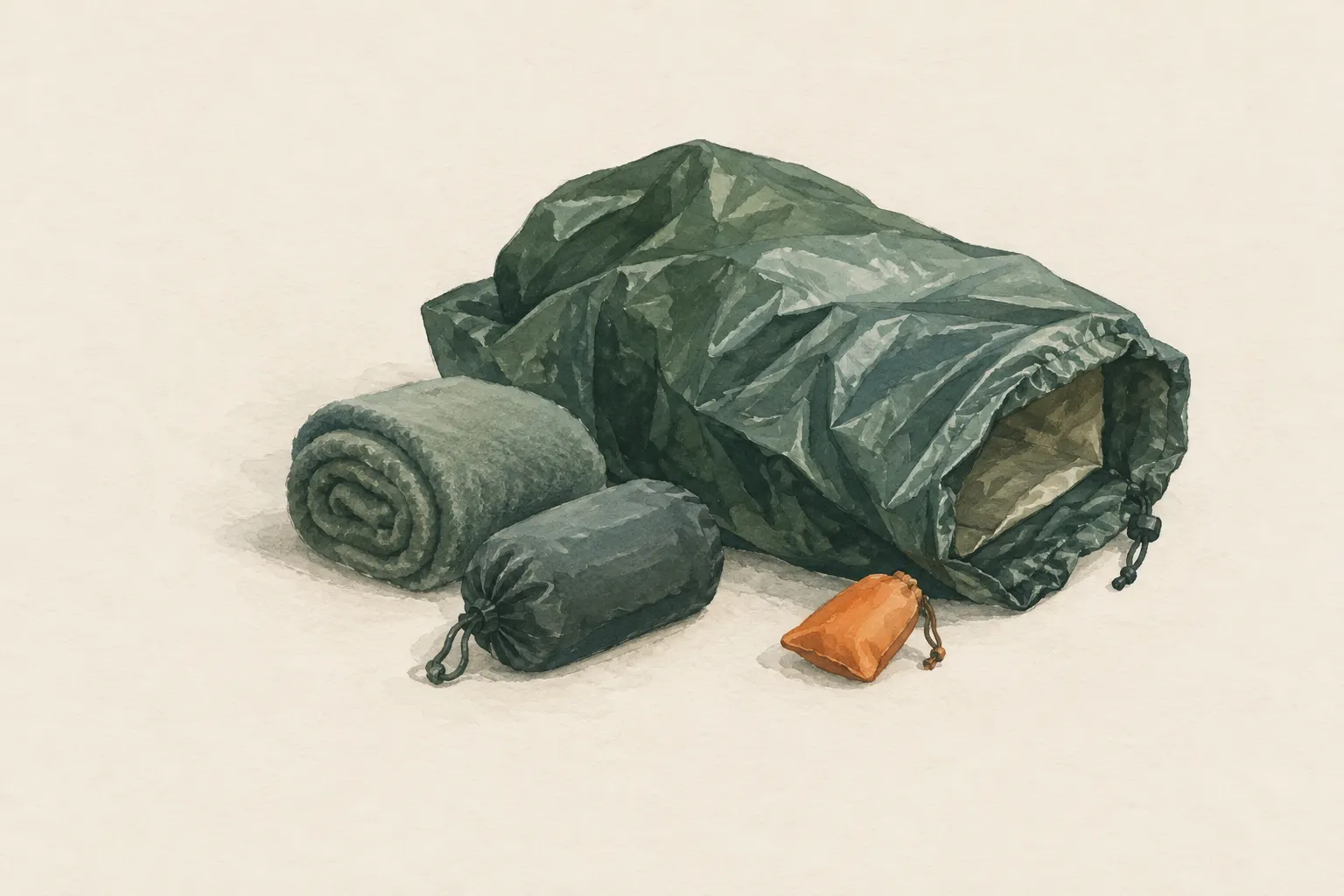
Explained simply
A group shelter is a large, light cover made of fabric, roughly like a giant pillowcase without poles. When a group out walking is caught by wind and rain, everyone pulls the cover over their heads and sits down on the edge. Done: a small, wind-still room – in less than a minute.
Inside, every person warms the air a little, just as many candles together make a room brighter than a single one. The closer you sit together, the warmer it gets. Anyone who is cold, injured or exhausted goes in the middle.
Because the cover is almost airtight, a small opening must always stay free and you air it regularly. If someone gets a headache or struggles to breathe, open it at once. Stoves or candles have no place inside.
How it works
Outside, the wind immediately carries away the warmth your body gives off into the air. Under the cover the air is still. Every person gives off heat all the time, and in the small, enclosed space it stays put for a while. With several people the air therefore becomes noticeably warmer than outside, and rain and wind are shut out.
Then there is huddling: when people sit close together, shoulders, backs and sides touch. These areas hardly lose any heat to the outside any more. The group as a whole loses less heat than the same people would on their own – a principle also known from animals that huddle together in the cold.
The bag needs neither poles nor stakes, because the people themselves are the frame: heads and shoulders lift the fabric, and sitting on the edge holds it to the ground. That is why setting it up is so quick, even in places where no tent could stand.
What really matters
The most common mistake is getting the bag out too late. It works best while everyone is still reasonably warm. If you wait until someone cannot go on, you then have to regain warmth the hard way. A break in the rain, a rest in the wind or waiting with an injured person are good moments.
Never sit directly on snow, rock or wet ground. Backpacks, sleeping pads or ropes under your bottom stop the ground drawing away your warmth. The size of the bag should suit the group: if it is too small, someone sits half outside; if it is too big for one person alone, the air inside hardly warms up.
Choose a spot that is as sheltered from the wind as possible, level and safe from rockfall and falls. A brightly coloured bag is easy to see from outside – an advantage when you are waiting for rescue.
Safety: what to watch out for
The fabric is usually waterproof and windproof, so it also lets in hardly any fresh air. When people breathe they use up oxygen and give off carbon dioxide; in a tight bag the air can therefore become stale over time. Keep a vent or window open and air it briefly at regular intervals. In case of headache, dizziness or shortness of breath, open it immediately.
Stoves, candles or other flames must never be used in the bag: they use up extra oxygen, can produce carbon monoxide, and the thin fabric can catch fire. Warm drinks from a vacuum flask are a safe way to warm someone from the inside.
The group shelter does not replace help. If someone is injured or shows signs of hypothermia – heavy shivering, confusion, listlessness – call the local emergency number (112 in the EU). Until help arrives, the bag is a good place to protect and look after the person.
When it makes sense – and when not
The group shelter is made for waiting: breaks in bad weather, caring for an injured person, waiting for fog to lift or for rescue. For school groups, guided groups and mountain walks it is a light piece of safety equipment that takes up little room in the backpack.
It is not meant for a whole night. You cannot lie down in it, condensation forms, and without insulation under the body it gets cold over time. Alone it is also not very effective, because one person cannot heat the large volume of air – a single-person bivy bag is better there.
Without a group shelter, huddling still helps: everyone close together, backs to the wind, sheets, emergency blankets or jackets around the outside. This is less effective but much better than waiting separately.
Good to know
In English the group shelter is often called a "bothy bag". In Britain a "bothy" is a simple, open refuge hut in the hills – so the bag is, in a way, a hut to take with you. It is common among mountain leaders, school groups and mountain rescue.
Practise using it once with your group in good weather. Then everyone knows how to get in, where the vent is and how to tuck the edge under themselves. In a storm there is no time for explanations.
Step by step
Decide early
Use the group shelter before everyone is cold – not only when someone can no longer continue.
- 1
Decide early
Use the group shelter before everyone is cold – not only when someone can no longer continue.
- 2
Choose a spot
As sheltered from the wind as possible, safe from rockfall and falls, on level ground.
- 3
Pull it over
Everyone stands close together, pulls the cover over their heads and sits down on backpacks or pads with the edge tucked under them.
- 4
Vent opening
Keep a vent or window open; air it briefly at regular intervals.
- 5
Vulnerable people in the middle
Put people who are cold-sensitive, injured or exhausted in the middle, insulate them and give them food and warm drinks if available.
- 6
Help and visibility
In an emergency, call for help. A brightly coloured bag is easy to see from outside.
Common mistakes
- Used too late
- Sitting directly on snow or rock
- No ventilation
- Bag too small for the group
Quick view
Materials
Group shelter bag
Airtight – ventilate regularly.
No stoves or candles inside.
Sleeping pad
Or backpacks as seating
Dry spare clothing
Carry it in waterproof packaging – wet clothing barely insulates.
Suitable for
- Breaks in wind and rain
- Waiting for help with an injured person
- School groups, guided groups, mountain walks
Not suitable for
- Overnight stays without insulation
- Alone (too large, gets cold)
Prerequisites
- A shelter sized for the group carried along
- Practised once
Safety
- Sitting on cold ground chills you – put backpacks, pads or ropes underneath.
How it works
The cover stops wind and rain and holds the air warmed by several bodies. The closer the group sits, the less surface area loses heat. Because people sit on the edge, the bag needs no stakes or poles.
Advantages
- Very quick
- Light and packs small
- Shared body warmth
- Good for caring for injured people
Disadvantages
- No lying space
- Condensation and stale air
- Only warm with several people
Deep knowledge
Background
Group shelters come from British hillwalking, where a "bothy" is a simple refuge hut. They are common among mountain leaders, school groups and mountain rescue.
Shared warmth in a closed group is a well-known principle of cold protection. It does not replace the bag, but the bag makes it far more effective.
Variants
- Huddling without a bag
- Without a group shelter everyone huddles closely, backs to the wind, with sheets, emergency blankets or jackets around the outside.
Common mistakes
- Used too late
- Sitting directly on snow or rock
- No ventilation
- Bag too small for the group
Limits and risks
- No figures for the temperature gain inside
- No substitute for a tent or hut overnight
Material alternatives
Derived from material properties: a substitute must have all relevant properties. Observe the notes on the substitute.
- Group shelter bag
- Tarp, Plastic sheet / large bin bag (Tears easily; never pull over the head (suffocation risk).), Emergency blanket (Tears easily once punctured; short-term shelter only.), Document folder (waterproof) (Store securely – contains sensitive personal data.), Rain poncho (When used as a shelter, it no longer protects your body from rain.), Bivy bag (Never fully close off the face.), Tent (Do not cook or heat inside the tent (fire and carbon monoxide danger).), Heavy-duty bin bag (large) (Suffocation risk: never pull plastic bags over the head or face and keep them away from small children.)
- Sleeping pad
- Dry leaves, grass or conifer boughs (Collect only where allowed; no protected plants. Check for ticks and insects.), Backpack, Dry spare clothing (Carry it in waterproof packaging – wet clothing barely insulates.), Wool blanket / duvet (Keep away from candles, stoves and heaters.), Insulated cool box (Keeps cold only for a limited time; without ice packs or ice it is not a fridge.), Sleeping bag (Do not store compressed long-term; do not pack away damp.), Newspaper and cardboard (Flammable – keep away from candles, stoves, heaters and embers.), Insulated cooking box (hay box, thermal cooker) (Never put open flame or embers inside – only the hot, closed pot.)
- Dry spare clothing
- Sleeping pad, Dry leaves, grass or conifer boughs (Collect only where allowed; no protected plants. Check for ticks and insects.), Backpack, Wool blanket / duvet (Keep away from candles, stoves and heaters.), Insulated cool box (Keeps cold only for a limited time; without ice packs or ice it is not a fridge.), Sleeping bag (Do not store compressed long-term; do not pack away damp.), Newspaper and cardboard (Flammable – keep away from candles, stoves, heaters and embers.), Insulated cooking box (hay box, thermal cooker) (Never put open flame or embers inside – only the hot, closed pot.)
Results come exclusively from structured entries. No improvised instructions are generated.
Sources
Wilderness & Environmental Medicine (Wilderness Medical Society) (2019): Wilderness Medical Society Clinical Practice Guidelines for the Out-of-Hospital Evaluation and Treatment of Accidental Hypothermia: 2019 Update
Wind, wet and ground contact as factors in hypothermia; calling for help at signs of hypothermia
The Mountaineers Books (2017): Mountaineering: The Freedom of the Hills, 9th edition
Camping, tents and bivouacs in the mountains and in snow