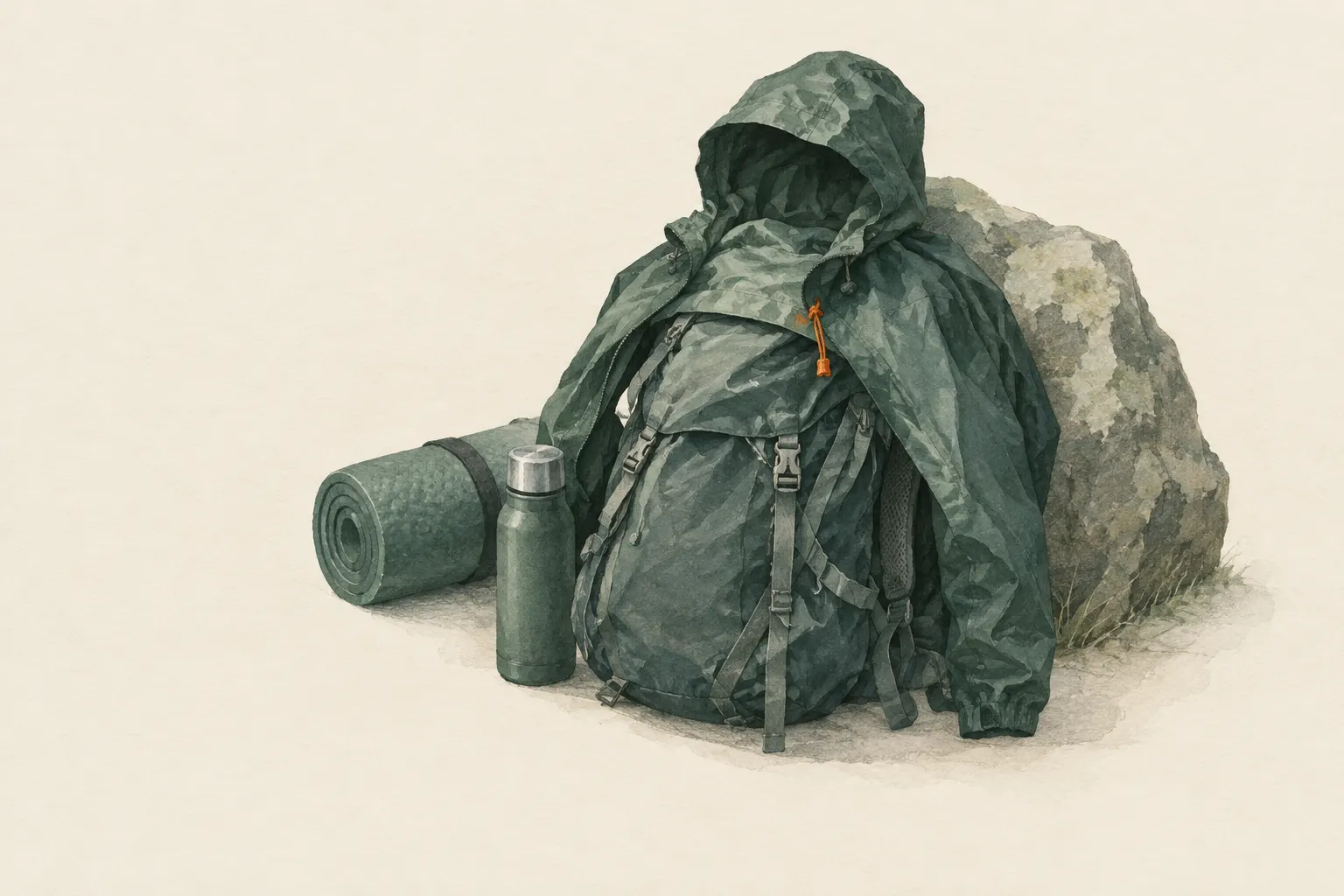
Sitting bivouac with backpack and rain gear
If you must wait unexpectedly while out – in fog, after dark or until help arrives – a sitting bivouac can protect quickly: sit on the backpack or pad, back against a rock or tree out of the wind, all clothing on, hood up, legs in the empty backpack. This keeps the contact area with the ground small.
- A few minutes
Explained simply
Sometimes you have to wait unexpectedly while you are out: it gets dark, fog rolls in, or someone is hurt and you are waiting for help. Then it is often wiser to stop than to keep walking in the dark. A sitting bivouac simply means: you make yourself as warm and sheltered as possible while sitting.
The secret is to touch as little of the cold ground as possible. Standing or lying, you lose heat in many places. If you sit on your backpack or a pad, only a small part of you touches something warm instead of the cold ground. Put on everything you have, pull up the hood and put your legs into the empty backpack – like a small sleeping bag.
Very important: a plastic bag or bin bag may only go over your legs and body, never over your head. Your face always stays free so you can breathe properly.
How it works
The body loses heat in four ways: through contact with cold surfaces (conduction), through air flowing past (wind), through radiation to the cold surroundings and through evaporation of sweat and wet. A sitting bivouac tries to reduce all four at once, using what you are carrying anyway.
Sitting, you touch the ground only with your bottom and feet. This small area can be insulated with a backpack, pad, rope or rolled-up clothing. If you draw up your legs and fold your arms, your surface area shrinks – you sit like a parcel that loses less heat than a stretched-out body.
The rain jacket over all your layers keeps out wind and wet, so the warm air between your clothing layers stays put. A boulder, tree trunk or bushes on the lee side take additional force out of the wind. An emergency blanket or bin bag around body and legs completes the cover.
What really matters
The most important decision is made before you sit down: stop in time. Anyone who keeps walking too long ends up soaked with sweat and exhausted, and then cools down especially fast while sitting. When darkness, fog or difficult terrain make carrying on dangerous, stop deliberately, note your position and call for help if needed.
Put everything on before you start to get cold. Dry layers go under the rain gear; hat, gloves and hood are especially important because the head and hands lose heat quickly. Then empty the backpack, sit on some insulation and put your legs into the backpack.
If two of you are waiting, sit back to back or close side by side and share a cover. That way you warm each other. Keep the headlamp within reach so you can give signals and be found.
Safety: what to watch out for
Sheeting, bin bags and emergency blankets never go over the head and face – there is a risk of suffocation. Always keep your face free, even when it is cold; hood and hat protect the head.
Lean only against stable rock from which no stones can fall, and do not sit under dead trees or branches. Hollows are good against wind, but not if water can flow through them in rain. Exposed ridges are dangerous in thunderstorms and no place for a bivouac.
Watch for signs of hypothermia in yourself and others: heavy shivering, clumsy movements, confusion or listlessness. With such signs or in an emergency, call the local emergency number (112 in the EU). A sitting bivouac is a solution for hours, not days.
Waiting actively
Waiting does not mean sitting motionless. Eat something now and then – the body needs fuel to produce heat. From time to time, tense the muscles in your legs, bottom and arms and relax again; this generates heat without you having to stand up and lose your insulation.
Listen regularly for calls, whistles or engine noise and keep the lamp ready. If you have phone signal, save battery by keeping the device warm in an inside pocket and checking it only occasionally. Staying calm and having a plan for when to do what also helps against fear.
Good to know
In mountaineering the sitting bivouac is a well-known emergency solution when there is no room to lie down in steep terrain. But the principle – keep ground contact small and keep the wind off – applies to any unplanned wait outdoors, whether in forest, mountains or snow.
If you occasionally do a trial, for example an hour of sitting bivouac on a cool evening in safe surroundings, you learn a lot: how quickly you cool down, what is missing from your backpack and how important dry clothing is. An emergency blanket, a hat and a headlamp weigh little and make a big difference.
Step by step
Stop in time
When carrying on becomes dangerous, stop deliberately, note your position and call for help if needed.
- 1
Stop in time
When carrying on becomes dangerous, stop deliberately, note your position and call for help if needed.
- 2
Find shelter from the wind
A boulder, tree trunk, hollow without running water or bushes on the lee side.
- 3
Put everything on
Dry layers under the rain gear, hat, gloves, hood up.
- 4
Sit insulated
Sit on a pad, rope or rolled clothing; empty the backpack and put your legs inside.
- 5
Add a cover
Wrap an emergency blanket or bin bag around body and legs, keeping the face free.
- 6
Wait actively
Eat something, tense muscles from time to time, keep the lamp ready, listen out for signals regularly.
Common mistakes
- Sitting directly on rock or snow
- Stopping too late and soaked with sweat
- Head unprotected
- Pulling a bin bag over the face
Quick view
Materials
Backpack
Rain and wind shell
Dry spare clothing
Carry it in waterproof packaging – wet clothing barely insulates.
Emergency blanket
Tears easily once punctured; short-term shelter only.
Conductive – keep away from power lines.
Heavy-duty bin bag (large)
Over legs and backpack, never over the head
Suffocation risk: never pull plastic bags over the head or face and keep them away from small children.
Not breathable – sweating and condensation.
Headlamp / flashlight
Suitable for
- Unexpected waits in the mountains or forest
- Terrain where you cannot lie down
- Waiting for rescue
Not suitable for
- Long frosty nights without further insulation
- Exposed ridges during thunderstorms
Prerequisites
- The decision not to keep going
- Some shelter from the wind nearby
Safety
- Lean only against stable rock with no rockfall from above; not under dead trees.
How it works
Sitting, only a small part of the body touches the ground, and that can be insulated with a backpack or pad. Drawn-up legs and folded arms reduce the surface area. Rain gear over all layers stops wind and wet; a windbreak reduces convection.
Advantages
- Possible almost anywhere
- Hardly any equipment needed
- No building effort
Disadvantages
- Uncomfortable over long periods
- Little protection in long frost or heavy rain
Deep knowledge
Background
Sitting bivouacs are a well-known emergency solution in mountaineering when you cannot lie down in steep terrain. The principle – minimise ground contact and keep the wind off – applies to any unplanned wait outdoors.
The decision to stop in time rather than walk on in the dark often prevents falls and getting lost.
Variants
- In pairs
- Sit back to back or close side by side and share a cover – this saves warmth.
Common mistakes
- Sitting directly on rock or snow
- Stopping too late and soaked with sweat
- Head unprotected
- Pulling a bin bag over the face
Limits and risks
- An emergency solution for hours, not days
- No statement about survivable temperatures
Material alternatives
Derived from material properties: a substitute must have all relevant properties. Observe the notes on the substitute.
- Backpack
- Sleeping pad, Dry leaves, grass or conifer boughs (Collect only where allowed; no protected plants. Check for ticks and insects.), Dry spare clothing (Carry it in waterproof packaging – wet clothing barely insulates.), Wool blanket / duvet (Keep away from candles, stoves and heaters.), Insulated cool box (Keeps cold only for a limited time; without ice packs or ice it is not a fridge.), Sleeping bag (Do not store compressed long-term; do not pack away damp.), Newspaper and cardboard (Flammable – keep away from candles, stoves, heaters and embers.), Insulated cooking box (hay box, thermal cooker) (Never put open flame or embers inside – only the hot, closed pot.)
- Rain and wind shell
- Cotton cloth / T-shirt (Removes coarse particles only – no disinfection.)
- Dry spare clothing
- Sleeping pad, Dry leaves, grass or conifer boughs (Collect only where allowed; no protected plants. Check for ticks and insects.), Backpack, Wool blanket / duvet (Keep away from candles, stoves and heaters.), Insulated cool box (Keeps cold only for a limited time; without ice packs or ice it is not a fridge.), Sleeping bag (Do not store compressed long-term; do not pack away damp.), Newspaper and cardboard (Flammable – keep away from candles, stoves, heaters and embers.), Insulated cooking box (hay box, thermal cooker) (Never put open flame or embers inside – only the hot, closed pot.)
- Heavy-duty bin bag (large)
- Tarp, Plastic sheet / large bin bag (Tears easily; never pull over the head (suffocation risk).), Emergency blanket (Tears easily once punctured; short-term shelter only.), Document folder (waterproof) (Store securely – contains sensitive personal data.), Rain poncho (When used as a shelter, it no longer protects your body from rain.), Bivy bag (Never fully close off the face.), Tent (Do not cook or heat inside the tent (fire and carbon monoxide danger).), Group shelter bag (Airtight – ventilate regularly.)
- Headlamp / flashlight
- Mobile phone (The battery drains quickly in cold and with continuous screen and GPS use.), Battery lantern / LED light
Results come exclusively from structured entries. No improvised instructions are generated.
Sources
Wilderness & Environmental Medicine (Wilderness Medical Society) (2019): Wilderness Medical Society Clinical Practice Guidelines for the Out-of-Hospital Evaluation and Treatment of Accidental Hypothermia: 2019 Update
Wind, wet and ground contact as factors in hypothermia; calling for help at signs of hypothermia
The Mountaineers Books (2017): Mountaineering: The Freedom of the Hills, 9th edition
Camping, tents and bivouacs in the mountains and in snow