Natural shelters: rock overhang, root plate, terrain edge
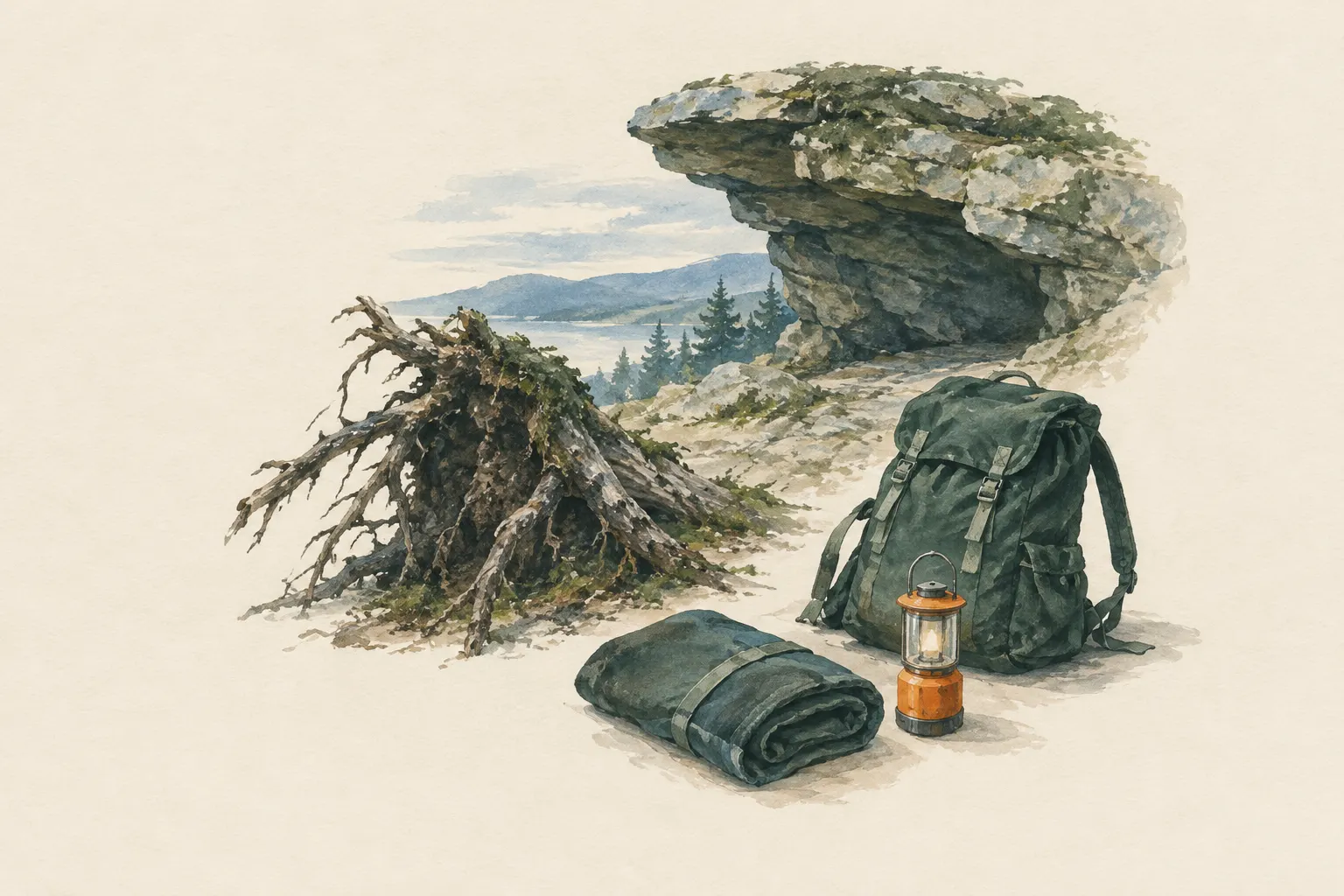
Rock overhangs, fallen trees or terrain edges can quickly offer protection from rain and wind without much building. But every natural shelter must be checked for rockfall, flooding, unstable root plates, animals and lightning danger. Never enter caves or mine tunnels beyond the front overhang.
- Checking and setting up: about 15–30 minutes
Explained simply
Sometimes nature has already built a roof: a rock overhang under which it stays dry, a fallen tree, or a terrain edge behind which the wind drops. A spot like that saves a lot of building work.
But every natural shelter must be checked – like a house you do not know. Can stones fall? Can water flow through in rain? Is an animal already living there? And in a thunderstorm an overhang does not protect against lightning.
Most important: never go deeper into caves or old mine tunnels. Only the front, open part under the overhang is an option.
How it works
Natural shelters use existing forms to save building time and energy. An overhang keeps rain off from above, a rock face or terrain edge slows the wind, and a fallen trunk can serve as a back wall.
But they rarely offer complete protection. Rock conducts heat well and therefore draws warmth from you quickly if you sit or lie directly on it. Open sides let wind in. So a layer of insulation against the ground belongs with it, and often a tarp, emergency blanket or bivy bag to close the open side.
More important than the form is checking for hazards: from above (rockfall, branches), from below (water) and from the side (animals, root plates that may tip).
Safety: what to watch out for
Rockfall: check the rock for cracks, loose blocks and fresh, light-looking fracture surfaces, and look at the ground – are there stones that came from above? Rockfall is more frequent with freeze-thaw cycles and rain, when water freezes in cracks and loosens rock.
Water: overhangs by streams, in gorges and in dry washes can flood in heavy rain, sometimes very quickly, even from rain further up that you cannot see. Watch for high-water marks such as washed-up debris and lines of mud. Lightning: shallow overhangs and cave entrances do not protect against lightning. In a thunderstorm there is no safe place outdoors; avoid exposed spots and get into a building or vehicle in good time.
Caves and mine tunnels: do not enter. There is a risk of collapse, disorientation, bad air, water and shafts. Root plates: the upturned root plates of fallen trees can tip back – do not camp under or directly behind them.
What really matters
Watch for signs of animals: droppings, tracks, nests or food remains show that the place is already in use. Then look for another one. Stay in the front, light area under the open overhang and do not go into dark areas.
Insulate yourself from the ground: a sleeping pad, backpack or dry material. Lying directly on rock chills you badly. Close the open side against wind with a tarp, backpack or emergency blanket.
No fire under the overhang: smoke collects, heat can damage rock and even make it flake off, and fires are prohibited under many rock shelters. Many overhangs are also protected natural or cultural monuments, for example because of old rock art or rare plants and animals.
When it makes sense – and when not
A checked natural shelter is ideal for escaping a shower quickly, taking a break out of the wind or saving energy in an emergency instead of building for a long time. Combined with insulation and a sheet it can also do for a night.
It is unsuitable in thunderstorms, in streambeds, gorges and dry washes in rain, at rock faces with fresh rockfall and anywhere beyond the entrance area of caves and tunnels. This entry cannot replace a geological assessment – when in doubt, move on.
Good to know
Survival manuals such as FM 3-05.70 recommend using natural forms to save energy and at the same time warn of rockfall, animals and flooding. Caving and entering old mines, by contrast, are specialist fields with their own considerable dangers that require training and specialist equipment.
Wild camping, bivouacking and fires are regulated very differently by region. Check local rules, do not damage living trees and leave the site without a trace – especially at rock shelters, which have often been used by people for centuries.
Step by step
Check above
Check the rock for cracks, loose blocks and fresh fracture surfaces; look on the ground for fallen rocks.
- 1
Check above
Check the rock for cracks, loose blocks and fresh fracture surfaces; look on the ground for fallen rocks.
- 2
Check water paths
Do not camp in gullies, streambeds or hollows; look for debris and flood lines.
- 3
Watch for animals
Tracks, droppings or nests are a sign the place is already in use – then move on.
- 4
Use only the front area
Stay under the open overhang; do not go into dark areas or tunnels.
- 5
Insulate and close
Put a sleeping pad or dry material underneath; close the open side against wind with a tarp, backpack or emergency blanket.
Common mistakes
- Overlooking signs of rockfall
- Camping in dry washes in rain
- Exploring deeper into a cave
- Lying directly on rock without insulation
- Fire under the overhang (smoke, damage to rock, often prohibited)
Quick view
Materials
Sleeping pad
Rock draws away a lot of heat
Tarp
To close the open side
Headlamp / flashlight
Suitable for
- A quick rain break
- Emergencies in rocky terrain
- Combined with a tarp or emergency bivouac
Not suitable for
- Thunderstorms
- Streambeds, gorges and dry washes in rain
- Rock faces with fresh rockfall
- Caves and mine tunnels beyond the entrance area
Prerequisites
- Critical inspection of the site in daylight
- Ground insulation
Safety
- Upturned root plates of fallen trees can tip back. Do not camp under or directly behind them.
- Wild camping, bivouacking, collecting material and fires are regulated very differently from region to region. Check local rules, do not damage living trees and leave the site without a trace.
How it works
Natural shelters use existing forms to save building time and energy. But they rarely offer complete protection: rock conducts heat away quickly and open sides let wind in. Ground insulation and often a tarp or emergency bivouac are therefore part of it. More important than the form is checking for hazards from above, below and water.
Advantages
- Hardly any building time
- No tools
- Often good rain protection from above
Disadvantages
- Many hidden hazards
- Rock is cold
- Rarely complete wind protection
Deep knowledge
Background
Survival manuals such as FM 3-05.70 recommend using natural forms to save energy and at the same time warn of rockfall, animals and flooding. Caving and entering old mines, by contrast, are specialist fields with their own considerable dangers.
Many rock overhangs are also protected natural or cultural monuments; fires and camping may be prohibited there.
Variants
- Fallen tree
- A fallen trunk offers wind protection on one side and can be extended with a tarp into a lean-to. First check that the trunk lies firmly and no branches under tension can spring free.
- Terrain edge
- Banks and boulders on the lee side break the wind; they are often the quickest complement to an emergency bivouac.
Common mistakes
- Overlooking signs of rockfall
- Camping in dry washes in rain
- Exploring deeper into a cave
- Lying directly on rock without insulation
- Fire under the overhang (smoke, damage to rock, often prohibited)
Limits and risks
- No geological assessment
- No protection from lightning
Material alternatives
Derived from material properties: a substitute must have all relevant properties. Observe the notes on the substitute.
- Sleeping pad
- Dry leaves, grass or conifer boughs (Collect only where allowed; no protected plants. Check for ticks and insects.), Backpack, Dry spare clothing (Carry it in waterproof packaging – wet clothing barely insulates.), Wool blanket / duvet (Keep away from candles, stoves and heaters.), Insulated cool box (Keeps cold only for a limited time; without ice packs or ice it is not a fridge.), Sleeping bag (Do not store compressed long-term; do not pack away damp.), Newspaper and cardboard (Flammable – keep away from candles, stoves, heaters and embers.), Insulated cooking box (hay box, thermal cooker) (Never put open flame or embers inside – only the hot, closed pot.)
- Tarp
- Plastic sheet / large bin bag (Tears easily; never pull over the head (suffocation risk).), Emergency blanket (Tears easily once punctured; short-term shelter only.), Document folder (waterproof) (Store securely – contains sensitive personal data.), Rain poncho (When used as a shelter, it no longer protects your body from rain.), Bivy bag (Never fully close off the face.), Tent (Do not cook or heat inside the tent (fire and carbon monoxide danger).), Heavy-duty bin bag (large) (Suffocation risk: never pull plastic bags over the head or face and keep them away from small children.), Group shelter bag (Airtight – ventilate regularly.)
- Headlamp / flashlight
- Mobile phone (The battery drains quickly in cold and with continuous screen and GPS use.), Battery lantern / LED light
Results come exclusively from structured entries. No improvised instructions are generated.
Sources
Headquarters, Department of the Army (USA) (2002): FM 3-05.70 Survival
Natural shelters and their hazards
NOAA National Weather Service (USA): Lightning Safety
No safe place outdoors during thunderstorms