Tree wells in deep snow: hazard, not shelter
Around conifers, deep snow often forms a funnel of loose snow because the branches shield the trunk from snowfall. Anyone who falls in head first may be unable to free themselves and can suffocate. Older manuals describe tree wells as shelter – in loose deep snow the danger outweighs the benefit.
- Knowledge, no build time
Explained simply
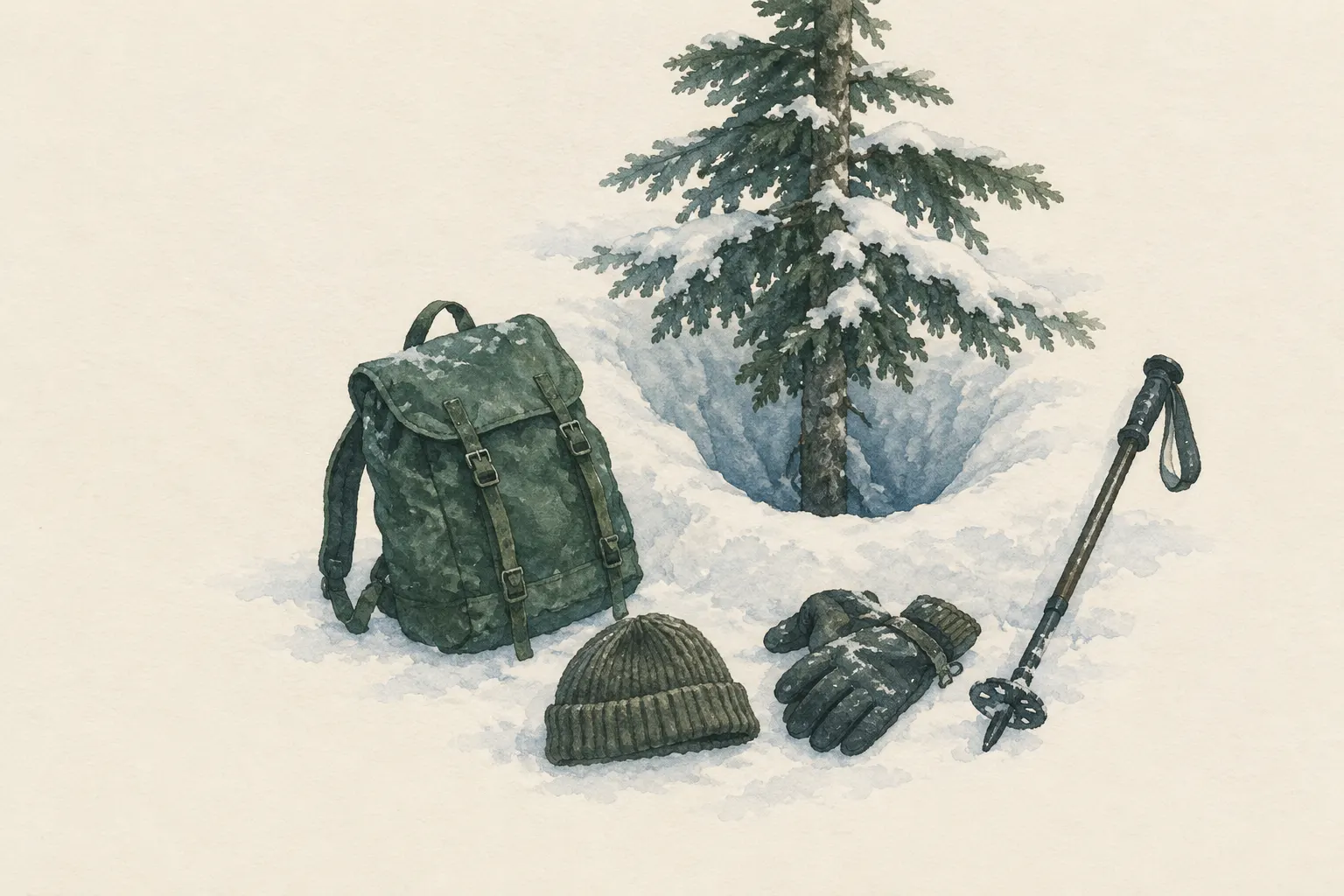
Conifers such as spruce have dense, low-hanging branches. Like an umbrella, they keep snow away from the trunk. Around the tree the snow then lies deep and firm, but right at the trunk a hole of loose snow remains – a so-called tree well. From above you often cannot see it at all.
Anyone who falls head first into such a well sometimes cannot free themselves. The loose snow pours in after them, and every movement can make them sink deeper. Then it becomes hard to breathe.
So: in deep snow keep your distance from trees, never travel alone and always keep your companions in sight. A tree well is not a cosy place to sleep but a trap.
How it works
The dense lower branches of conifers catch falling snow. Beneath them, at the trunk, less snow arrives and it is hardly compressed. All around, by contrast, the snow lies deep and becomes firmer under its own weight and through wind. So a hidden hollow of loose snow forms next to the trunk.
If someone falls in, especially head first, loose snow slides in from the edges and from the branches. Arms and legs find no grip because there is only powder around them. The more you struggle, the more snow falls in and the deeper you can sink. Snow in front of the mouth and nose can very quickly make breathing very hard.
What makes it especially treacherous is that you cannot see the danger: the well can be hidden by branches and a thin layer of snow.
Safety: what to watch out for
With plenty of fresh snow and dense conifers, expect tree wells even if you see no hollow. In deep snow keep as wide a distance from trunks as possible, especially when descending on skis or a snowboard and when walking downhill on snowshoes.
Never travel alone in snowy forest. Stay close enough to your companions that you can see and hear each other, and wait for each other regularly. A person who disappears is only found if someone notices where they were last.
Snow on the branches is also a hazard: it can fall and bury a well or a shelter beneath it. For an emergency bivouac, therefore, choose a sheltered spot next to the tree, not in the well, and look up to see how much snow lies on the branches.
If someone falls in
If you fall in yourself: if possible, hold on to branches or the trunk. Use your hands to create an air space in front of your face. Stay as calm as you can, because violent struggling makes you sink deeper. Call or whistle for help – a whistle on your pack strap is ideal for this.
If someone in your group has disappeared: one person calls the local emergency number (112 in the EU) at once while the others search at the same time. Clearing the airway takes priority. Dig with a shovel from the side towards the head rather than stepping into the well from above – otherwise you press even more snow onto the person.
These points are only basic principles. How to care further for a buried person is something you learn in a first-aid course; follow the instructions of the emergency dispatcher.
Good to know: shelter or trap?
Older military survival manuals such as FM 3-05.70 describe the tree pit as a possible snow shelter. Ski areas and mountain safety organisations, on the other hand, warn of suffocation accidents in tree wells in deep snow. Both can be reconciled: a shallow, firmly packed hollow can offer shelter; a deep funnel of loose powder is a trap.
This entry is therefore deliberately written as a warning, not as building instructions. Anyone travelling in deep snow gains more safety from keeping clear of trees, partners in sight and a whistle than from any shelter at the trunk.
Step by step
Recognise
With plenty of fresh snow and dense conifers, expect tree wells even if no hollow is visible.
- 1
Recognise
With plenty of fresh snow and dense conifers, expect tree wells even if no hollow is visible.
- 2
Keep your distance
In deep snow keep as wide a distance from trunks as possible, especially when descending.
- 3
Partner in sight
Travel in pairs or groups so you can see and hear each other.
- 4
If you fall
If possible hold on to branches or the trunk, use your hands to create an air space in front of your face, stay calm to avoid sinking deeper, and call or whistle for help.
- 5
Avoid as a shelter
For an emergency bivouac choose a sheltered spot beside the tree, not in the funnel, and watch for snow in the branches above.
Common mistakes
- Skiing or riding close past trees
- Being alone in deep-snow forest
- Using a tree well as a convenient sleeping spot
Quick view
Suitable for
- Ski touring, snowshoeing and off-piste riding in forest
- Planning winter bivouacs in forest
Not suitable for
- As building instructions for a shelter
Prerequisites
- Awareness of deep-snow conditions
- A companion within sight
Safety
- Snow on the branches can fall and bury a tree well or a shelter beneath it.
How it works
The dense lower branches of conifers keep snow away from the trunk. There the snow stays loose and shallower, while it lies deep and firm all around. A hidden hollow forms. If someone falls in, loose snow pours in after them, and every movement can make them sink deeper.
Advantages
- Knowledge prevents an accident that is hard to recognise
Disadvantages
- The danger is often invisible from outside
Deep knowledge
Background
Military survival manuals such as FM 3-05.70 describe the tree pit as a possible snow shelter. Ski areas and mountain safety organisations, on the other hand, warn of suffocation accidents in tree wells in deep snow. Both can be reconciled: a shallow, firmly packed hollow can offer shelter; a deep funnel of loose powder is a trap.
This entry is deliberately framed as a warning, not as building instructions.
Common mistakes
- Skiing or riding close past trees
- Being alone in deep-snow forest
- Using a tree well as a convenient sleeping spot
Limits and risks
- No rescue or treatment instructions beyond basic principles
- No statistics
Sources
Headquarters, Department of the Army (USA) (2002): FM 3-05.70 Survival
Tree-pit snow shelter (historical description)
European Resuscitation Council – Resuscitation (journal) (2021): European Resuscitation Council Guidelines 2021: First Aid
Emergency call and first aid principles