Habitats and animal movement: edges, water, dawn and dusk
Animals are not evenly distributed. They need food, water, cover and rest – and move between these places on recurring routes. Activity is particularly high at transitions such as forest edges, hedgerows and shores, at water sources and at dawn and dusk. Knowing this helps you find more tracks, observe more successfully and choose campsites that do not bring animals and people into conflict.
- 10 minutes to read
Explained simply
Animals are not spread evenly everywhere. They need four things: something to eat, water to drink, a hiding place and rest. They move between these places – often on the same routes, just as you take the same way to school every day.
There is especially much going on where two landscapes meet, for example at a forest edge. In the forest animals can hide; on the meadow they find food. At the edge they have both close together. Many animals also meet at water sources, and at dawn and dusk many are especially active.
If you know this, you find more tracks and see more animals. And you also know where not to pitch your tent: not right at the water source and not on an animal path. There, animals and people would disturb each other.
How it works
Every animal needs food, water, cover and rest. All four rarely lie in a single place. So animals move back and forth between them, and because they prefer convenient and safe routes, they use the same ones again and again. That is how game trails form.
At the boundary between two habitats, such as forest and meadow, hedge and field, or shore and land, cover and food lie close together. Such edge zones are therefore often used more intensively than the interior of large, uniform areas. In ecology this is called the edge effect: diversity and activity are often higher at transitions between habitats.
Landforms also steer movement. Passes, shore strips, stream courses, narrow passages between rocks or gaps in fences funnel the routes of many animals. These are called corridors. You often find especially many tracks there.
Time of day and season
Many mammals are crepuscular or nocturnal. “Crepuscular” means they are mainly active in the morning and evening when it is half light. That is when they move between their resting places and their feeding places. At midday many animals lie in cover. For observation, the early morning and late evening hours are therefore usually the most rewarding.
Water attracts animals from the whole surroundings, especially in dry periods. In dry regions water sources are real focal points where many animals gather at certain times.
The season changes behaviour too. During breeding, birthing and mating seasons animals are often more sensitive and sometimes more defensive. Keep extra distance at those times and respect protection periods and closed areas. In winter animals need their energy, and every disturbance costs them strength.
Safety: what to watch out for
Do not set up camp directly at water sources, on game trails or at feeding sites. The likelihood of wildlife encounters is higher there, and you block animals' access. Especially in dry areas, keep your distance from the only water source around so the animals can keep drinking.
This knowledge helps when driving too. At dawn and dusk wild animals cross roads more often, especially along forest edges and where signs warn of wildlife crossings. Drive more slowly there and be ready to brake. Animals often do not appear alone – where one runs across the road, others may follow.
And: this knowledge is meant for watching animals and avoiding conflicts, not for seeking them out in their quiet zones. Local protection periods and path rules always take precedence.
How to use it
You can plan a lot at home with a topographic map. Look for forest edges, hedgerows, streams, lakes, saddles – low points between two summits – and narrow passages. Animal routes often cross there.
Then ask yourself: where is cover, such as a thicket or rocks? Where is food, such as a meadow, a field or berry bushes? Where is water? The imagined connecting lines between these places are likely trails. In the field you can check whether you actually find tracks there.
From this, choose an observation spot at a distance from an edge zone, ideally with the wind in your face. For a campsite do the opposite: away from water sources and trails. This works in cities too: railway embankments, riverbanks, parks and gardens are corridors, and nocturnal garden visitors often follow hedges and fences.
Good to know
Everything in this entry is about probabilities, not certainties. Animals do not follow rules, and behaviour varies greatly between regions, species and seasons. Exact predictions are therefore not possible.
Trackers have always used the edge effect to find promising places. For hikers and campers, the same insight is a simple safety rule: where animals move regularly is not a good place to camp. The Leave No Trace principles likewise call for choosing campsites so that wildlife is not disturbed.
Step by step
Read the map
Look for forest edges, hedgerows, streams, lakes, saddles and narrow passages. Animal routes often cross there.
- 1
Read the map
Look for forest edges, hedgerows, streams, lakes, saddles and narrow passages. Animal routes often cross there.
- 2
Connect basic needs
Where is cover (thicket, rocks), where is food (meadow, field, berry bushes), where is water? The connecting lines are likely trails.
- 3
Mind the time of day
Dawn and dusk are the most active times for many mammals. At midday many animals are in cover.
- 4
Consider the season
Breeding, birthing and mating seasons change behaviour and sensitivity. Keep extra distance during these times and observe protection periods.
- 5
Apply
Choose an observation spot at a distance from an edge zone; choose a campsite away from water sources and trails.
Common mistakes
- Camping right at the only water source around
- Assuming animals are evenly distributed
- Ignoring breeding and birthing seasons
- Driving too fast along forest edges at dusk
Quick view
Materials
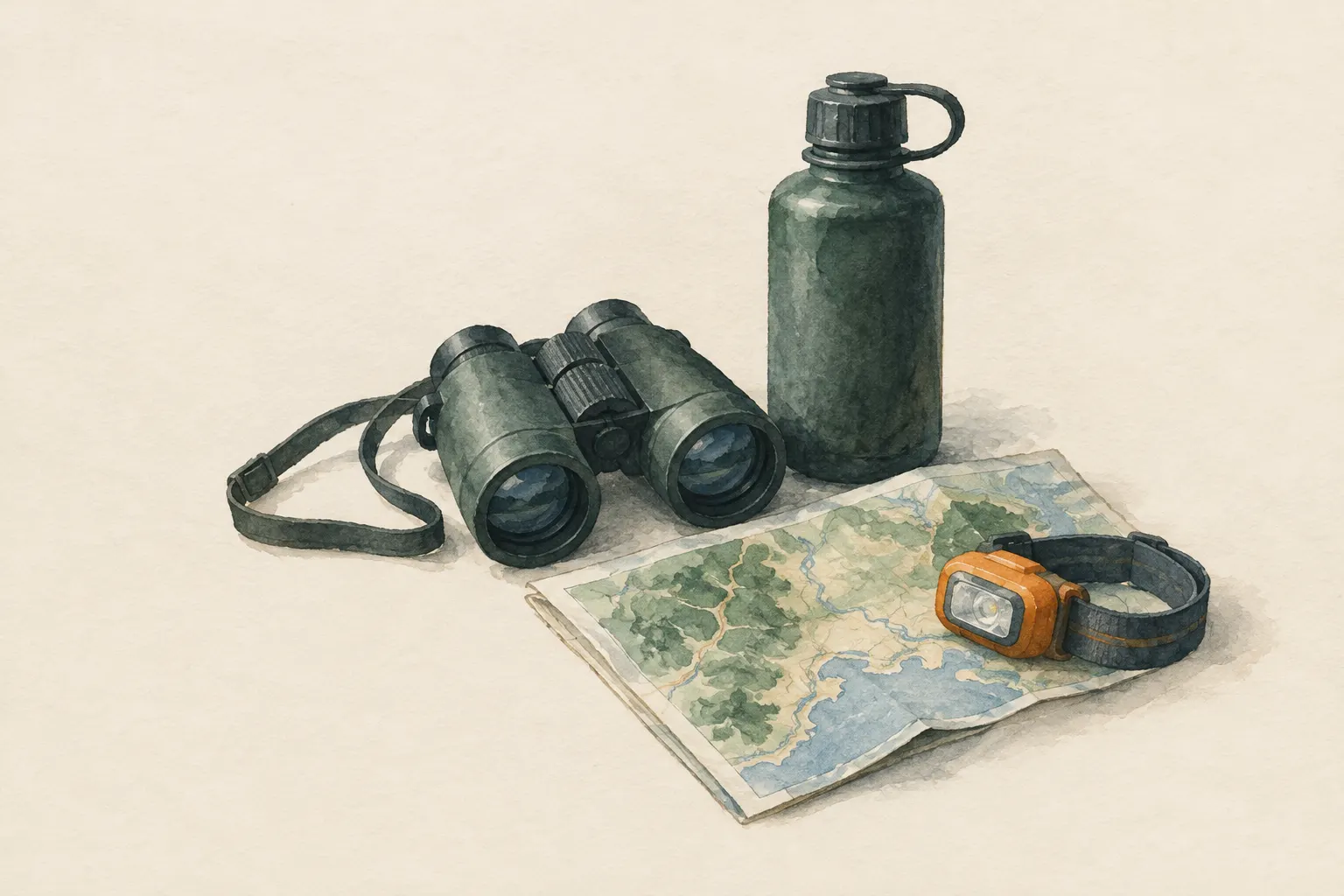
Binoculars
Never look directly at the sun.
Suitable for
- Planning observations
- Choosing rest and camp sites
- Understanding wildlife collision hotspots
Not suitable for
- Seeking out animals in quiet zones
- Exact predictions
Prerequisites
- Topographic map or map app of the area
- Basic map reading
Safety
- Do not camp directly at water sources, on game trails or at feeding sites – the likelihood of wildlife encounters is higher there.
- Wild animals cross roads more often at dusk and dawn. When driving along forest edges and at wildlife crossing signs, slow down and be ready to brake.
How it works
At the boundary between two habitats – such as forest and meadow – cover and food lie close together. Such edge zones are therefore often used more intensively than the interior of large, uniform areas. Water attracts animals from the whole surroundings, especially in dry periods. Many mammals are crepuscular or nocturnal and move between resting and feeding sites in the morning and evening. Landforms such as passes, shore strips, stream courses or gaps in fences funnel movement into corridors.
Advantages
- Explains where to find tracks
- Helps avoid conflicts
- Can be planned at home with a map
Disadvantages
- Only probabilities, no certainty
- Varies greatly by region and season
Deep knowledge
Background
The “edge effect” – increased diversity and activity at transitions between habitats – is a well-known concept in ecology. Trackers have always used it to find promising places.
For hikers and campers, the same insight is a safety rule: where animals move regularly is not a good place to camp.
Variants
- In the city
- In cities too, animals use corridors: railway embankments, riverbanks, parks and gardens. Nocturnal garden visitors often follow hedges and fences.
- In dry regions
- Water sources are focal points for animals there. Do not camp right next to them and leave animals access.
Common mistakes
- Camping right at the only water source around
- Assuming animals are evenly distributed
- Ignoring breeding and birthing seasons
- Driving too fast along forest edges at dusk
Limits and risks
- No species-specific behaviour details
- Local protection periods and path rules take precedence
Sources
Leave No Trace Center for Outdoor Ethics: The Seven Principles of Leave No Trace (Principle 5: Minimize Campfire Impacts)
Choosing campsites so wildlife is not disturbed