Pellets and droppings: observe, don't touch – hygiene first
Pellets from owls and raptors and mammal droppings reveal who lives in an area and what they eat. But they can contain pathogens and parasite eggs. So: photograph and measure instead of touching, do not sniff them, wash your hands – and for pellet studies with children use treated pellets from educational suppliers.
- A few minutes per find
Explained simply
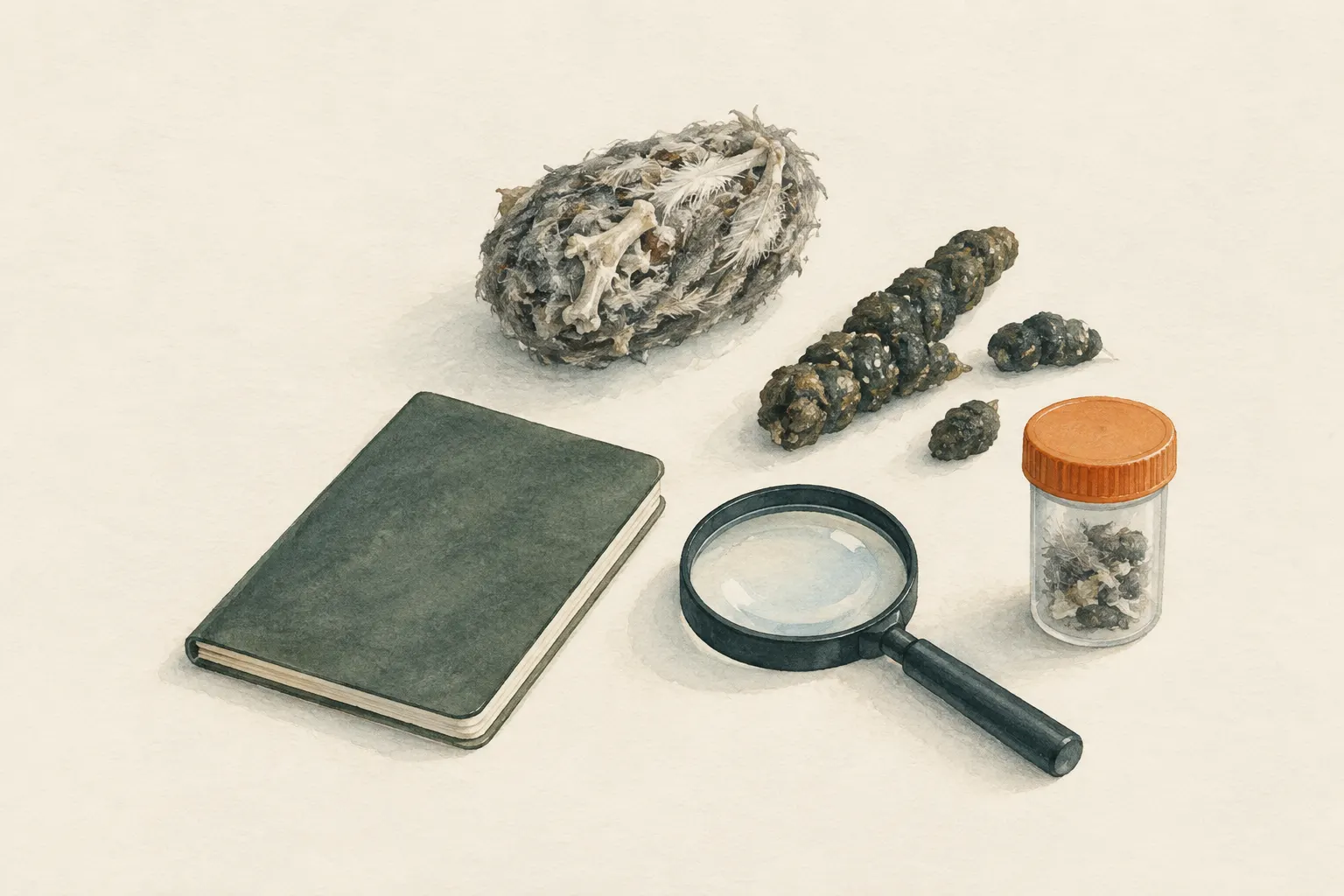
Owls often swallow small prey whole or in large pieces. What they cannot digest – fur, feathers and bones – they form into a small ball in their stomach and bring back up. This ball is called a pellet. So it comes out of the beak, not the other end. When you examine a pellet, you often find tiny skulls and can see what the owl has eaten.
Mammal droppings, also called scat, reveal a lot too: which animal lives here and what it eats. But droppings can contain pathogens and worm eggs that can make people ill. That is why the most important rule is: looking and photographing yes, touching and sniffing no.
Afterwards always wash your hands thoroughly with soap. If you want to take a pellet apart at school or at home, use specially treated pellets from an educational supplier and wear gloves.
How it works
Owls and birds of prey have no teeth and cannot chew their prey. What cannot be digested collects in the stomach and is regurgitated as a pellet. In owls, bones often remain well preserved because their digestion breaks bones down less than that of raptors such as buzzards or falcons. That is why owl pellets are a small treasure chest for naturalists: skulls and jaws reveal which small mammals live in the area.
Mammal droppings differ by shape, size, content and location. Plant-eaters often leave round or oval pellets, carnivores more sausage-shaped scat with hair, bone fragments or seeds in it. Some species deliberately deposit their droppings at prominent spots – on stones, tree stumps or path junctions – to tell other animals: I am here. Some even use fixed toilet sites, so-called latrines.
Both signs are valuable for tracking because they reveal shy and nocturnal species that you rarely see. Exact identification, however, is often difficult and works best with a field guide and in combination with other signs.
Safety: what to watch out for
Droppings of foxes, dogs, cats, rodents and other animals can contain parasites and pathogens. In parts of Europe, for example, fox tapeworm is widespread, and its eggs are passed in the droppings. Other pathogens can be inhaled via dust from dried rodent droppings. Which pathogens occur depends on region and species.
This leads to simple rules: never touch droppings with bare hands, do not sniff them and do not crumble dried droppings, so no dust is created. Do not collect fox, dog or cat droppings at all. While working, do not eat, drink or touch your face. Afterwards dispose of the gloves, wash your hands thoroughly with soap and clean work surfaces.
People with a weakened immune system should talk to their doctor first. Local health guidance always takes precedence – this knowledge base does not replace medical advice.
What really matters: documenting instead of touching
Almost everything you want to know can be found out without touching. First photograph the location with its surroundings: is the pellet lying under a tree, in a barn, in a rock niche? Are the droppings right on top of a stone or at a path junction? The location is often a strong clue in itself.
Then place a tape measure or ruler beside it without touching the find, and photograph it from above. Note shape, length, diameter and visible contents such as hair, bones, feathers, seeds or shiny insect parts. Identify later at home with a field guide rather than taking the find apart on site.
If anything is collected, then only pellets, only with gloves and in a sealed bag. Do not disturb owl roosts and nest sites while doing so: anyone poking around under an occupied roost tree may flush the birds. Many owl species are protected, and local rules take precedence.
How to practise it with children
Taking apart a pellet is a popular nature-study experiment in schools. For this, pellets from an educational supplier are used that have been treated so that germs are killed. Self-collected, untreated pellets are not suitable for children.
Even with treated pellets: wear gloves, work on a wipeable surface, sort with tweezers and wooden sticks instead of fingers and clean the surface afterwards. The bones can be laid out on dark paper and sorted into skulls, jaws, ribs and leg bones. Children are often amazed at how many small animals are inside a single pellet.
Good to know
Pellets are not excrement in the strict sense, because they have not passed through the gut. Other birds also produce pellets, for example some gulls, crows and herons; their pellets often contain less well preserved remains. Elbroch and Marks describe pellets as an important bird sign in “Bird Tracks & Sign”, and Elbroch's “Mammal Tracks & Sign” covers mammal droppings. Both books refer to North America, but the principles transfer.
Latrines and prominent dropping sites are, by the way, good spots for a wildlife camera placed at a distance: they show that an animal passes by regularly. That way you learn a lot about an animal without ever getting close to it.
Step by step
Look at the location
Pellets are often found under roost trees, in barns or rock niches; droppings at path junctions, stones or tree stumps. Photograph the location.
- 1
Look at the location
Pellets are often found under roost trees, in barns or rock niches; droppings at path junctions, stones or tree stumps. Photograph the location.
- 2
Photograph and measure
Place a tape measure beside it for scale without touching. Note shape, length, diameter, visible contents (hair, bones, seeds, insect parts).
- 3
Interpret the context
Compare with tracks, feeding signs and habitat. Identify later with a field guide, not by pulling it apart on site.
- 4
If collecting
Pellets only, only with gloves, into a sealed bag. Do not collect fox, dog or cat droppings.
- 5
Hygiene
Dispose of gloves, wash hands thoroughly with soap, clean work surfaces. Do not eat, drink or touch your face while working.
Common mistakes
- Picking up droppings with bare hands
- Sniffing them
- Crumbling dried droppings (dust)
- Flushing owls from their roost
- Dissecting untreated pellets with children
Quick view
Materials
Disposable gloves
Consider latex allergies – prefer latex-free gloves (e.g. nitrile).
Tape measure or folding rule
As a scale in photos
Soap / detergent
Rinse drinking-water containers thoroughly after cleaning.
Field notebook and pencil
Suitable for
- Tracking and species records
- Nature study with school classes (with treated pellets)
- Monitoring owl and raptor roosts
Not suitable for
- Collecting at breeding or roost sites of protected species while in use
- People with weakened immune systems without medical advice
Prerequisites
- Gloves and a way to wash hands
Safety
- Droppings of foxes, dogs, rodents and other animals can transmit parasites and pathogens, for example fox tapeworm in parts of Europe. Do not touch with bare hands, do not sniff, do not stir up dust, wash hands thoroughly afterwards.
- Do not disturb owl roosts or nest sites; collect pellets only where this is possible without disturbance and under local rules.
- For teaching and children use treated pellets from educational suppliers, wear gloves and clean the work surface afterwards.
How it works
Owls and raptors regurgitate the indigestible remains of their prey – hair, feathers, bones – as pellets. In owls, bones often remain well preserved, which is why their pellets reveal much about prey. Mammal droppings differ by shape, size, content and location; some species deliberately deposit them at prominent spots as markers.
Advantages
- Records even shy, nocturnal species
- Much information without animal contact
Disadvantages
- Hygiene risk
- Identification often uncertain
Deep knowledge
Background
Elbroch and Marks describe pellets as an important bird sign in 'Bird Tracks & Sign'; Elbroch's 'Mammal Tracks & Sign' covers mammal droppings and their interpretation. Both cover North American species, but the principles transfer.
Which pathogens occur in droppings depends on region and species; local health advice takes precedence.
Variants
- Latrines
- Some species use fixed latrine sites. They indicate regular presence – a good spot for a wildlife camera at a distance.
Common mistakes
- Picking up droppings with bare hands
- Sniffing them
- Crumbling dried droppings (dust)
- Flushing owls from their roost
- Dissecting untreated pellets with children
Limits and risks
- No species identification
- No medical advice
Sources
Mark Elbroch, Eleanor Marks – Stackpole Books (2001): Bird Tracks & Sign: A Guide to North American Species
Pellets as bird sign
Mark Elbroch – Stackpole Books (2003): Mammal Tracks & Sign: A Guide to North American Species
Mammal droppings and their interpretation