Water in the mountains: streams, meltwater and glacial runoff
In the mountains water often looks pure, but livestock, wildlife, huts and people upstream can contaminate it. Glacial streams carry fine rock flour that clogs filters, and they swell during the day. Collect water at safe spots, pre-clarify and treat it; enter glaciers and stream beds only with suitable experience.
- Low to moderate; settling time for glacial water
Explained simply
In the mountains, water often looks wonderfully clean: crystal clear, ice cold and fresh. But further up there may be cows or sheep grazing, chamois drinking from the stream, or a hut on the slope. Their germs end up in the water and you cannot see them. That is why you always treat mountain water too, for example with a filter and tablets or by boiling.
Water coming straight from a glacier often looks milky grey. That is not dirt in the usual sense but rock flour: the glacier grinds the rock beneath it into fine powder. This powder clogs filters quickly. If you let the water stand for a while, part of it sinks to the bottom.
And very important: you never go onto a glacier or under overhanging ice to get water, and you do not balance on wet stones at the bank. Streams fed by snow and ice often become much bigger and wilder in the afternoon than in the morning.
How it works
In the mountains, water comes from snow and glacier melt, from springs and from rain. Springs at high altitude with nobody living, working or grazing above them are usually the least contaminated – but never reliably free of germs. Wildlife, livestock, huts with their waste water and many people on popular trails can bring pathogens such as bacteria or parasites into the water. Cold and clarity do not kill them.
Glaciers move slowly downhill and grind the rock beneath them into a very fine flour, glacial silt. It turns the water milky, turquoise or grey. The particles are so fine that they settle only slowly and quickly clog the pores of water filters. UV devices also work poorly in cloudy water, because the light no longer reliably reaches the germs.
Meltwater streams follow a daily rhythm: the sun melts snow and ice during the day, and the water takes time to reach the stream. That is why many of these streams carry much more water in the afternoon than in the early morning. Thunderstorms can also make them swell quickly.
What really matters
Good planning starts on the map: where are the springs, streams and huts? Do the huts supply drinking water, and are they open when you travel? Do streams run dry in late summer? Clarifying this in advance means carrying less and avoiding trouble on the way.
When collecting, prefer springs right where they emerge from the ground or fast-flowing side streams above trails, huts and pastures. Avoid standing pools with livestock signs. Fill up at a flat, stable spot on the bank, not on slippery stones and never at the edge of snow bridges with a stream running underneath.
Leave milky glacial water to stand in a vessel first, for example a collapsible container, then pour off the clearer upper layer. After that it is treated: filtered and chemically disinfected, treated with UV (only if clear) or boiled. At high altitude water boils at a lower temperature; here you follow official boiling guidance, which gives a longer boiling time for this.
Safety: what to watch out for
Glaciers and glacier snouts – the caves from which the glacial stream emerges – are dangerous. There are hidden crevasses, ice can break off, and dammed water can burst out suddenly. Do not go onto glaciers or under ice overhangs to get water. Glacier travel requires a rope, equipment and experience and is a topic of its own.
The banks of mountain streams are slippery, the water is ice cold and often faster and stronger than it looks. Falling in can quickly become dangerous. So plan stream crossings for the morning, when less water flows, and if a spot looks unsafe, look for another one or turn back.
Rock flour and minerals from the rock cannot be completely removed by common outdoor treatment. Settling and decanting mainly help the filters; the water is still water that has to be disinfected.
Typical situations
On a hut-to-hut tour, fill up with drinking water at the hut in the morning if it explicitly offers it, and plan refill points at springs along the way. A stream right below a hut or alpine pasture is not a good choice without treatment, even if it is clear and cold.
At the edge of a snowfield, meltwater can be a welcome source. Avoid dark or reddish discoloured snow and spots with animal tracks, because snow can contain animal droppings. This water is treated too.
Mountaineering handbooks agree: even remote mountain streams should not be regarded as safe. The good news is that water is often plentiful in the mountains – with a little planning and the right treatment you do not have to carry much.
Step by step
Plan water points
Mark springs, streams and huts on the map. Find out whether huts provide drinking water and whether streams run dry in summer.
- 1
Plan water points
Mark springs, streams and huts on the map. Find out whether huts provide drinking water and whether streams run dry in summer.
- 2
Choose the collection point
Prefer springs at the outlet or fast-flowing side streams above trails, huts and pastures. Avoid standing pools with livestock signs.
- 3
Collect safely
Fill at a flat, stable spot on the bank. Do not balance on slippery stones and never at the edge of snow bridges.
- 4
Settle glacial water
Leave milky glacial water to stand in a vessel and pour off the clearer upper layer before filtering or disinfecting it.
- 5
Treat
Filter and disinfect chemically, treat with UV (only with clear water) or boil. At high altitude water boils at a lower temperature – follow official boiling guidance.
Common mistakes
- Drinking clear mountain water untreated
- Collecting water below a pasture
- Clogging the filter with glacial silt
- Going onto the glacier for water
- Crossing a swollen stream in the afternoon
Quick view
Materials
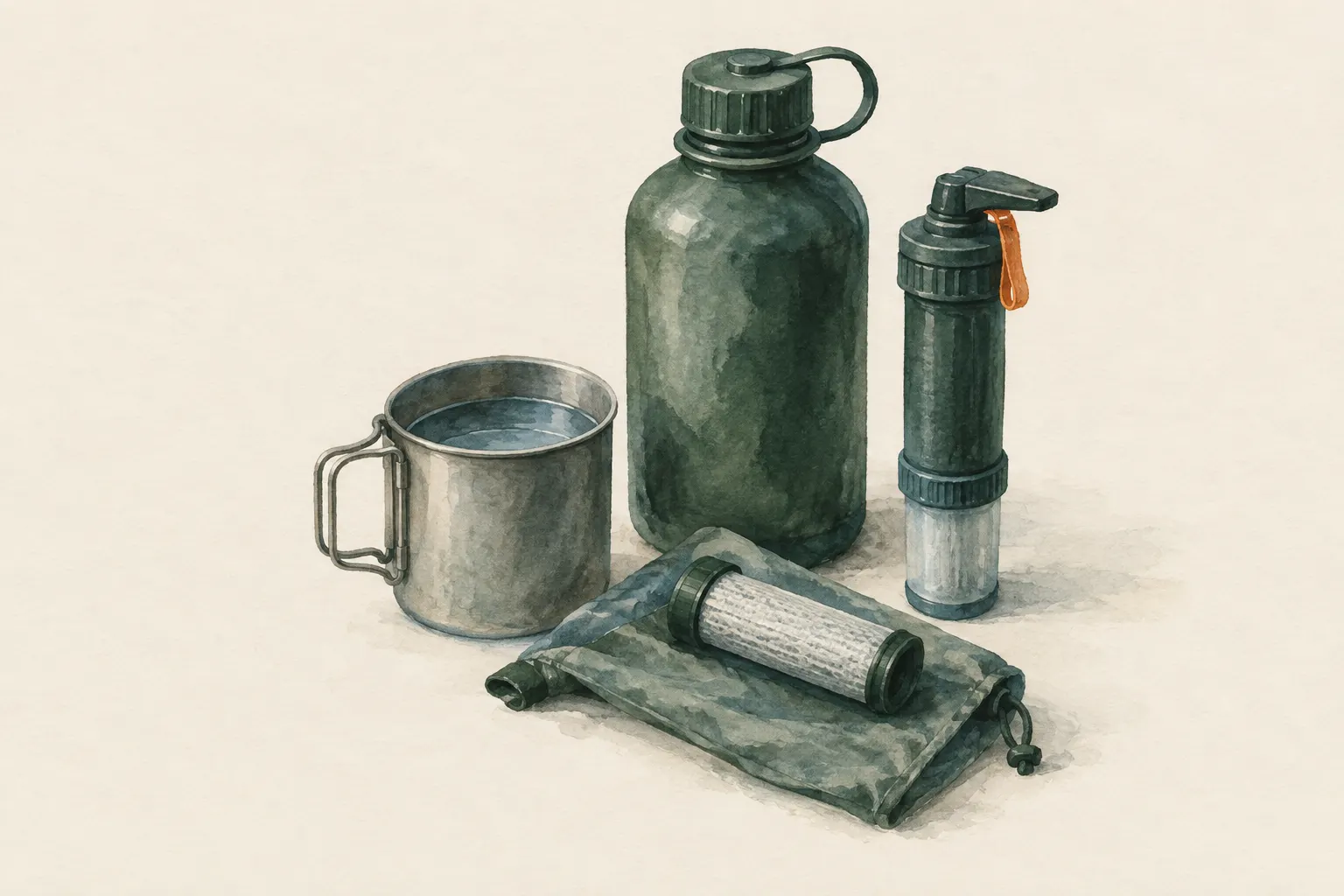
Portable water filter (hollow fibre / membrane)
Do not let it freeze – fibres can be damaged without visible signs.
Chlorine dioxide tablets or drops
Only approved drinking-water products; follow manufacturer instructions.
Metal pot (stainless steel, aluminium, titanium)
Hot – scalding risk.
Collapsible water container or bag
For settling glacial water
Protect from sharp objects.
Use only food-grade and only for water.
Suitable for
- Mountain hikes and alpine tours
- Hut-to-hut trips with refills along the way
Not suitable for
- Glaciers without rope, equipment and experience
- Streams below huts, pastures or livestock without treatment
Prerequisites
- A disinfection method
- A map showing springs and huts
- Sure footing at the bank
Safety
- Meltwater streams often carry much more water in the afternoon than in the morning, and thunderstorms make them swell quickly. Do not balance on wet rocks at the bank; plan crossings for the morning.
- Even clear mountain water can contain pathogens. Treat it – especially below huts, pastures, livestock and busy trails.
How it works
In the mountains water comes from snow and glacier melt, springs and rain. Springs at altitude with no use upstream are usually least contaminated, but never reliably germ-free. Glaciers grind rock into fine flour that turns the water milky; it settles slowly and clogs filter pores.
Advantages
- Water is often plentiful
- Less weight if refilling can be planned
Disadvantages
- Glacial silt burdens filters
- Risk of falling and strong current at the bank
- Streams can dry up in late summer
Deep knowledge
Background
Mountaineering handbooks point out that even remote mountain streams should not be considered safe and that water must be treated before drinking. Glacial silt is a known problem for water filters.
The daily fluctuation of meltwater streams is a classic topic of trip planning, because it makes afternoon stream crossings more dangerous.
Variants
- Snowfields
- Meltwater at the edge of snowfields can be a water source. Avoid dark or reddish discolouration and tracks; snow can contain animal droppings.
Common mistakes
- Drinking clear mountain water untreated
- Collecting water below a pasture
- Clogging the filter with glacial silt
- Going onto the glacier for water
- Crossing a swollen stream in the afternoon
Limits and risks
- No statement on water quality in specific areas
- No instructions for glacier travel or stream crossings
- Mineral load from rock is possible
Material alternatives
Derived from material properties: a substitute must have all relevant properties. Observe the notes on the substitute.
- Chlorine dioxide tablets or drops
- Chlorine tablets (NaDCC) for drinking water (Follow the manufacturer's dose and contact time.), Unscented household bleach (sodium hypochlorite) (Only unscented, without additives, with known concentration.), Iodine water purification tablets (Not in pregnancy, thyroid disease or iodine allergy without medical advice.)
- Metal pot (stainless steel, aluminium, titanium)
- Single-wall stainless steel bottle (Heat only single-wall bottles without paint/plastic; remove the lid before heating.)
- Collapsible water container or bag
- Single-wall stainless steel bottle (Heat only single-wall bottles without paint/plastic; remove the lid before heating.), Double-wall insulated bottle (Never heat directly.), PET bottle (clear, max. 2 litres) (Do not heat or place in a fire.), Food-grade water container (Only use containers that never held chemicals or fuel.), Airtight food-grade storage container (Fill only when clean and completely dry; never use containers that previously held chemicals.), Food-grade water bag (Use only for drinking water, never for chemicals or fuel.), Fermentation jar or crock (Use only food-grade containers of glass, food-safe glazed stoneware or food-grade plastic – no metal containers for acidic food.), Resealable food bags (Use only bags intended for food; do not use with boiling water unless the manufacturer explicitly allows it.)
Results come exclusively from structured entries. No improvised instructions are generated.
Sources
The Mountaineers Books (2017): Mountaineering: The Freedom of the Hills, 9th edition
Water supply in the mountains, treatment and hazards at glaciers and streams
Wilderness & Environmental Medicine (Wilderness Medical Society) (2019): Wilderness Medical Society Clinical Practice Guidelines for Water Disinfection for Wilderness, International Travel, and Austere Situations: 2019 Update
Treating surface water in the wilderness
World Health Organization (2015): Boil water – Technical brief
Boiling at high altitude