Planning water for trips: refill points and reserves
Planning water for a trip means fixing refill points, carrying amounts and a reserve before setting off. Springs can dry up, huts can be closed, fountains can be marked ‘not drinking water’. A second treatment method and a plan B in case a water point fails are part of it.
- Preparation 15–60 minutes depending on the trip
Explained simply
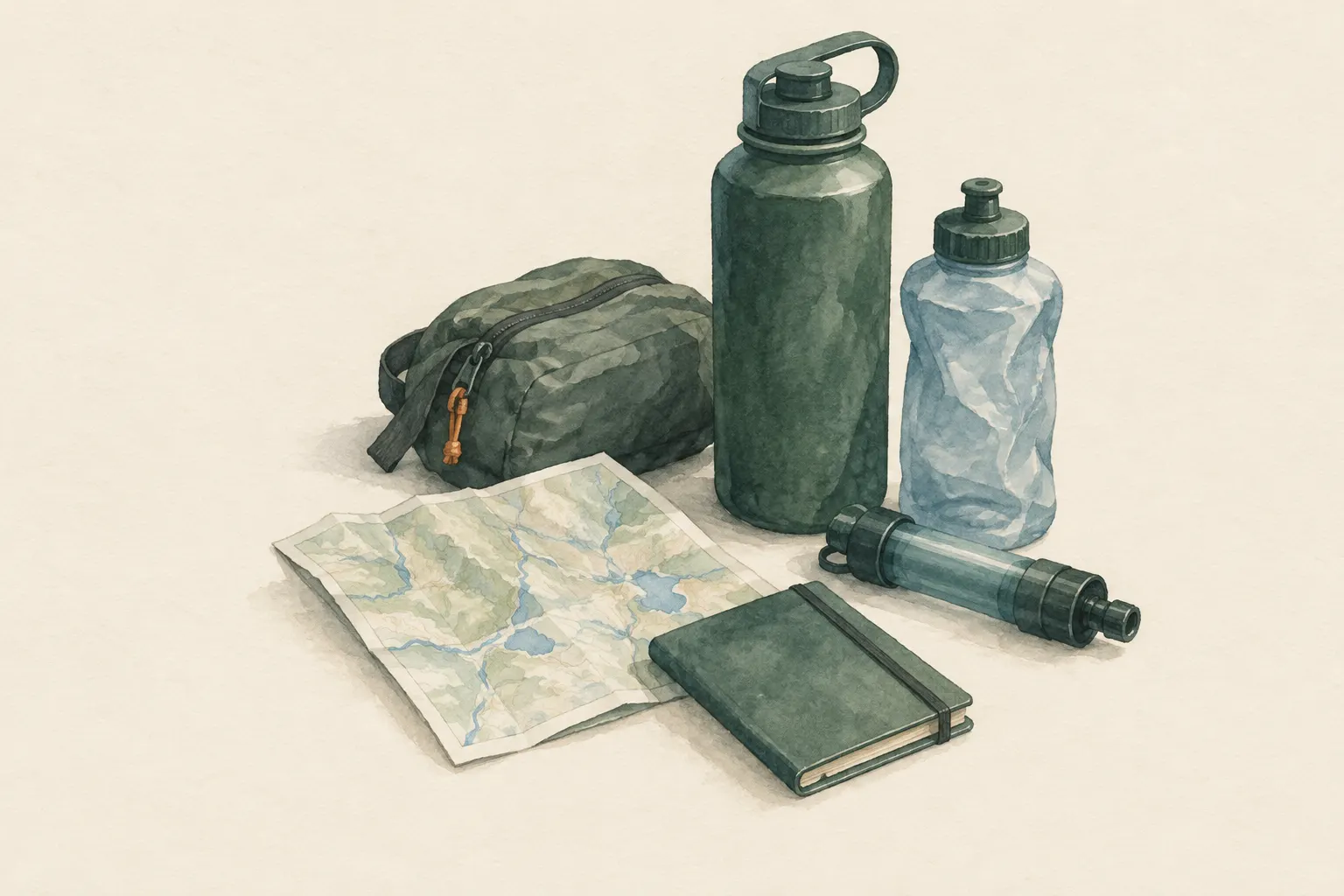
When you go on a hike or a bike tour, water is like fuel for a car: you need to know where the next filling station is. So you look at the map beforehand: where are huts, fountains, springs or villages where you can refill? Between them are stretches for which you must carry enough water.
But watch out: a spring can be dry in summer, a hut can be closed, and a fountain can have a sign saying ‘not drinking water’. That is why you always carry a bit more than you actually need – a reserve. With the reserve you can turn back or walk to the next safe water point.
You also take two ways of making water safe, for example a filter and tablets. If one breaks, you still have the other. And you tell someone at home which route you are taking.
How it works
One litre of water weighs about one kilogram. Every trip is therefore a trade-off between carrying weight and safety reserve: carry too much and you slow down and sweat more; carry too little and you are in trouble if a source fails. Good planning resolves this conflict by dividing the route into sections between reliable refill points.
For each section you estimate how long you will be on the move, how hot it will be and how strenuous the terrain is. This gives a carrying amount plus a reserve. The less reliable the next refill point, the larger the reserve. There are no fixed litre figures for everyone – needs depend heavily on heat, exertion, body and acclimatisation.
You learn best how much you yourself need on shorter trips: note how much you drank in which weather and at which effort, and how you felt. These personal figures are more valuable for planning than any general rule of thumb.
What really matters
Mark every possible water point on the map: huts, fountains, springs, streams, villages. Then check them with information that is as current as possible – from huts, tourist offices or recent trip reports. Is the hut open? Does the fountain supply drinking water? Does the stream carry water in this season? Information on sources is often outdated, so never plan around a single uncertain spot.
Your gear includes a main treatment method and a backup, for example a filter plus tablets. For dry sections, a light collapsible container can add capacity that you fill only where you need it.
A turnaround point is especially important: decide in advance when you will turn back or divert if a water point fails. That decision is much harder to make on the trail when you are tired and thirsty. Leave the plan with a trusted person.
Safety: what to watch out for
Never set off assuming that a single source will definitely have water. Many water emergencies on hikes arise not from bad luck but from a source that was unexpectedly dry. The reserve must be enough to turn back or reach the next reliable water point.
In heat, water needs rise sharply. Schedule strenuous sections for the cool morning and evening hours, and during heat warnings adapt the plan or postpone the trip. Headache, dizziness, great tiredness and dark urine are signs that you need to drink more and rest in the shade. For confusion or impaired consciousness, call the local emergency number (112 in the EU).
Take signs such as ‘not drinking water’ at fountains and huts seriously. Use such water only after treatment at most – and water from streams and springs is always treated too.
Typical situations
With children, plan regular drinking breaks, because children often drink too little and report thirst late. Carry extra water for them, and a light bottle of their own that they can drink from themselves helps.
On a multi-day trip in late summer, a spring that flowed strongly in spring may have dried up. Anyone travelling with a reserve and a fallback plan turns the dry spring into a change of plan rather than an emergency.
For trips in deserts or expeditions into very remote areas this kind of planning is not enough; they need specialised preparation and experience.
Step by step
Divide the route into sections
Mark possible water points on the map: huts, fountains, springs, streams, villages. Divide the route into sections between them.
- 1
Divide the route into sections
Mark possible water points on the map: huts, fountains, springs, streams, villages. Divide the route into sections between them.
- 2
Check the water points
Check current information on whether huts are open, fountains supply drinking water and streams carry water in that season – e.g. via huts, tourist offices or recent trip reports.
- 3
Set carrying amounts
For each section, estimate time, heat and exertion and set a carrying amount with a reserve. Carry more when sources are uncertain.
- 4
Plan treatment
Take a main method and a backup, for example a filter plus tablets.
- 5
Set a turnaround point
Decide when you will turn back or divert if a water point fails, and leave the plan with a trusted person.
Common mistakes
- Relying on a single source
- Saving weight by skimping on water at the start
- No backup treatment method
- Underestimating heat and elevation gain
- Looking for water only when the bottle is empty
Quick view
Materials
Topographic map
Check the publication date – paths and buildings may have changed.
Protect from wet (map case or bag).
Collapsible water container or bag
For extra capacity on dry sections
Protect from sharp objects.
Use only food-grade and only for water.
Portable water filter (hollow fibre / membrane)
Do not let it freeze – fibres can be damaged without visible signs.
Chlorine tablets (NaDCC) for drinking water
As a second method
Follow the manufacturer's dose and contact time.
Suitable for
- Day hikes and multi-day trips
- Cycling tours and trekking
- Trips with children
Not suitable for
- Desert and expedition planning without expertise – that needs specialised planning
Prerequisites
- Current map and route information
- Knowing one's own needs in heat and exertion
Safety
- Never set off assuming a single source will definitely have water. Carry enough reserve to turn back or reach the next reliable water point if a source is dry.
- In heat, water needs rise sharply. Schedule strenuous sections for the cool hours and adapt plans during heat warnings.
- Take signs such as ‘not drinking water’ at fountains and huts seriously; use such water only after treatment.
How it works
Water is heavy: every trip is a trade-off between carrying weight and safety reserve. Planning divides the route into sections between reliable refill points and sets a carrying amount plus reserve for each section. The less reliable a refill point, the larger the reserve.
Advantages
- Prevents emergencies caused by dry sources
- Optimises carrying weight
- Makes turnaround decisions easier
Disadvantages
- Information on sources is often outdated
- Preparation takes time
Deep knowledge
Background
Trip planning in mountaineering and outdoor handbooks treats water as a fixed component: where is resupply, how much must be carried, and how will it be treated?
Many water emergencies on hikes arise not from misfortune but from a source that was unexpectedly dry.
Variants
- With children
- Children often drink too little and report thirst late. Plan regular drinking breaks and carry extra water for them.
Common mistakes
- Relying on a single source
- Saving weight by skimping on water at the start
- No backup treatment method
- Underestimating heat and elevation gain
- Looking for water only when the bottle is empty
Limits and risks
- No fixed litre figures – needs are individual
- Does not replace desert or expedition planning
- Source information can change at short notice
Material alternatives
Derived from material properties: a substitute must have all relevant properties. Observe the notes on the substitute.
- Collapsible water container or bag
- Single-wall stainless steel bottle (Heat only single-wall bottles without paint/plastic; remove the lid before heating.), Double-wall insulated bottle (Never heat directly.), PET bottle (clear, max. 2 litres) (Do not heat or place in a fire.), Food-grade water container (Only use containers that never held chemicals or fuel.), Airtight food-grade storage container (Fill only when clean and completely dry; never use containers that previously held chemicals.), Food-grade water bag (Use only for drinking water, never for chemicals or fuel.), Fermentation jar or crock (Use only food-grade containers of glass, food-safe glazed stoneware or food-grade plastic – no metal containers for acidic food.), Resealable food bags (Use only bags intended for food; do not use with boiling water unless the manufacturer explicitly allows it.)
- Chlorine tablets (NaDCC) for drinking water
- Chlorine dioxide tablets or drops (Only approved drinking-water products; follow manufacturer instructions.), Unscented household bleach (sodium hypochlorite) (Only unscented, without additives, with known concentration.), Iodine water purification tablets (Not in pregnancy, thyroid disease or iodine allergy without medical advice.)
Results come exclusively from structured entries. No improvised instructions are generated.
Sources
The Mountaineers Books (2017): Mountaineering: The Freedom of the Hills, 9th edition
Trip planning including water supply
Wilderness & Environmental Medicine (Wilderness Medical Society) (2019): Wilderness Medical Society Clinical Practice Guidelines for the Prevention and Treatment of Heat Illness: 2019 Update
Fluid needs in heat and exertion
Wilderness & Environmental Medicine (Wilderness Medical Society) (2019): Wilderness Medical Society Clinical Practice Guidelines for Water Disinfection for Wilderness, International Travel, and Austere Situations: 2019 Update
Treatment methods on the move