Skip to content
In an emergencyAustriaEmergency numbers →
SurviveBetter
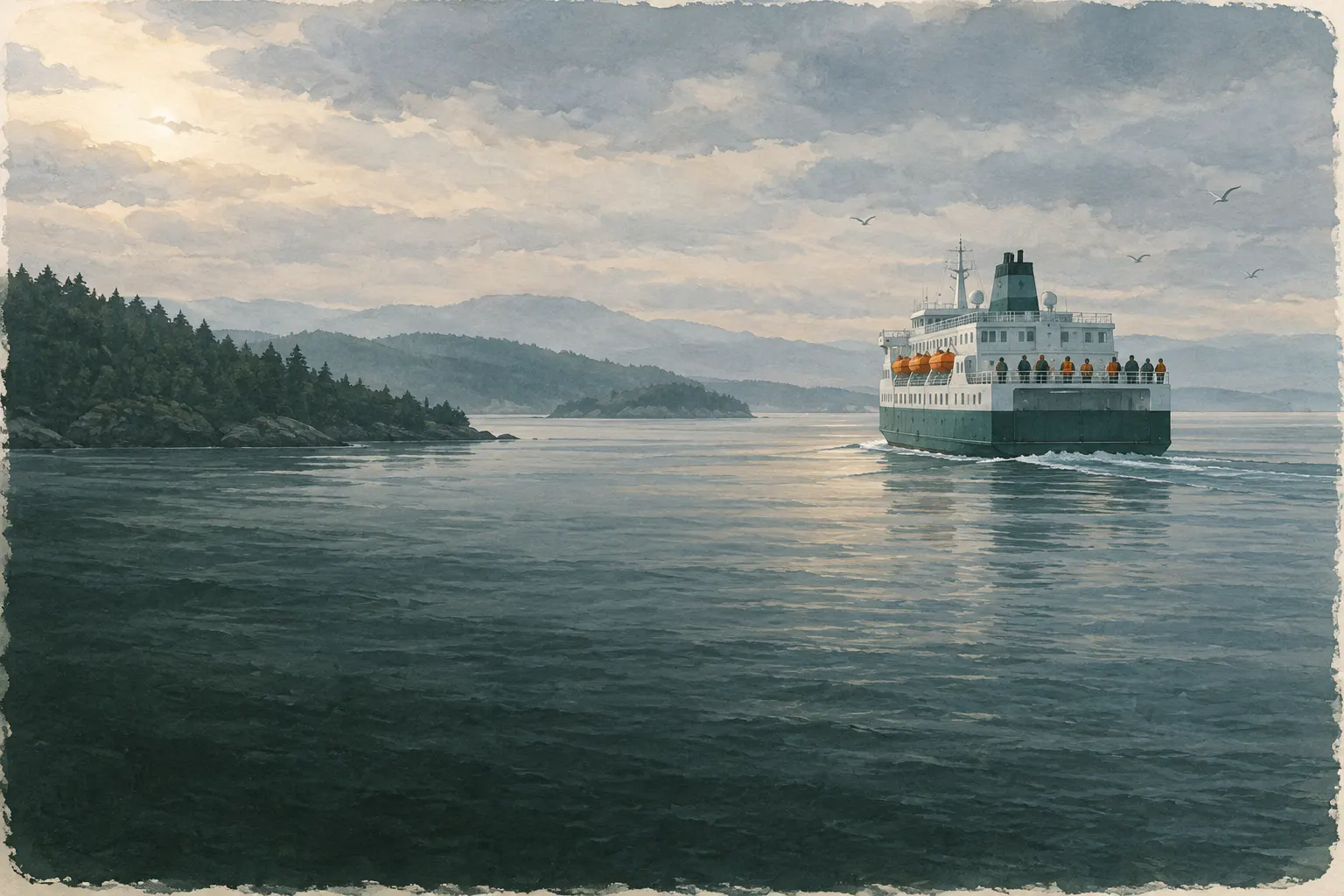
Ferry on a calm sea, people in life jackets gathering calmly on deck by the lifeboats

The alarm sounds on a ferry

Seven short blasts, one long – and people everywhere who do not know where to go. Whoever took the safety briefing seriously does.

First

  1. Stay calm and listen to the crew's announcements. The general emergency alarm on ships usually consists of seven or more short blasts and one long one.
  2. Take warm clothing, sturdy shoes and medication; do not pack.
  3. Go to the muster station – by the stairs, not the lift. Hold children by the hand.
  4. Put on a life jacket as the crew instructs and follow only their instructions.

Call emergency services if

  • Fire or smoke the crew has not yet noticed: alert the crew or the nearest fire alarm at once
  • Someone has gone overboard: shout “man overboard”, keep the person in sight, alert the crew
  • Someone is injured or unresponsive
  • After leaving the ship: hypothermia

What is happening

On ferries and passenger ships there are fixed procedures for emergencies: alarm signals, announcements, muster stations, life jackets and a crew that practises these procedures. The international rules for safety at sea (SOLAS) require, among other things, a general emergency alarm, which usually consists of seven or more short blasts and one long blast. The crew says over the loudspeakers exactly what to do.

Most alarms end without an evacuation – with a check, a small fire put out quickly, or a drill. That is exactly why people tend to ignore alarms, pack first or search the whole ship for relatives. That costs time and blocks stairs and corridors.

If a ship really has to be abandoned, only the ship's command decides, and the crew guides passengers to lifeboats or life rafts. Anyone who jumps or runs to the lifeboats on their own endangers themselves and others.

For travellers this means: take the briefing seriously, know your muster station and the life jackets, dress warmly when the alarm sounds, go to the muster station and follow the instructions there.

Step by step

The alarm sounds on a ferry – Phase 1 of 4When boarding. Follow the safety briefing or video attentively. Look for the signs to the muster station and life jackets, including children's ones. Walk the route from your seat or cabin to the muster station once, ideally two different routes. Agree with your family: when the alarm sounds, everyone goes straight to the muster station.
Phase 1 of 4

Phase 1 of 4

When boarding

Follow the safety briefing or video attentively. Look for the signs to the muster station and life jackets, including children's ones. Walk the route from your seat or cabin to the muster station once, ideally two different routes. Agree with your family: when the alarm sounds, everyone goes straight to the muster station.

The animation shows the key actions of each phase schematically; the text below is what counts.

  1. Phase 1

    When boarding

    • Follow the safety briefing or video attentively.
    • Look for the signs to the muster station and life jackets, including children's ones.
    • Walk the route from your seat or cabin to the muster station once, ideally two different routes.
    • Agree with your family: when the alarm sounds, everyone goes straight to the muster station.
  2. Phase 2

    Alarm: dress and go

    • Listen to the announcements. With the general emergency alarm, do not wait to see whether it is serious.
    • Take warm clothing, sturdy shoes, medication and ID – do not pack.
    • Go to the muster station by the stairs, quickly but without running. No lifts.
    • Leave the car deck at once. Do not stay in vehicles or fetch anything.
  3. Phase 3

    At the muster station

    • Put on the life jacket when the crew says so and fasten it properly – help children first.
    • Report to the crew. Report missing relatives to the crew instead of searching yourself.
    • Stay together, hold children by the hand, explain calmly what is happening.
    • Follow only the crew's instructions. Do not go to the lifeboats on your own and do not jump.
  4. Phase 4

    If the ship is abandoned – and afterwards

    • Follow the crew to the life-saving appliances and follow their boarding instructions exactly.
    • If you end up in the water: lie back, calm your breathing, stay close to others and be visible.
    • Ashore or on the rescue vessel: keep warm and register with the crew or the authorities.
    • Send relatives a sign of life and contact your travel insurance or consulate if needed.

★ Pro tips

What experienced people do differently: proven practice from mountain rescue, fire services, lifeguards and civil protection that beginners rarely know.

  1. Count the doors to the stairs

    When you check in, count how many cabin doors lie between yours and the nearest stairway, and on which side. In smoke or a power cut you can then find your way by feeling along the wall.

  2. Follow the floor-level lighting

    Passenger ships have low-level lighting or glowing strips along corridors and stairs that lead to the exits. Smoke rises, so these markings stay visible longest. On your first walk round the ship, deliberately look down to spot them.

  3. On night crossings, lay things out

    Before sleeping, put your shoes, warm jacket, glasses, medication, ID and phone where you can grab them in the dark. If the alarm goes at three in the morning, you're ready in seconds.

  4. Only jump if ordered – and do it right

    If the crew orders you to jump: first check below that it's clear. One hand holds the lifejacket down at the collar, the other covers mouth and nose. Legs together, feet first, look straight ahead.

What to watch out for

  • Lifts

    Do not use lifts when the alarm sounds. They can stop, and stairs are the intended route.

  • Small boats without life jackets

    Better not to board obviously overloaded boats, boats without life jackets or trips in a storm – even if it is the only connection of the day.

  • Searching the whole ship

    Anyone searching for relatives on their own walks against the flow and blocks routes. The crew counts at the muster stations and searches systematically.

  • Cold water

    The sea is often cool even in summer. Warm clothing under the life jacket helps you stay warm longer in the water or in a lifeboat.

Common mistakes

  • Assuming the alarm is a drill and staying seated.
  • Packing suitcases or going to the car first.
  • Taking the lift.
  • Searching the ship for relatives instead of going to the muster station.
  • Running to the lifeboats or jumping on your own.

Prepare in advance

  • Medication, ID and a warm layer in your hand luggage, not in the car.
  • Show children the muster station before the crossing and agree on what to do in an alarm.
  • On small boats ask about life jackets and wear them on open boats.
  • Keep emergency contacts and travel insurance details to hand.
  • Check the forecast and choose a later crossing if a storm warning is out, where possible.

Special consideration

People with limited mobility
When checking in, say that help will be needed in an emergency. When the alarm sounds, tell the crew at once where the person is.
Pets
Pets usually stay in kennels or in the car. Do not go to them when the alarm sounds; inform the crew.

Sources

  • International Convention for the Safety of Life at Sea (SOLAS), 1974, as amended · International Maritime Organization (IMO), 1974
  • Respect the Water – Float to Live · Royal National Lifeboat Institution (RNLI), UK
  • 112 – the European emergency number · European Commission

Your situation

Where are you right now?
With you

Matching entries

0 rules apply

No AI decides here. Every recommendation is based on a visible rule.

Add details about your situation above to get more specific guidance.

Basics for this situation

Why: Always applies to this situation – regardless of your answers.

All rules of this situation (5)
  1. [not active] If Where are you right now? = On the car deck

    Leave the car deck at once and go up the stairs to the muster station. Do not stay in the car and do not fetch anything from it.

  2. [not active] If Where are you right now? = In the cabin

    Warm clothing, shoes, medication, ID – then out. If there is smoke in the corridor stay low and take the nearest exit.

  3. [not active] If With you = Family is in different places

    Everyone goes straight to their muster station. Report missing relatives to the crew instead of searching the ship yourself.

  4. [not active] If With you = Children

    Hold children by the hand and get children's life jackets from the crew. Explain calmly what is happening.

  5. [not active] If With you = Someone with limited mobility

    Tell the crew at once where the person is and what help they need. Do not carry them down stairs alone if the crew can take over.