Skip to content
In an emergencyAustriaEmergency numbers →
SurviveBetter
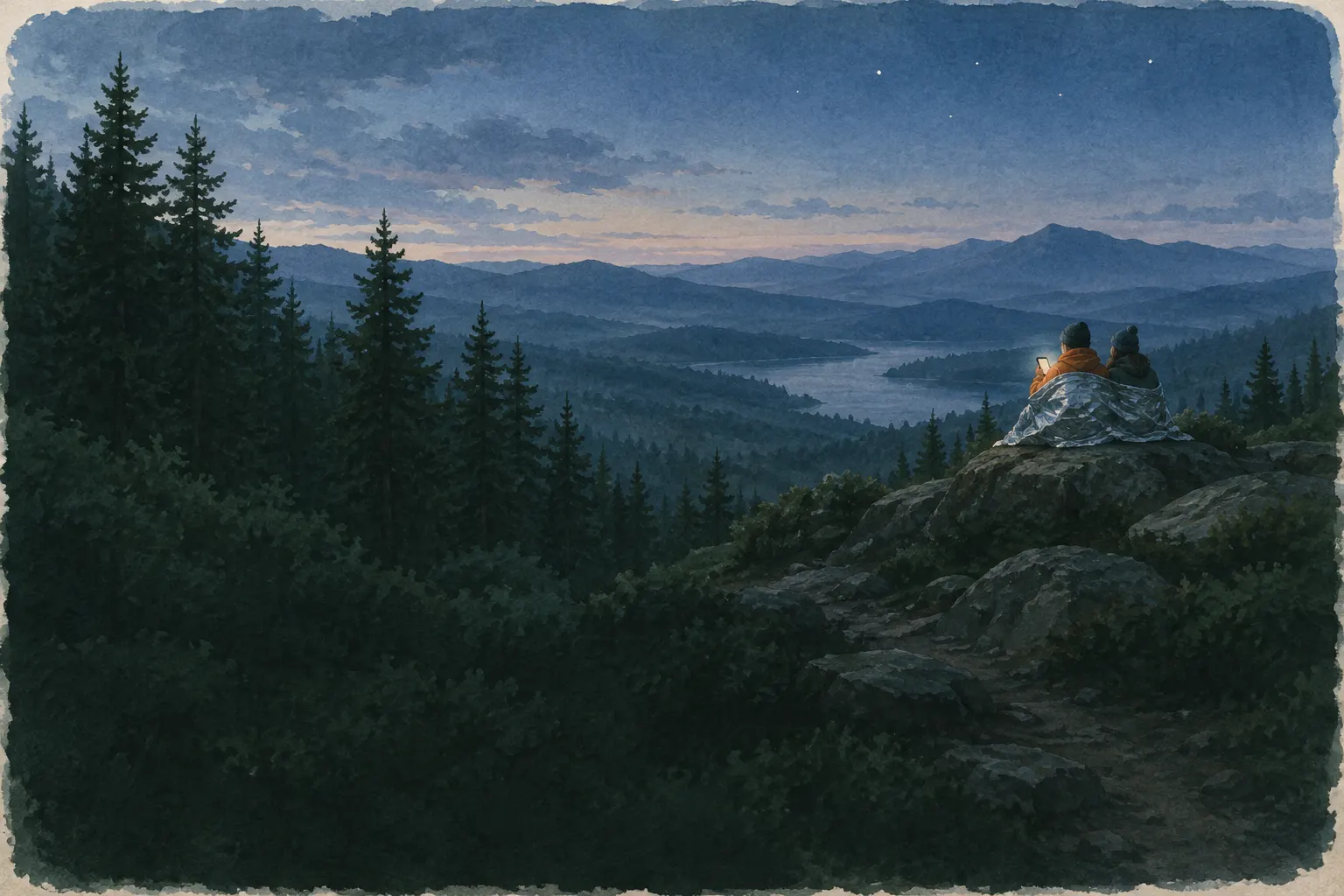
Two hikers sitting under a foil blanket on a rock by a mountain trail at dusk

I will not make it back before nightfall: walk on or stay out?

The sun has gone, the way is still long and you have no headlamp. Now a calm decision counts: carry on carefully or wait safely.

First

  1. Stop in good time and decide while it is still light enough: do I know the way for sure? Is it wide and safe? How much further?
  2. If the path is steep, exposed, unmarked or unknown: do not continue in the dark. A safe emergency bivouac is better than a fall.
  3. Protect your phone battery: brightness down, airplane mode between navigation and calls, use the torch only briefly and when needed.
  4. Tell someone where you are and what you plan to do. If there is danger, injury or cold: call 112, in the Austrian mountains also 140.

Call emergency services if

  • You cannot go forward or back without danger
  • Someone is injured, exhausted or very cold
  • The weather is getting worse (thunderstorm, rain, snow)
  • You are lost and no longer know where you are
  • Someone from the group is missing

What is happening

The tour took longer, the break was too comfortable or you misjudged things: the sun is setting and the car or hut is still far away. In forests and valleys it often gets dim well before the official sunset, and in autumn it happens especially fast.

Darkness itself is not dangerous. The dangers are falls, taking a wrong turn at junctions and getting cold if you have to stop. Many mountain rescue call-outs involve uninjured people who could not go any further in the dark – often a simple headlamp would have been enough.

The most important decision is made while there is still some light: if you know the way for sure and it is wide with no risk of falling, you can walk on slowly. If it is steep, rocky, unmarked or unknown, an emergency bivouac is usually the safer choice. A night outdoors is unpleasant, but with warm clothing and insulation from the ground it can be got through well.

Your phone is now your most valuable tool – for map, light and emergency call. Above all, the battery must last for the emergency call.

Step by step

I will not make it back before nightfall: walk on or stay out? – Phase 1 of 3Still light: decide. Stop, sit down, have a quick drink and something to eat. The STOP rule helps against rushing. Check on the map or app: where am I? How far to go? What is the path like? Is there a nearer hut, road or an easier way down? Estimate with your hand how long the sun will stay above the horizon, and remember that it gets dark earlier in the forest. Decide: only walk on along a familiar, wide and safe path. Otherwise look for a bivouac spot now – in the last light. Tell someone: where you are, what you plan to do, when you will check in again.
Phase 1 of 3

Phase 1 of 3

Still light: decide

Stop, sit down, have a quick drink and something to eat. The STOP rule helps against rushing. Check on the map or app: where am I? How far to go? What is the path like? Is there a nearer hut, road or an easier way down? Estimate with your hand how long the sun will stay above the horizon, and remember that it gets dark earlier in the forest. Decide: only walk on along a familiar, wide and safe path. Otherwise look for a bivouac spot now – in the last light. Tell someone: where you are, what you plan to do, when you will check in again.

The animation shows the key actions of each phase schematically; the text below is what counts.

  1. Phase 1

    Still light: decide

    • Stop, sit down, have a quick drink and something to eat. The STOP rule helps against rushing.
    • Check on the map or app: where am I? How far to go? What is the path like? Is there a nearer hut, road or an easier way down?
    • Estimate with your hand how long the sun will stay above the horizon, and remember that it gets dark earlier in the forest.
    • Decide: only walk on along a familiar, wide and safe path. Otherwise look for a bivouac spot now – in the last light.
    • Tell someone: where you are, what you plan to do, when you will check in again.
  2. Phase 2

    If you walk on

    • Walk slowly, small steps, hands free. Poles help you feel the ground.
    • Use light only where needed: at junctions, steps, roots and stream crossings. In between, your eyes can adjust to the dark.
    • Check waymarks and junctions carefully. If you are unsure whether you are still on track: stop, do not guess.
    • In a group stay close together and count heads regularly.
    • If the path becomes harder than expected, turn back or stop – do not push on “just quickly”.
  3. Phase 3

    If you stay: the night

    • Find a level spot away from drop-offs, gullies and streams, sheltered from the wind if possible.
    • Put everything on before you get cold. Sit on your pack, rope, branches or leaves – the ground draws away most warmth.
    • Wrap yourself in an emergency blanket or bivvy bag, hood or hat on. In a group, huddle closely.
    • Keep the phone warm against your body, airplane mode on, switch on only at agreed times.
    • Violent shivering, confusion, an injury or an approaching thunderstorm: call 112 at once, do not wait for morning.
    • Walk on at first light, not before. If you hear searchers or a helicopter: flash your light, shout, blow a whistle.
    • Without signal: give the alpine distress signal – six whistle blasts or flashes per minute, then a minute's pause. Show a helicopter that you need help with both arms raised diagonally (Y).

★ Pro tips

What experienced people do differently: proven practice from mountain rescue, fire services, lifeguards and civil protection that beginners rarely know.

  1. Set a battery limit for the light

    Decide in advance at what battery level the torch stays off, for example at half. Keep the rest for the emergency call, location and check-ins. A fixed limit stops you shining "just a bit longer" until the battery is flat.

  2. A dead battery in the cold is often just cold

    Phone batteries deliver less power in the cold, and the phone sometimes simply switches off. Put it in an inside pocket close to your body for a while. Once it has warmed up, it often comes back on.

  3. Don't shine your light straight at the helicopter

    Use your light to attract attention while the helicopter is still searching. Once it is heading towards you, stop pointing the light directly at the cockpit. At night pilots often fly with night-vision goggles, and a bright light can dazzle them. Shine it on the ground beside you instead.

  4. One light for two: walk close together

    If you only have one light, the person holding it walks right behind the other and lights the ground between you both. That way both can see where to step. If the person in front holds the light, the one behind walks in their shadow.

What to watch out for

  • Shortcuts in the dark

    Anyone who leaves the path in the dark to take a shortcut often ends up on steep ground, at drop-offs or in thickets. Stay on the marked path even if it is longer.

  • Flat battery

    The torch function, navigation and cold drain the battery quickly. No battery, no emergency call. Switch in time: save light, secure the call.

  • Getting cold while waiting

    After walking you are sweaty. As soon as you stand still you cool down quickly – even in summer, especially in the mountains. Put on a dry layer, insulation under your body.

  • Air in the bivvy bag

    Bivvy and group shelter bags are often airtight. Keep an opening free, air them regularly and never run a stove or candle inside.

  • Streams and wet rocks

    Stream crossings and wet stones are especially treacherous in the dark. Better to wait before a crossing than to slip in the dark.

Common mistakes

  • Putting off the decision until it is completely dark.
  • Walking on with the phone light until the battery is flat.
  • Taking shortcuts or leaving the path.
  • Sitting down without first putting on warm clothing and finding something to sit on.
  • Splitting up as a group because the faster ones go ahead.
  • Not calling for help out of embarrassment even though it is getting dangerous.

Prepare in advance

  • Always take a headlamp with full batteries – even on short walks. It weighs almost nothing.
  • Pack a small power bank and a cable.
  • Before the tour, check the sunset time and set a turnaround time.
  • A warm layer, hat and emergency blanket always belong in the pack.
  • Download offline maps and leave your route with a trusted person.
  • In autumn and winter plan considerably shorter tours.

Special consideration

With children
Children sense your mood. Explain calmly: “We're having an adventure now and waiting until it gets light” or “We'll walk very slowly, hand in hand.” Give them a task, such as holding the light or counting stars, and dress them in the warmest things.

Sources

  • FM 3-05.70 Survival · Headquarters, Department of the Army (USA), 2002
  • Mountaineering: The Freedom of the Hills, 9th edition · The Mountaineers Books, 2017
  • Wege und Markierungen – Informationen des Alpenvereins zu Bergwegen und Wegemarkierung (Organisationswebsite) · Österreichischer Alpenverein
  • Wilderness Medical Society Clinical Practice Guidelines for the Out-of-Hospital Evaluation and Treatment of Accidental Hypothermia: 2019 Update · Wilderness & Environmental Medicine (Wilderness Medical Society), 2019
  • International Commission for Alpine Rescue (ICAR) – recommendations and information (organisation website) · ICAR – International Commission for Alpine Rescue
  • 112 – the European emergency number · European Commission
  • Notrufnummern (oesterreich.gv.at) · Bundesministerium für Finanzen – Amtshelfer oesterreich.gv.at
  • Astronomical Applications Department – sun and moon data, phases of the moon · U.S. Naval Observatory

Your situation

Way to your destination
Light
Weather
Who is with you?

Matching entries

0 rules apply

No AI decides here. Every recommendation is based on a visible rule.

Add details about your situation above to get more specific guidance.

Basics for this situation

Why: Always applies to this situation – regardless of your answers.

All rules of this situation (7)
  1. [not active] If Way to your destination = Wide, familiar path or forest road

    On wide, familiar paths, walking on slowly is often acceptable: short bursts of light, small steps, check junctions carefully. If unsure, rather stop.

  2. [not active] If Way to your destination = Steep, rocky, unmarked or unknown

    On steep or unknown ground a fall is the greatest danger. Find a level, sheltered spot away from drop-offs and wait out the night there or wait for help.

  3. [not active] If Light = Only my phone

    Your phone is now lamp, map and emergency line in one. The emergency call comes first: below about a third of battery, stop using it as a torch and keep it for getting help.

  4. [not active] If Light = No light at all

    With no light at all, only walk on along wide, level paths and in bright moonlight. Otherwise stop, wrap up warm and attract attention with a whistle or by calling if someone is searching.

  5. [not active] If Weather = Cold, wet or windy

    Cold and wet are the second big danger at night. Put on every layer straight away, before you get cold, sit on your pack or branches and shelter from the wind.

  6. [not active] If Who is with you? = Group

    Stay together, the slowest member walks at the front, the lights share the work: one light at the front, one at the back, the others save power. If you bivouac, huddle closely.

  7. [not active] If Who is with you? = With children

    Take children by the hand, explain calmly what is happening and turn the waiting into a small adventure: counting stars, guessing sounds. Children get cold faster – they get the warmest clothes.