Estimating time until sunset with your hand – and making camp in time
With your arm outstretched and your fingers held horizontally, you measure how high the sun still stands above the horizon. As a rough rule of thumb one finger counts as about a quarter of an hour – but depending on place, season and hand this is very imprecise. Mountains and forest make it dark earlier. So plan backwards: shelter, fire and water take hours, and you start building camp long before the sun reaches the horizon.
- 1 minute per measurement
Explained simply
You can measure with your hand how long it will stay light. Stretch your arm out fully and hold your hand sideways in front of you, fingers together. Put your little finger on the horizon and count how many fingers fit between the horizon and the sun. But never look straight at the sun!
As a rough rule: each finger is about a quarter of an hour, a whole hand about an hour. That is only an estimate. In the mountains the sun disappears earlier behind a peak, and in the forest it gets dark faster than in a meadow.
The most important thing is to start early enough. Building a sleeping place, collecting wood and fetching water takes much longer than you think. If only two hand widths are left, stop walking and set up your camp while you can still see well.
How it works
A finger at arm's length covers a small angle in the sky. For most people this angle is similar, because longer arms usually go with broader fingers – which is why the method also works for children. In the evening the sun sinks steadily towards the horizon. If you count the fingers in between, you know roughly how long it still needs.
How fast it sinks, however, depends on place and season. Near the equator the sun sets almost vertically, quickly and with a short twilight. In Central Europe it moves at a slant towards the horizon and needs longer for the same number of fingers; in the far north its path is very flat in winter. The rule of thumb 'one finger, a quarter of an hour' is therefore only a rough guide.
After sunset there is a twilight during which it stays light enough to see outdoors for a while. How long it lasts also depends on latitude and season. In forest and narrow valleys you often hardly notice this twilight.
What really matters
Hold your arm fully stretched, hand sideways, fingers closed and horizontal, thumb tucked in. Put the bottom edge of your little finger on the horizon and stack the other hand above it until the top edge of your fingers covers the sun. That way you never look straight at the sun. Count the fingers.
Measure to the horizon behind which the sun will really disappear. In the mountains that is a ridge lying much higher than the flat horizon – there the sun disappears well before official sunset. If you have a watch, calibrate your hand on the first evening: note the number of fingers and the time, and repeat until sunset.
Plan backwards. Think about what you need before dark – a safe spot, a shelter, wood, water, warm clothes – and how long that takes. A shelter from natural materials often takes hours. If, for example, two hand widths remain, it is time to start making camp.
Safety: what to watch out for
Never look straight at the sun – not even briefly and not with sunglasses. The eyes can be permanently damaged without it hurting. With the hand method, the top edge of your fingers covers the sun; you only squint past it to the side.
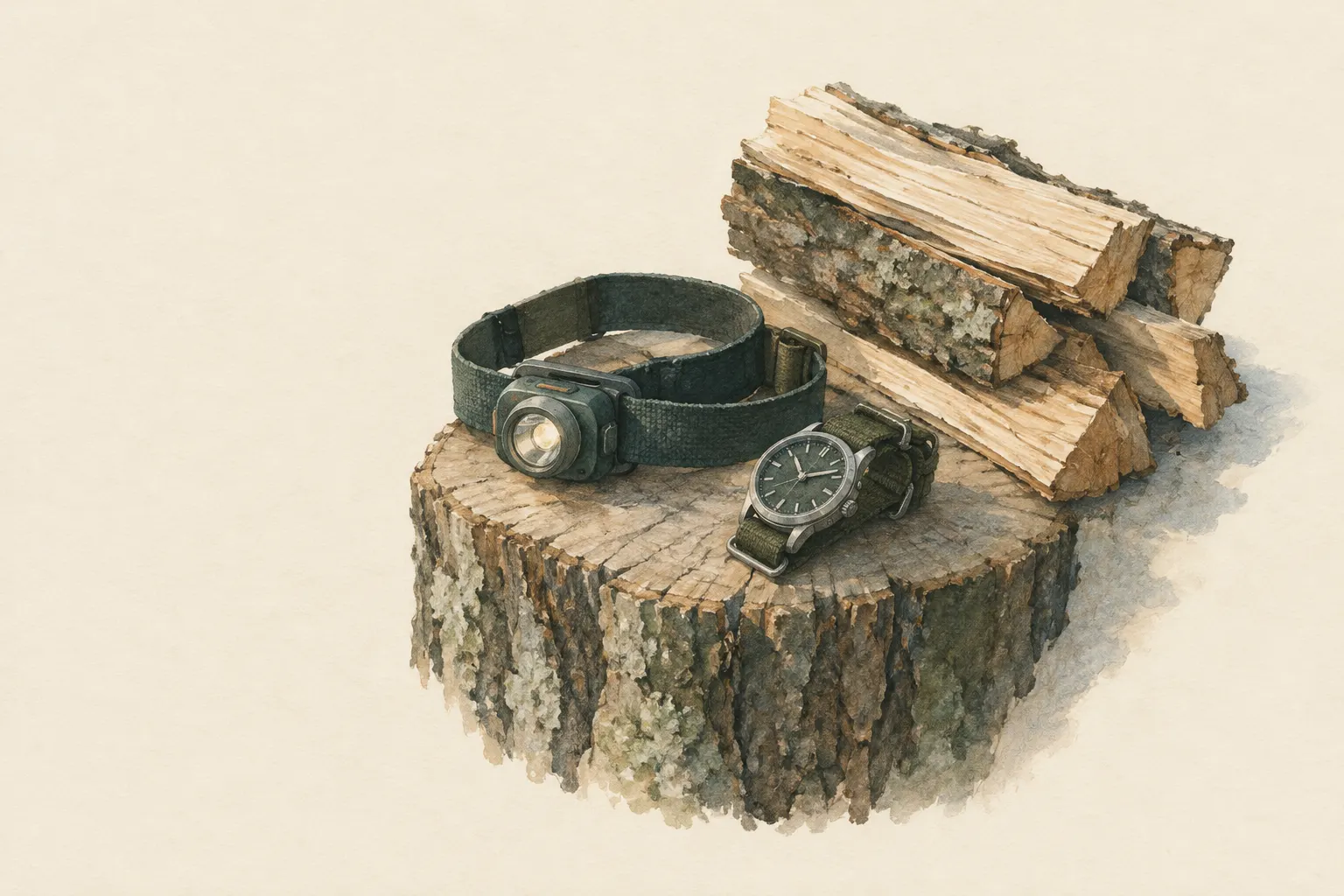
The biggest danger is overestimating the time left. Anyone who still wants to build a shelter, look for wood or find a way down at dusk makes mistakes, gets hurt more easily and gets cold. After sunset it cools down quickly. Plan generously, put on warm clothes before you get cold and always carry a headlamp.
When it makes sense – and when not
The hand method makes sense when you have no watch or do not know the sunset time, and as a quick check on the way. Above all it helps with the decision 'go on or make camp?' – and in an emergency that decision is often more important than any navigation.
It does not work with thick cloud or fog. It is too rough for precise time planning. And anyone who looks up the sunset time before the trip and sets a turnaround time often does not need it at all.
Good to know
Sunset and twilight times for any place and date can be found in calendars, weather services or at the U.S. Naval Observatory. In late autumn and winter the days are short where we live – many emergencies outdoors begin with people being surprised by darkness setting in early.
Bushcraft textbooks advise always building camp with plenty of daylight. Practise the hand method on evenings at home or on holiday and compare with a watch. After a few measurements you will know how much your fingers mean where you live in summer and in winter.
Step by step
Know sunset beforehand
Before the trip, look up when the sun sets and write it down. Fix a turnaround time by which you turn back or make camp at the latest. The hand method is plan B if you have no watch or phone.
- 1
Know sunset beforehand
Before the trip, look up when the sun sets and write it down. Fix a turnaround time by which you turn back or make camp at the latest. The hand method is plan B if you have no watch or phone.
- 2
Measure with your hand
Stretch your arm out fully, hand sideways, fingers together and horizontal, thumb tucked in. Put the bottom edge of your little finger on the horizon and stack hand over hand until the top edge of your fingers covers the sun. Count the fingers. Do not look at the sun!
- 3
Apply the rule of thumb
Roughly: one finger about 15 minutes, one hand of four fingers about an hour. That is an estimate – at our latitudes it differs noticeably depending on the season. Rather count on less time than you think.
- 4
Calibrate your own hand
If you have a watch, measure the number of fingers on the first evening, note the time, and repeat until sunset. That way you know how many minutes one finger really means at this place and in this season.
- 5
Allow for the terrain
Measure to the real horizon behind which the sun will disappear – in the mountains that is a ridge that lies much higher than the flat horizon. In forest and narrow valleys it is already dark while the sun still shines outside. After sunset there is a short twilight, in forest almost none.
- 6
Plan backwards
Think about what you need before dark: a safe spot, shelter, dry wood, water, warm clothes. A shelter from natural materials often takes hours. If, for example, only two hand widths remain, start making camp now instead of walking on.
- 7
Be ready before dark
Put the headlamp, warm clothes and water within reach, collect wood for the whole night and finish the sleeping place while you can still see. Working in the dark takes much longer and is more dangerous.
Common mistakes
- Looking straight at the sun
- Measuring to the flat horizon although a ridge is in front of it
- Taking the rule of thumb as exact
- Only starting camp at dusk
- Going out without a headlamp
Quick view
Materials
Analogue wristwatch
To calibrate your own hand
Only a very rough direction aid – never a substitute for a compass in precise navigation.
Headlamp / flashlight
Always carry one – in case it gets dark after all
Field notebook and pencil
Note the sunset time
Suitable for
- Trip planning without watch or phone
- Deciding whether to go on or make camp
- An emergency where a night outdoors looms
Not suitable for
- Thick cloud or fog
- Precise time planning
- High latitudes in winter, where the sun moves very flat
Prerequisites
- Sun visible or recognisable through thin cloud
- Never look straight at the sun
- Knowing how much time camp, fire and water need
Safety
- The rule of thumb is rough. In valleys, on north slopes and in forest it gets dark much earlier than official sunset. Plan generously and always carry a headlamp.
- After sunset it cools down quickly. Put on warm clothes before you get cold, and have your sleeping place ready while you can still see.
How it works
In the evening the sun sinks steadily towards the horizon. A finger at arm's length covers a small angle in the sky that is similar for everyone, because people with longer arms usually have broader fingers too. How long the sun takes to sink one finger width, however, depends on latitude and season: near the equator it sinks steeply and quickly, at our latitudes more obliquely and slowly, in the far north very flatly. That is why the rule of thumb is only an estimate that you should calibrate yourself with a watch.
Advantages
- Needs nothing but your own hand
- Quick and usable anywhere
- Helps you decide in time
Disadvantages
- Rough estimate
- Depends on place and season
- Not possible with cloud cover
Deep knowledge
Background
The hand method is an old rule of thumb from seafaring and hiking. Sunset and twilight times for any place are published, for example, by the U.S. Naval Observatory; they also show that twilight lasts much longer at high latitudes than near the equator.
Bushcraft textbooks stress building camp with plenty of daylight. If you start too late, you freeze in a half-finished shelter.
Variants
- In the morning
- In the morning it works the other way round: the fingers between horizon and sun roughly show how long the sun has been above the horizon.
- With children
- Children have shorter arms but also narrower fingers – the method works similarly. Let them measure too; it makes the time tangible.
Common mistakes
- Looking straight at the sun
- Measuring to the flat horizon although a ridge is in front of it
- Taking the rule of thumb as exact
- Only starting camp at dusk
- Going out without a headlamp
Limits and risks
- No exact time
- Applies in this form mainly to mid-latitudes
- Does not replace a watch or trip planning
Material alternatives
Derived from material properties: a substitute must have all relevant properties. Observe the notes on the substitute.
- Headlamp / flashlight
- Mobile phone (The battery drains quickly in cold and with continuous screen and GPS use.), Battery lantern / LED light
Results come exclusively from structured entries. No improvised instructions are generated.
Sources
U.S. Naval Observatory: Astronomical Applications Department – sun and moon data, phases of the moon
Sunset and twilight times by place and date
Ray Mears – Hodder & Stoughton (2002): Bushcraft
Making camp with enough daylight
Mors L. Kochanski – Lone Pine Publishing: Bushcraft: Outdoor Skills and Wilderness Survival
Preparing shelter and fire before dark