Skip to content
In an emergencyAustriaEmergency numbers →
SurviveBetter
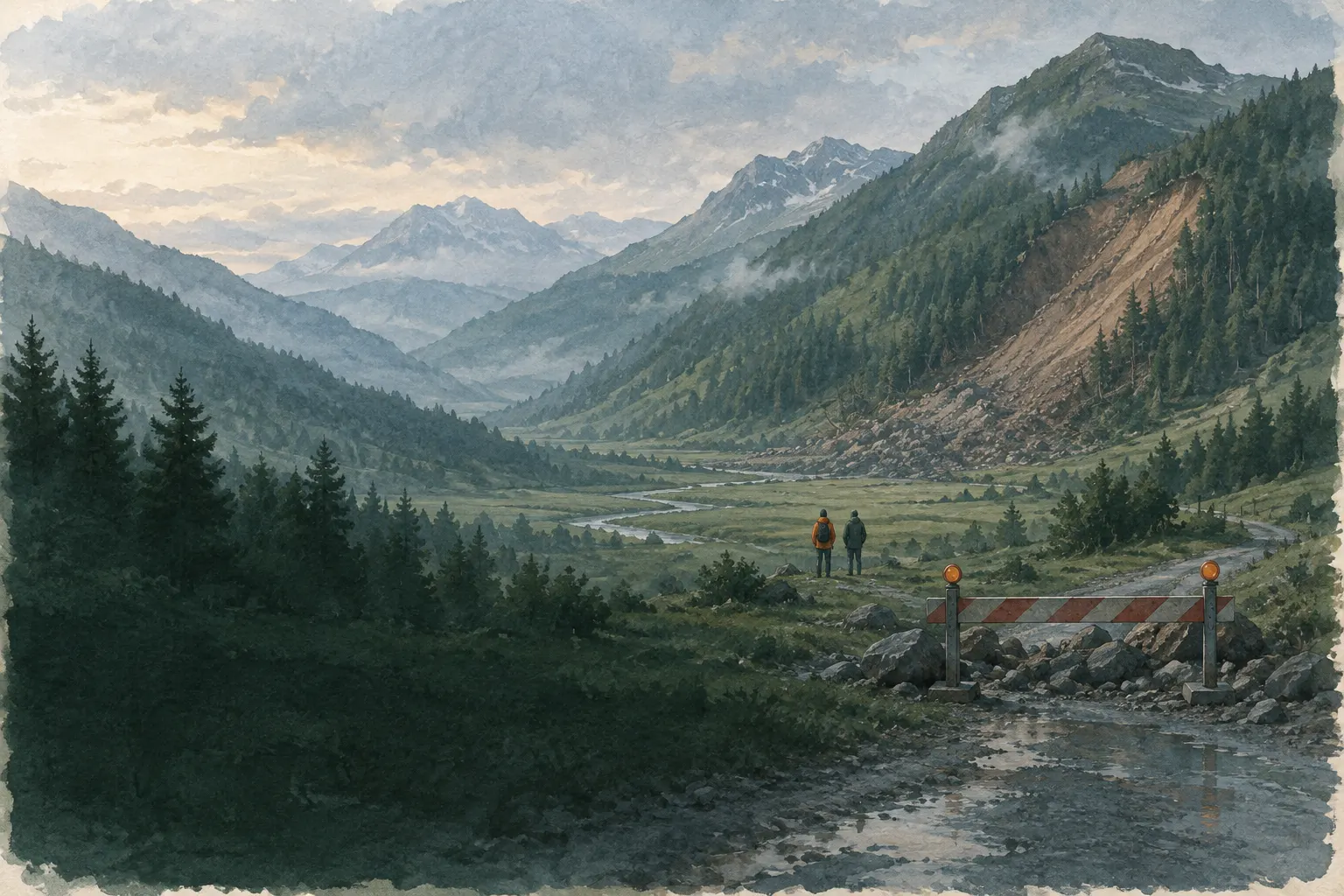
Alpine valley after rain with a fresh landslide scar in the distance and a road barrier in front

The slope is moving – landslide or debris flow

After days of rain something cracks in the woods and the stream suddenly turns brown. Such signs are the only warning – and they are enough if you take them seriously.

First

  1. With warning signs leave the danger zone at once – across the direction of the slide and up and out of valleys and gullies, not down.
  2. Do not stop to look or film.
  3. Call 112 and describe the place as soon as you are safe.
  4. Avoid the area afterwards: further slides are possible.

Call emergency services if

  • A slope has come down or is moving
  • Someone is missing or buried
  • Road, house or utility lines are damaged
  • You are cut off

What is happening

Landslides and debris flows mainly occur after heavy or prolonged rain, during snowmelt, after earthquakes or on slopes that have lost their vegetation, for example through wildfires. Debris flows can move quickly through gullies and valleys.

Ready.gov lists typical warning signs: new cracks in the ground, walls or roads, tilting trees, fences or poles, doors and windows that suddenly stick, unusual sounds such as trees cracking or boulders knocking, and streams that suddenly turn muddy or carry less water despite rain.

Anyone who notices such signs leaves the danger zone at once – not down the valley or gully, but across the possible direction of the slide and onto higher, stable ground. Afterwards: keep your distance, further slides are possible.

This page helps you recognise warning signs and react correctly. Whether a slope is safe is for specialists to judge; warnings and orders from the authorities take priority.

Step by step

The slope is moving – landslide or debris flow – Phase 1 of 4With a warning and continuous rain. Follow warnings on the radio and warning app and obey orders at once. Listen for sounds: cracking, rumbling, knocking. Watch streams: suddenly muddy, more debris, or less water despite rain. Avoid trips through valleys and below steep slopes.
Phase 1 of 4

Phase 1 of 4

With a warning and continuous rain

Follow warnings on the radio and warning app and obey orders at once. Listen for sounds: cracking, rumbling, knocking. Watch streams: suddenly muddy, more debris, or less water despite rain. Avoid trips through valleys and below steep slopes.

The animation shows the key actions of each phase schematically; the text below is what counts.

  1. Phase 1

    With a warning and continuous rain

    • Follow warnings on the radio and warning app and obey orders at once.
    • Listen for sounds: cracking, rumbling, knocking.
    • Watch streams: suddenly muddy, more debris, or less water despite rain.
    • Avoid trips through valleys and below steep slopes.
  2. Phase 2

    Warning signs: leave at once

    • Leave the danger zone at once – do not stop to look.
    • Across the direction of the slide and onto higher, stable ground, not into gullies or down the valley.
    • Warn others: shout, knock on doors.
    • If escape is no longer possible: protect your head and shelter behind something solid.
  3. Phase 3

    In the car

    • Watch for rocks, mud, fallen trees and subsided tarmac.
    • Do not drive over buried roads or through mud – turn around.
    • Avoid bridges over raging streams.
    • Report hazards to 112 or the police.
  4. Phase 4

    Afterwards

    • Keep away from the slide area – further slides and flooding are possible.
    • Call 112: who is missing, exactly where? Do not dig in the debris yourself.
    • Report damaged power, gas and water lines.
    • Only go back into the house once the authorities allow it.

★ Pro tips

What experienced people do differently: proven practice from mountain rescue, fire services, lifeguards and civil protection that beginners rarely know.

  1. Stay awake at night during heavy rain

    Many people are caught by debris flows while asleep. If you live on a slope or by a mountain stream, stay awake at night during heavy, continuous rain, or take turns. If possible, sleep upstairs on the side of the house facing away from the slope.

  2. Short downpours after long rain

    It gets especially dangerous when a short, intense downpour follows days of rain. By then the ground is saturated and cannot take up any more water. That is exactly when to be most alert and to leave sooner rather than later.

  3. Mark and date cracks

    If you find a crack in a wall, floor or path, draw a pencil line at each end, write the date next to it and take a photo. That lets you see over the next days whether it is getting longer or wider. If it grows, call your council or specialists straight away.

  4. After a slide: keep your distance

    Where a slope has slid once, a second slide can quickly follow. Keep away from the edge and the foot of the slide, even if everything seems calm. Also watch for flooding, because slide material can dam streams.

What to watch out for

  • Gullies and stream beds

    Debris flows follow gullies and valleys. Exactly where water flows is most dangerous in heavy rain.

  • Less water in the stream

    If a stream suddenly carries less water despite rain, something may be damming it upstream.

  • After wildfires

    Burnt slopes can start to slide even with moderate rain.

  • Onlookers

    Anyone who stops to film loses time and gets in the way of rescuers.

Common mistakes

  • Dismissing warning signs as coincidence.
  • Fleeing down the valley or into a gully.
  • Driving over buried roads.
  • Digging in the debris for buried people instead of calling 112.
  • Going back into the house before it has been cleared.

Prepare in advance

  • Find out whether your property lies in a hazard zone (hazard maps of the municipality or region).
  • Install a warning app and stay alert in continuous rain.
  • Know escape routes from the house to higher, stable ground.
  • Watch for cracks, tilting walls and sticking doors and ask specialists.
  • Keep a go bag ready.

Special consideration

Out in the mountains
In heavy rain abandon or postpone tours and do not rest in gorges or stream beds.
Children
Do not let children play by streams and slopes while rain and warnings continue.

Sources

Your situation

Where are you?
What do you notice?

Matching entries

0 rules apply

No AI decides here. Every recommendation is based on a visible rule.

Add details about your situation above to get more specific guidance.

Basics for this situation

Why: Always applies to this situation – regardless of your answers.

All rules of this situation (5)
  1. [not active] If What do you notice? = Only a warning, continuous rain

    With continuous rain and a warning stay alert, listen for unusual sounds, watch for changes in streams and follow evacuation orders at once.

  2. [not active] If What do you notice? = Cracks, tilting trees, muddy water, rumbling

    With visible warning signs do not wait: leave the danger area at once and inform the authorities.

  3. [not active] If What do you notice? = Something has already come down

    Keep your distance, do not dig for buried people on your own but call 112 and tell the rescuers exactly where someone is missing.

  4. [not active] If Where are you? = Driving

    On roads in valleys and below slopes watch for rocks, mud and subsided tarmac. Do not drive over buried roads or through mudflows – turn around.

  5. [not active] If Where are you? = On foot in the mountains

    In heavy rain avoid gullies, stream beds and steep, soaked slopes and abandon the tour.