Power banks and power stations: choosing, calculating, using safely
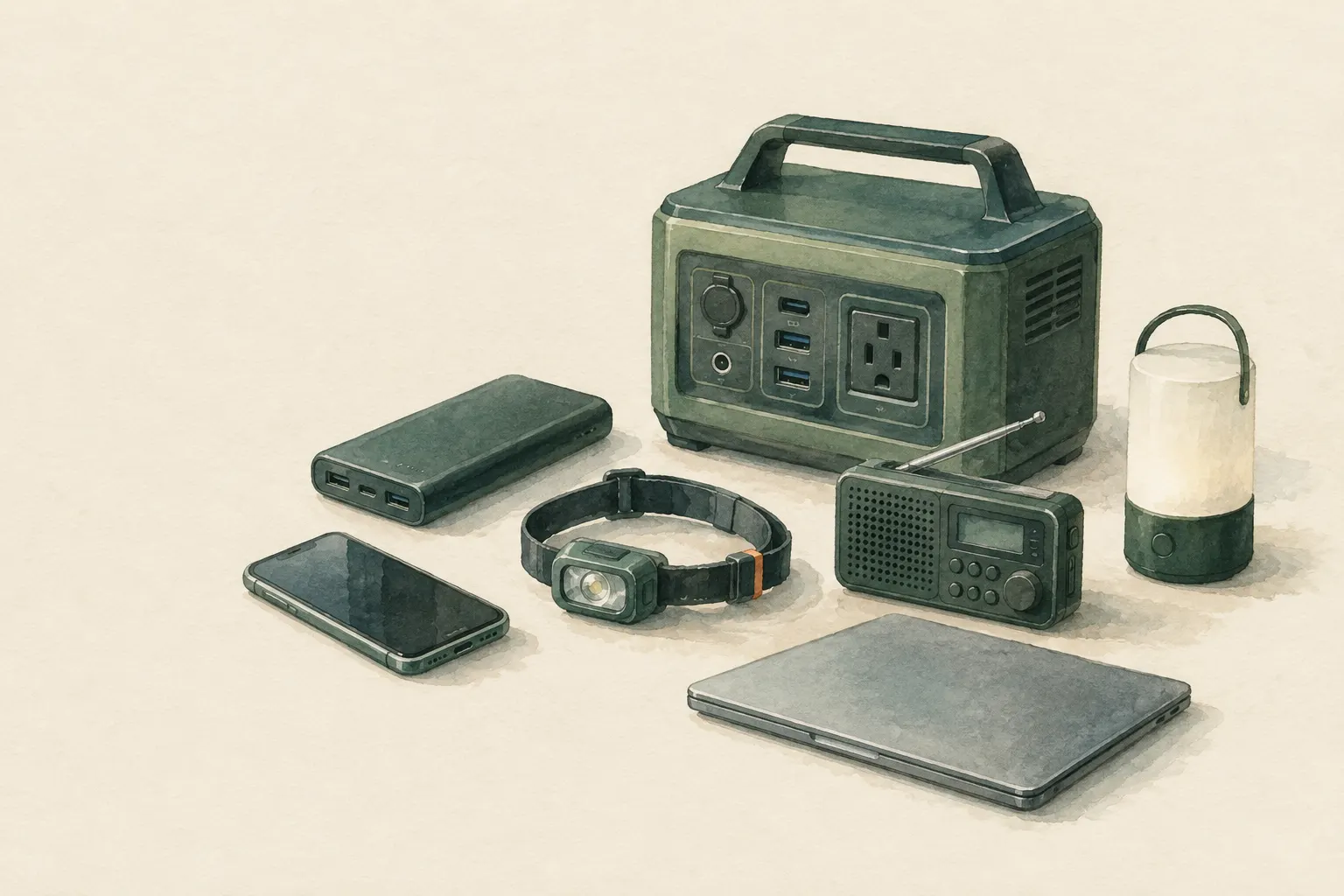
Power banks supply phone, radio and headlamp; portable power stations with a socket can also run a router, laptop or small lamp for hours. What matters is comparing the capacity in watt-hours with the devices' consumption, keeping the batteries charged and charging and storing lithium batteries safely.
- Calculate once, then recharge quarterly
Explained simply
A power bank is a portable battery, roughly the size of a phone. You charge it from a socket beforehand, and during an outage it passes the energy on to a phone, headlamp or radio. A power station is its big sister: a heavy battery box with real sockets, which can also run a laptop, a router or a lamp for a few hours.
How much energy is stored inside is measured in watt-hours. Think of it as a water tank: the watt-hours tell you how big the tank is, and each device draws off a different amount. A fan heater or kettle would suck the tank dry in no time – these batteries are not made for that.
Important for safety: batteries can catch fire if they are damaged or get too hot. Charge them on a surface that does not burn, never under cushions or in full sun. And a power station is never “plugged back” into a house socket.
How it works
Stored energy is measured in watt-hours (Wh). The calculation is simple: a device's power in watts times hours of use gives watt-hours. A 10-watt device runs for ten hours on a 100 Wh store in theory. In practice less is available, because energy is lost when converting the voltage and in the inverter – the part that turns battery power into socket power. Cold reduces usable capacity further.
Power banks are often rated in milliamp-hours (mAh), referring to the voltage of the cells inside, not the voltage at the USB output. To compare them with consumption, convert: watt-hours = mAh × voltage ÷ 1000. For common lithium-ion cells this nominal voltage is usually about 3.6 to 3.7 volts; a 10,000 mAh power bank therefore holds roughly 36 to 37 Wh. Many manufacturers now print the watt-hours directly on the case.
Power stations have a second important figure: the inverter's continuous output in watts. It determines which devices will start at all. If a device needs more power than the inverter can deliver, it shuts off – no matter how full the battery is.
What really matters
Start with a list: which devices should run during an outage, for how many hours a day and for how many days? The power in watts is on the rating plate or in the manual. A made-up example: a 5-watt LED lamp that shines for four hours a day needs 20 Wh per day. Calculate this for each device and add them up. Then plan with a clear margin, because the full printed capacity is never usable.
For a phone and a lamp, one or two power banks are usually enough. For devices with a mains plug you need a power station whose continuous output is higher than the draw of the largest device. Also check the outputs: USB, 12 volts or socket. Where possible, supply devices directly via USB or 12 volts rather than through the socket – this saves conversion losses. Switch the inverter off when you do not need it, because it uses energy even when idle.
A battery only helps if it is charged. Store it as the manufacturer says and recharge it regularly, for example whenever the clocks change. When severe weather is forecast, charge it fully. During an outage: communication and light first, comfort later.
Safety: what to watch out for
Lithium batteries store a lot of energy in a small space. If they are damaged, overheated or charged incorrectly, they can catch fire, and such fires are hard to put out. So charge on a non-flammable surface, not on a bed or sofa, not under cushions and not in full sun. Stop using swollen, damaged or unusually hot batteries and dispose of them properly, for example at a battery collection point.
A power station must never feed into the house wiring, for example through a cable into a wall socket. This endangers line workers on the grid and yourself. Fixed connections to the house wiring are made exclusively by a qualified electrician.
For powered medical devices, do not rely on your own calculations. Clarify with the doctor, care service and device supplier which backup supply is suitable.
When it makes sense – and when not
Battery packs are ideal for communication and light over a few days and for small loads such as a router, laptop or fan. They produce no exhaust, are quiet and may be used indoors. That makes them particularly interesting for flats where a generator cannot be run.
They are unsuitable for electric heaters, kettles, cookers or hair dryers: these devices need so much power that even large stores would be empty after a short time or would not start them at all. A folding solar panel can recharge a power bank or power station during the day, but the output depends strongly on sun, orientation and season.
Good to know
Batteries age even when they are not used. Technical literature on batteries describes how capacity and power delivery depend on temperature and age. A store bought a few years ago therefore often holds less than at the beginning. A test from time to time shows you what it can really still do.
The calculation in this entry is deliberately rough and is meant to give a feel for the order of magnitude. The manufacturer's information on charging, storage and permitted devices always takes precedence.
Step by step
List the need
Which devices, how many hours per day, how many days? Note the power draw (W) from the rating plate or manual.
- 1
List the need
Which devices, how many hours per day, how many days? Note the power draw (W) from the rating plate or manual.
- 2
Rough calculation
Watts × hours = watt-hours per day. Plan with a clear margin because not all of the rated capacity is usable.
- 3
Choose to match
For phone and lamp one or two power banks are usually enough. For mains devices a power station whose continuous output exceeds the draw of the largest device. Check the outputs (USB, 12 V, socket).
- 4
Keep charged
Store according to the manufacturer and recharge regularly, e.g. whenever the clocks change. Charge fully when severe weather is forecast.
- 5
Use sparingly in an outage
Communication and light first, comfort later. Supply devices directly via USB or 12 V where possible – this saves conversion losses. Switch the inverter off when not needed.
Common mistakes
- Calculating as if the printed capacity were all usable
- Storing batteries empty for years
- Fan heater or kettle on a power station
- Leaving it charging on a bed or sofa
Quick view
Materials
Power bank
Do not use damaged or swollen batteries; do not charge while covered.
Portable power station (battery with inverter)
Do not use lithium batteries that are damaged, swollen or overheated.
Charge, operate and store only according to the manufacturer's instructions.
Folding solar charger
For recharging during longer outages
Do not let phones and power banks overheat in direct sun while charging.
Output depends strongly on sun, orientation and season.
Suitable for
- Communication and light over a few days
- Small loads such as router, laptop, fan
- Flats where a generator must not be run
Not suitable for
- Electric heaters, kettles, cookers – consumption too high
- Life-sustaining devices without consulting doctor and device supplier
Prerequisites
- A list of devices that should run during an outage
- Rating plate or manual with power figures
Safety
- Lithium batteries can catch fire if damaged, overheated or charged incorrectly. Charge on a non-flammable surface, not under cushions or in full sun; stop using damaged or swollen batteries and dispose of them properly.
How it works
Stored energy is measured in watt-hours (Wh): a 10 W device runs for ten hours on 100 Wh in theory. In practice less is available because voltage conversion and the inverter have losses and cold reduces capacity. Power banks are often rated in milliamp-hours (mAh) at the cell voltage; Wh = mAh × voltage ÷ 1000. For power stations the inverter's continuous rating also limits which devices will start at all.
Advantages
- No exhaust, usable indoors
- Quiet
- Easy to use
Disadvantages
- Limited amount of energy
- Must be charged beforehand
- Batteries age even when unused
Deep knowledge
Background
Ready.gov recommends having alternative power sources for phones and important devices during outages; the BBK lists charged batteries and power banks as part of preparedness. Battery handbooks such as "Linden's Handbook of Batteries" describe how capacity and power delivery depend on temperature and age.
The calculation here is deliberately rough. Manufacturer instructions on charging, storage and permitted loads take precedence.
Variants
- Recharging with a solar panel
- A folding panel can recharge a power bank or station during the day; output depends strongly on sun, orientation and season.
Common mistakes
- Calculating as if the printed capacity were all usable
- Storing batteries empty for years
- Fan heater or kettle on a power station
- Leaving it charging on a bed or sofa
Limits and risks
- No product recommendations
- No instructions for connecting to house wiring
Sources
Ready.gov – U.S. Federal Emergency Management Agency (FEMA): Power Outages
Alternative power sources for phones and devices during outages
Bundesamt für Bevölkerungsschutz und Katastrophenhilfe (BBK), Deutschland: Ratgeber für Notfallvorsorge und richtiges Handeln in Notsituationen
Charged batteries and power banks as preparedness
Thomas B. Reddy (ed.) – McGraw-Hill: Linden's Handbook of Batteries
Dependence of battery performance on temperature and age