Batteries in the cold
In a battery, chemical reactions supply the current. Cold slows these reactions and raises internal resistance – devices switch off early even though energy is still stored. Once warmed up the battery usually recovers. Lithium-ion batteries should not be charged below freezing. Carry spare batteries close to the body and take devices into the sleeping bag at night.
- 5 minutes reading
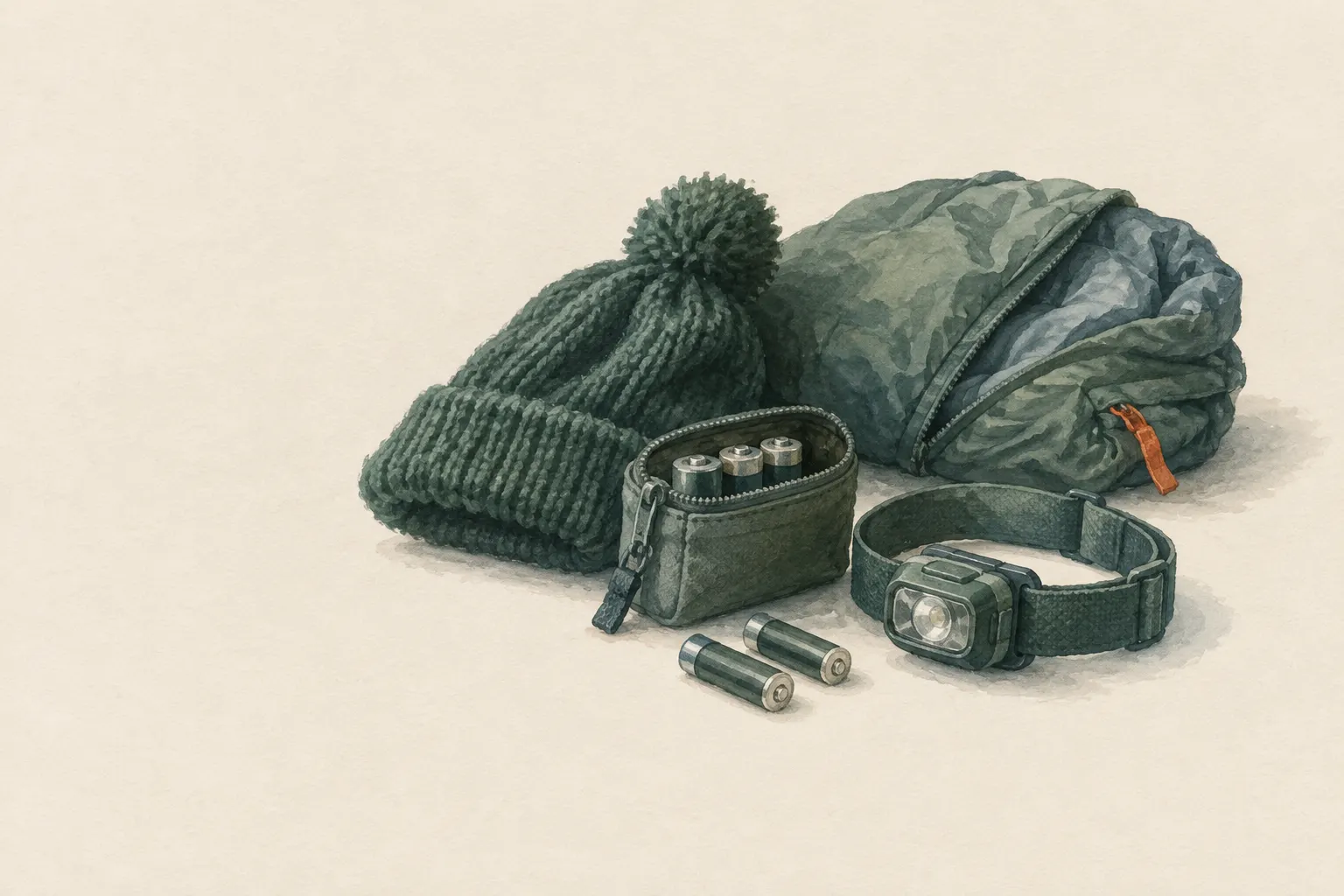
Explained simply
A battery does not contain ready-made electricity. Inside, two different substances are waiting to react with each other. When you switch the device on, they are allowed to, and current flows. As with every chemical reaction: warmth makes it faster, cold makes it slower.
Think of honey. From a warm jar it flows easily; straight from the fridge it only oozes out slowly. In a cold battery the tiny charged particles move just as sluggishly. The device does not get enough current at once and switches off – even though there is still energy inside. When the battery warms up again, it usually works again.
That is why in winter you carry your phone and spare batteries in an inside pocket close to your body and take them into your sleeping bag at night. But: never warm a battery at a fire, on a stove or with hot air. It can be damaged, catch fire or even burst.
How it works
Every battery has two electrodes – a positive and a negative terminal – and between them an electrolyte, a liquid or paste through which charged particles called ions can travel. When a device is connected, chemical reactions take place at the electrodes. The electrons flow outside through the device, the ions inside through the electrolyte. Only both together make a circuit.
Cold slows this process at several points. The reactions at the electrodes get slower, and the electrolyte becomes more viscous, so the ions move with more difficulty. Together this is called higher internal resistance. If the device wants a lot of current at once – for example a phone while transmitting or a bright headlamp – the voltage collapses. If it falls below the limit the device needs, it reports “empty” or switches off.
Most of the stored energy is still there; it just cannot get out fast enough. When the battery warms up again, the internal resistance drops and it delivers current again. That is why it is worth not throwing away cold, apparently empty batteries but warming them and testing them again.
Different kinds of battery
Not every battery reacts the same way to cold. Ordinary alkaline batteries, the most common single-use cells, lose a lot of performance in the cold. Lithium single-use batteries are considered much more cold-tolerant and are therefore often chosen for winter trips. Rechargeable nickel-metal hydride cells lie somewhere in between. Which types a device accepts is in its manual – some devices are not designed for every battery type.
Lithium-ion batteries, as found in phones, power banks and many headlamps, also deliver less in the cold. For them an important additional rule applies to charging: they should not be charged below freezing. Metallic lithium can then build up on the negative electrode instead of being stored properly. This damages the battery permanently and can make it dangerous.
Manufacturers state their own temperature ranges for charging and using their batteries. These specifications always take precedence over general rules of thumb.
What really matters
The simplest heat source is you. Carry your phone, spare batteries and power bank in an inside pocket, not in the outer pocket of the rucksack. At night they come into the sleeping bag, ideally in a small pouch so nothing gets lost. With headlamps that have a separate battery pack on a cable, you can wear the pack under your jacket.
The swap principle helps: two sets of batteries, one working in the device and one warming on your body. When the device dies, swap the sets. Also save energy: dim the screen, switch off unnecessary functions, and put the phone in airplane mode in areas without coverage, because the constant search for a network uses a lot of power.
When you bring a cold device into a warm room, moisture condenses on it – inside too. So let it warm up slowly in a sealed bag, and only charge a cold battery once it has reached room temperature.
Safety: what to watch out for
Batteries contain a lot of energy in a small space. If a battery gets too hot, it can react uncontrollably, catch fire or burst. So never warm them at a campfire, on a stove, at a cooker, with a hair dryer or in a microwave. Body heat is slow but safe.
Damaged, dented or swollen batteries no longer belong in a device or on a charger. Put them in a safe place away from flammable things and take them to a collection point. Never open a battery and do not try to repair it.
Loose batteries in a pocket can short-circuit against keys or coins and get hot. So keep spare batteries in a box or with their terminals covered. And remember that great heat also does harm: a battery left in a car in the summer sun ages faster.
Typical situations
On a winter trip the phone is often map, lamp and emergency phone all at once. Precisely when you need it most – in cold, wind and darkness – its battery is at its weakest. Knowing this, you plan for it: keep the phone warm, carry a power bank and pack an independent lamp as well as a paper map.
During a power cut in winter the home also gets cold quickly. Torches and radios in a cold room or car run for less time than expected. So keep your emergency batteries in a place that does not get cold, and check them regularly.
Step by step
Carry close to the body
Carry the phone, spare batteries and power bank in an inside pocket; take them into the sleeping bag at night.
- 1
Carry close to the body
Carry the phone, spare batteries and power bank in an inside pocket; take them into the sleeping bag at night.
- 2
Swap rather than discard
Swap cold, apparently empty batteries for warm ones and rewarm the cold ones on your body – they often still deliver power.
- 3
Choose chemistry deliberately
Choose battery types suitable for cold according to the manufacturer; check the device manual for permitted types.
- 4
Avoid condensation
Bring cold devices into warm rooms in a sealed bag and let them warm up slowly there.
Common mistakes
- Throwing away cold batteries as empty
- Warming a battery at a stove
- Charging in a tent in frost
- Carrying the phone in an outer pocket
Quick view
Materials
Spare batteries
Store cool and dry, observe the expiry date; keep button cells out of children's reach.
Power bank
Do not use damaged or swollen batteries; do not charge while covered.
Headlamp / flashlight
Suitable for
- Winter trips
- Winter power outages
- Phone as emergency device in the cold
Not suitable for
- Repairing or opening batteries
Prerequisites
- None
Safety
- Do not charge lithium-ion batteries below freezing; let them reach room temperature first. Manufacturer instructions take precedence.
How it works
Batteries convert chemical energy into electrical energy as ions move through an electrolyte and react at the electrodes. In the cold these processes slow down, internal resistance rises and the voltage collapses under load. The device reports "empty" although the energy is still there. Charging lithium-ion batteries in the cold can deposit metallic lithium on the anode, which permanently damages the battery and can make it dangerous. Different chemistries react differently: lithium primary cells are considered more cold-tolerant than alkaline cells.
Advantages
- Simple habits greatly extend run time
Disadvantages
- Body heat is limited
- Different chemistries behave differently
Deep knowledge
Background
Battery engineering references such as "Linden's Handbook of Batteries" describe how temperature affects capacity, internal resistance and charging behaviour of different battery chemistries. Manufacturers specify their own charging temperature ranges for lithium-ion batteries.
In an emergency the phone is often the most important device; its run time in the cold depends heavily on how warm you keep it.
Common mistakes
- Throwing away cold batteries as empty
- Warming a battery at a stove
- Charging in a tent in frost
- Carrying the phone in an outer pocket
Limits and risks
- No product or run-time figures
Material alternatives
Derived from material properties: a substitute must have all relevant properties. Observe the notes on the substitute.
- Headlamp / flashlight
- Mobile phone (The battery drains quickly in cold and with continuous screen and GPS use.), Battery lantern / LED light
Results come exclusively from structured entries. No improvised instructions are generated.
Sources
Thomas B. Reddy (ed.) – McGraw-Hill: Linden's Handbook of Batteries
Temperature behaviour of battery chemistries, charging in the cold