Ski areas off-piste
A few metres beside the marked run, uncontrolled terrain begins: no avalanche control, no patrol checks, rocks, gullies and tree wells. Anyone who wants to ride there needs avalanche training, rescue equipment, the current avalanche bulletin and, at first, a mountain guide. Closed runs and areas are off-limits.
- Avalanche course, practice with rescue gear, trip planning
Explained simply
A ski run is like a well-kept, supervised playground: the snow is groomed smooth every night, ski patrol checks the slopes, and dangerous avalanches are deliberately set off when necessary before anyone rides there. Just a few metres to the side, all that stops. There the snow lies as wind and weather have shaped it.
In uncontrolled terrain avalanches can release, rocks can be hidden under the snow and deep holes can form in the snow around trees. Being close to the lift does not make it safer – avalanches do not care how close the run is.
The most important point: nobody rides off-piste without an avalanche course, rescue equipment, a partner and the current avalanche bulletin. At first you ride with a mountain guide. And closed runs are always off-limits.
How it works
A snowpack consists of many layers, created anew with every snowfall, every windy spell and every temperature change. Some layers are firm, others loose and weak. When a firm, cohesive slab of snow sits on a weak layer, it can break away and slide as a slab avalanche. Wind moves snow and deposits it as wind slab in hollows and behind ridges – often exactly where the powder looks most tempting.
Such an avalanche is often triggered by the extra weight of a person, and often by the victim or their own group. Avalanches typically release on steep slopes, and there are many of them beside the runs. Being close to the lifts creates a false sense of safety; terrain near the runs follows the same laws as a ski tour in the high mountains.
Runs, by contrast, are groomed, checked and, if necessary, secured by avalanche blasting. That is why closures must be taken seriously: they have reasons such as planned blasting, grooming machines with winch cables that are barely visible in the snow, or acute avalanche danger.
Training, guiding and the bulletin
We strongly recommend: before your first day off-piste, take an avalanche course with an alpine club, a mountain school or mountain guides, and practise companion rescue every season. Ride your first days in open terrain with a certified mountain guide or a qualified local guide, and learn to assess terrain along the way. No text can replace this experience.
Read the official avalanche bulletin before every day. The European Avalanche Warning Services use a five-level danger scale. The bulletin also names the typical avalanche problems, such as wind slab or persistent weak layers, and the particularly dangerous aspects and elevations. Adapt your plan accordingly – and hold back when the bulletin and your gut feeling do not match.
Other riders' tracks are not a sign of safety. A slope can carry many tracks and still break under the next rider. What decides is what the bulletin says and what trained eyes recognise in the terrain.
Gear and materials
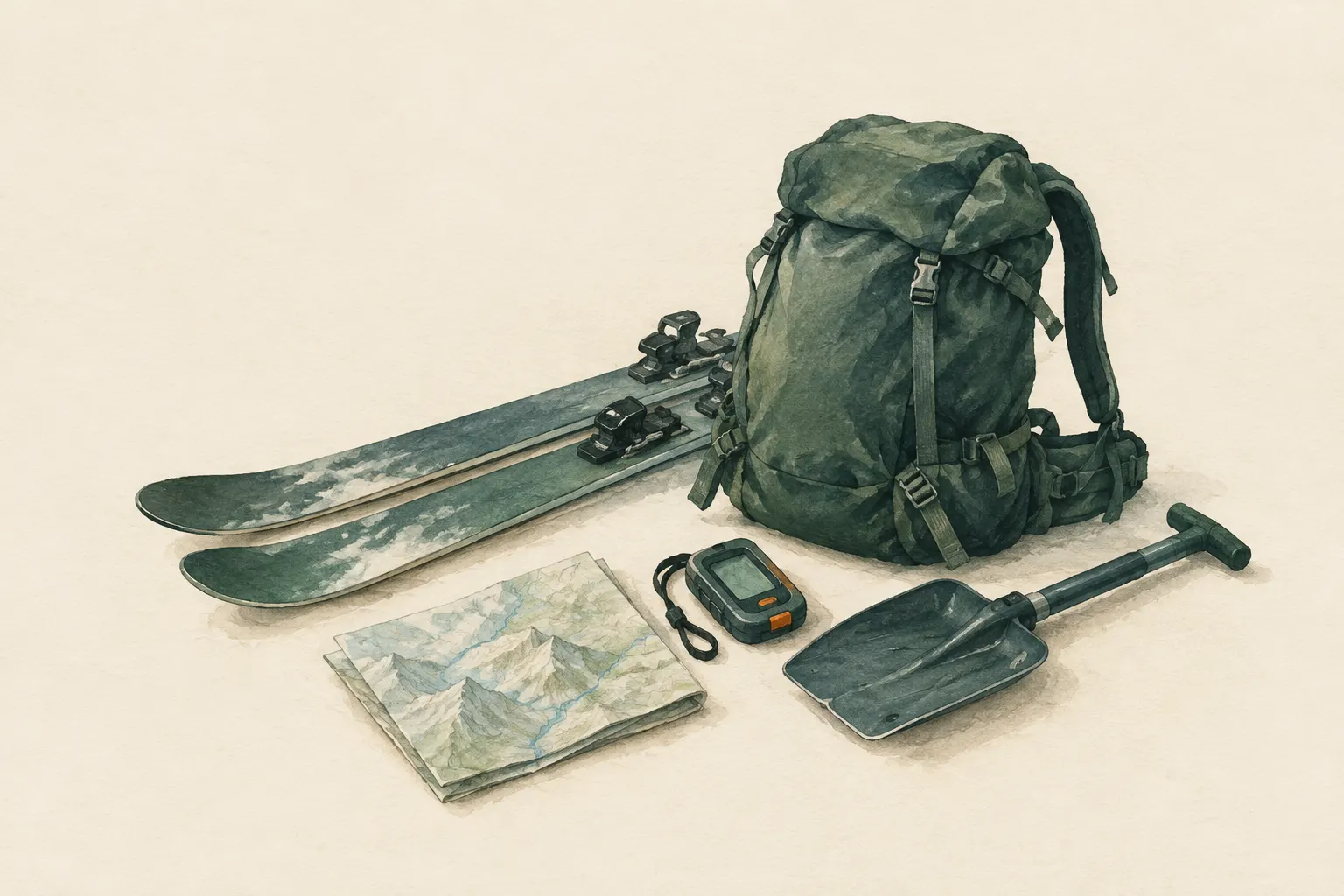
The basic kit is an avalanche transceiver, an avalanche shovel and a probe – carried by every person in the group. The transceiver sends a signal that partners use to locate a buried person; the probe shows the exact position and depth, and the shovel is for digging out. Without all three items and without practised partners, the equipment is useless.
Before setting off, the group checks that all transceivers are switched on and transmitting. The phone is charged and the ski patrol's emergency number is saved. Also check beforehand whether your insurance covers off-piste rescues.
Safety: what to watch out for
If someone is buried, every minute counts. Survival chances fall quickly, and professional rescue often takes too long. That is why companion rescue by your own group is so important – and why it must be practised. At the same time, alert the local emergency number (112 in the EU) or the ski patrol.
On steep slopes ride one at a time and regroup in spots outside possible avalanche paths, for example on ridges or far enough away from the slope's runout. Keep visual contact. That way the whole group is never buried in an emergency, and there is always someone who can search.
In deep snow, hollows can form around trees, known as tree wells. Anyone who falls in head first cannot free themselves and can suffocate. Keep away from trees and stay within sight of your partner. Never ride closed runs or areas.
When it makes sense – and when not
Off-piste is for experienced, trained skiers and snowboarders who ride confidently in all snow types. Children and beginners do not belong in uncontrolled terrain, and a spontaneous detour without equipment is never a good idea – not even „just for a moment“.
Guided freeride days are a good way to get to know the terrain. Anyone who later wants to go ski touring outside ski areas additionally needs route planning, navigation and uphill technique. This text gives no avalanche assessment and replaces neither a course nor guiding – it explains why both are indispensable.
Step by step
Get trained
Take an avalanche course with an alpine club, mountain school or guides and practise companion rescue every season.
- 1
Get trained
Take an avalanche course with an alpine club, mountain school or guides and practise companion rescue every season.
- 2
Read the bulletin
Understand the danger level, avalanche problems and particularly dangerous aspects and elevations, and adapt the plan accordingly.
- 3
Check gear
Avalanche transceiver switched on and checked, shovel and probe in the pack, phone charged.
- 4
Start with a guide
Ride your first off-piste days with a mountain guide and learn terrain assessment.
- 5
Ride one at a time, regroup in safe spots
On steep slopes ride one at a time, regroup in spots outside possible avalanche paths, keep visual contact.
Common mistakes
- Taking other people's tracks as a sign of safety
- Going just briefly beside the run without equipment
- Riding closed areas
- Everyone entering a slope at once
- Not reading the bulletin
Quick view
Materials
Avalanche transceiver
Only effective with training and regular practice; always together with shovel and probe.
Battery and function check before every trip.
Snow shovel
Always take it inside when digging a snow shelter.
Mobile phone
The battery drains quickly in cold and with continuous screen and GPS use.
Do not plan on it as your only means of navigation or emergency calls.
Suitable for
- Experienced, trained skiers and snowboarders
- Guided freeride days
Not suitable for
- Spontaneous detours without equipment
- Children and beginners
- A substitute for an avalanche course
Prerequisites
- Avalanche course and regular companion rescue practice
- Confident riding in all snow types
- Reading the avalanche bulletin
Safety
- In deep snow, hollows can form around trees into which you can fall head first and suffocate. Keep away from trees and stay within sight of your partner.
- In an accident, alert the local emergency number (112 in the EU) or the ski patrol immediately. Check insurance cover for off-piste rescues beforehand.
How it works
Runs are groomed, checked and, if necessary, secured by avalanche blasting. Beside the run the snow lies as wind, sun and temperature have shaped it – with wind slabs, weak layers and hidden obstacles. Being close to the lifts creates a false sense of safety; avalanches in terrain near the runs follow the same laws as on ski tours.
Advantages
- Lifts shorten the way to help
- Training and guiding are widely available
Disadvantages
- Deceptive closeness to the run
- High avalanche risk without control
Deep knowledge
Background
The European Avalanche Warning Services (EAWS) define the five-level avalanche danger scale used in the bulletins. The International Commission for Alpine Rescue (ICAR) publishes recommendations on avalanche rescue and rescue equipment.
"Mountaineering: The Freedom of the Hills" covers snow science and avalanche danger as the basics for any travel in uncontrolled snow terrain.
Variants
- Ski touring
- Ski tours outside ski areas additionally require route planning, navigation and uphill technique – see avalanche terrain.
Common mistakes
- Taking other people's tracks as a sign of safety
- Going just briefly beside the run without equipment
- Riding closed areas
- Everyone entering a slope at once
- Not reading the bulletin
Limits and risks
- No avalanche assessment
- No substitute for a course and guiding
Material alternatives
Derived from material properties: a substitute must have all relevant properties. Observe the notes on the substitute.
- Mobile phone
- Headlamp / flashlight, Battery lantern / LED light
Results come exclusively from structured entries. No improvised instructions are generated.
Sources
European Avalanche Warning Services (EAWS): European Avalanche Danger Scale
Avalanche danger scale and bulletins
ICAR – International Commission for Alpine Rescue: International Commission for Alpine Rescue (ICAR) – recommendations and information (organisation website)
Recommendations on avalanche rescue and rescue equipment
The Mountaineers Books (2017): Mountaineering: The Freedom of the Hills, 9th edition
Snow science and avalanche danger
European Commission: 112 – the European emergency number
European emergency number 112