Emergency sheet for babysitters, guests and caregivers
Whoever is minding the children, caring for a relative or staying as a guest does not know the family's emergency plan. A one-page sheet in a fixed place – address, emergency number, contacts, allergies and medication, escape route, meeting point, shut-offs – makes them able to act within minutes.
- 30 minutes, update when things change
Explained simply
When a babysitter, grandma or a guest is at your place, they do not know your home as well as you do. They might not even know the exact address. In an emergency that is a problem: whoever calls the fire service has to be able to say where to come.
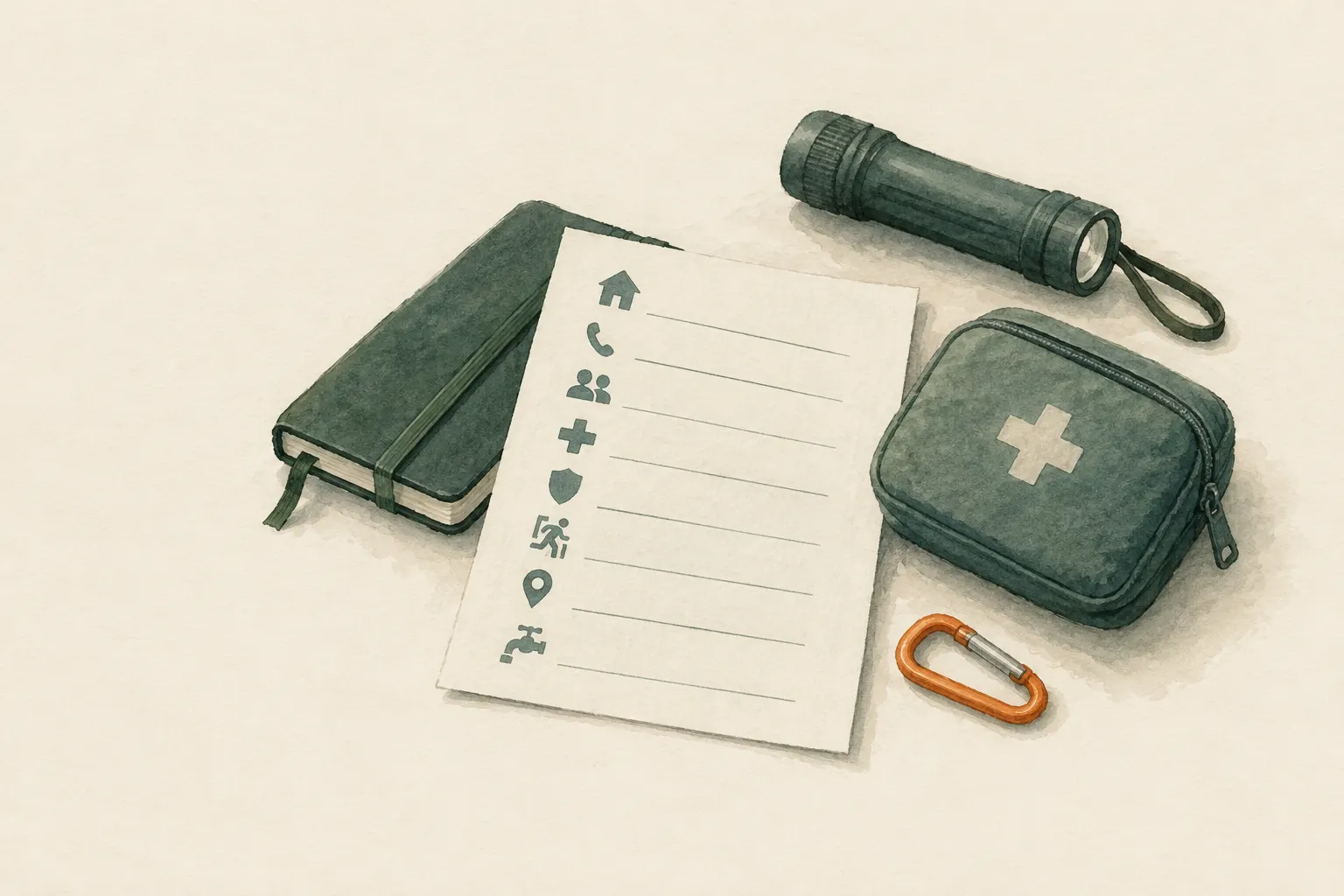
That is why there is the emergency sheet. It is a single sheet of paper in a fixed place, for example on the inside of a kitchen cupboard door. Everything important is on it at a glance: at the top the emergency number and the address, then the parents' phone numbers, who has which allergy, where the torch is and where to meet outside if everyone has to leave the house.
The most important thing: in a life-threatening situation call the emergency number first (112 in the EU) and only then the parents.
How it works
Families know countless things without thinking about them: where the fire extinguisher hangs, which key opens the front door, which child cannot have nuts. For a guest all of this is unknown. Under stress hardly anyone thinks clearly, and that is exactly when this knowledge is missing. The sheet puts it on paper so it is available without asking and without a phone.
The fixed order is the core: emergency call first, then people, then the house. At the very top is the emergency number and below it the full address with floor, doorbell name and a landmark or cross street. That way it can simply be read out in an emergency. Below follow the names and ages of the children or people being cared for, allergies, medication and where it is kept, doctors and the phone numbers of both parents and a backup person.
The third part is about the house: escape route and meeting point outside, fire extinguisher, torch, first-aid kit, fuse box and water shut-off. Finally come the house rules: who may collect the children, which pets there are and what applies in a power cut – for example a torch instead of candles.
What really matters
The address is the most common blind spot. Guests and babysitters often arrive by car or with navigation and never memorised the house number. Whoever calls the emergency number is first asked where the emergency is. Without the address, valuable minutes are lost. That is why it sits directly below the emergency number, clearly legible and complete.
Allergies and medication belong on the sheet in writing, not just in a quick chat at the door. What you say between putting on your coat and saying goodbye is quickly forgotten. But the sheet contains no medical instructions. If a child needs emergency medication or a medical device, the caregiver must be instructed in person, as the doctor specifies. A note does not replace that training.
The sheet needs a date. Phone numbers change, medication is added or stopped, a child gets older. Change the sheet as soon as something changes, and write the date of the last update on it. An outdated sheet can be misleading in an emergency.
Safety: what to watch out for
The top rule on the sheet is: in a life-threatening situation call the local emergency number first (112 in the EU), then the parents. Many babysitters would call the parents first out of uncertainty – and lose time doing so. Say this rule out loud on the first visit too, so it is clear.
A simple order helps with the emergency call: where did it happen? What happened? How many people are affected? Then answer questions and do not hang up yourself until the dispatcher ends the call. These points can be written small below the address.
The sheet contains personal data. Do not post it where it can be read through a window or from the front door, and ask guests not to take it with them or photograph and pass it on after the visit. A spot on the inside of a cupboard door or in a clear sleeve in the kitchen is usually ideal.
The quick walk-through
A sheet is good, a walk-through together is better. On the first visit take five minutes and show the person the exits, the extinguisher, the torch and the first-aid kit. Also show how the front door opens from inside when it is locked – in many flats this is not obvious.
For people caring for someone who needs care, further points are added: which aids there are, how the person being cared for communicates, how to reach the care service and what to do with powered devices in an outage. These points are clarified beforehand with the care service or the doctor.
Step by step
Header
Emergency number, full address with floor and doorbell, nearest cross street or landmark.
- 1
Header
Emergency number, full address with floor and doorbell, nearest cross street or landmark.
- 2
People
Name and age of each child or person cared for, allergies, medication and where it is kept, family doctor or paediatrician, phone numbers of both parents and a backup person.
- 3
House
Escape route and meeting point outside, location of extinguisher, torch, first-aid kit, fuse box and water shut-off.
- 4
House rules
Who may pick up, which pets there are, what to do in a power outage (no candles, use the torch).
- 5
Quick walk-through
On the first visit show exits, extinguisher and torch together.
- 6
Keep it current
Change immediately for new medication, numbers or a move; write the date on the sheet.
Common mistakes
- Address missing – guests often do not know it
- Only digital on the parents' phones
- Allergies only mentioned verbally
- Outdated phone numbers
Quick view
Materials
Document folder (waterproof)
Or a clear sleeve in a fixed place
Store securely – contains sensitive personal data.
Headlamp / flashlight
Torch in a known place
Suitable for
- Babysitters and grandparents
- Care workers and home helps
- Guests and home swaps
Not suitable for
- A substitute for instruction in medical devices or emergency medication – that needs personal training
Prerequisites
- A family emergency plan
- Current contact details and health information
Safety
- At the very top: in a life-threatening situation call the local emergency number (112 in the EU) first, then the parents. The full address directly below so it can be read out under stress.
- The sheet contains personal data. Do not post it where it is visible from outside, and do not pass it on after the visit.
How it works
In an emergency outsiders lack exactly the knowledge the family takes for granted: the exact address, where the extinguisher hangs, which child has an allergy. A sheet with a fixed order – emergency call first, then people, then the house – answers the most urgent questions without a phone.
Advantages
- Fast, correct action by outsiders
- Reassures parents and caregivers
Disadvantages
- Needs maintaining
- Contains sensitive data
Deep knowledge
Background
Ready.gov recommends writing down emergency contacts and including caregivers in the family plan; the German BBK guide also advises keeping a list of important phone numbers.
The sheet adds to the emergency folder a short version for people who are only temporarily in the household.
Variants
- For people needing care
- Add aids, communication needs, the care service and what to do with powered devices during an outage.
Common mistakes
- Address missing – guests often do not know it
- Only digital on the parents' phones
- Allergies only mentioned verbally
- Outdated phone numbers
Limits and risks
- No medical instructions
- Does not replace training for emergency medication
Material alternatives
Derived from material properties: a substitute must have all relevant properties. Observe the notes on the substitute.
- Document folder (waterproof)
- Tarp, Plastic sheet / large bin bag (Tears easily; never pull over the head (suffocation risk).), Emergency blanket (Tears easily once punctured; short-term shelter only.), Rain poncho (When used as a shelter, it no longer protects your body from rain.), Bivy bag (Never fully close off the face.), Tent (Do not cook or heat inside the tent (fire and carbon monoxide danger).), Heavy-duty bin bag (large) (Suffocation risk: never pull plastic bags over the head or face and keep them away from small children.), Group shelter bag (Airtight – ventilate regularly.)
- Headlamp / flashlight
- Mobile phone (The battery drains quickly in cold and with continuous screen and GPS use.), Battery lantern / LED light
Results come exclusively from structured entries. No improvised instructions are generated.
Sources
Ready.gov – U.S. Federal Emergency Management Agency (FEMA): Make A Plan
Written emergency contacts, including caregivers
Bundesamt für Bevölkerungsschutz und Katastrophenhilfe (BBK), Deutschland: Ratgeber für Notfallvorsorge und richtiges Handeln in Notsituationen
List of important phone numbers