Fire piston (compression fire lighting)
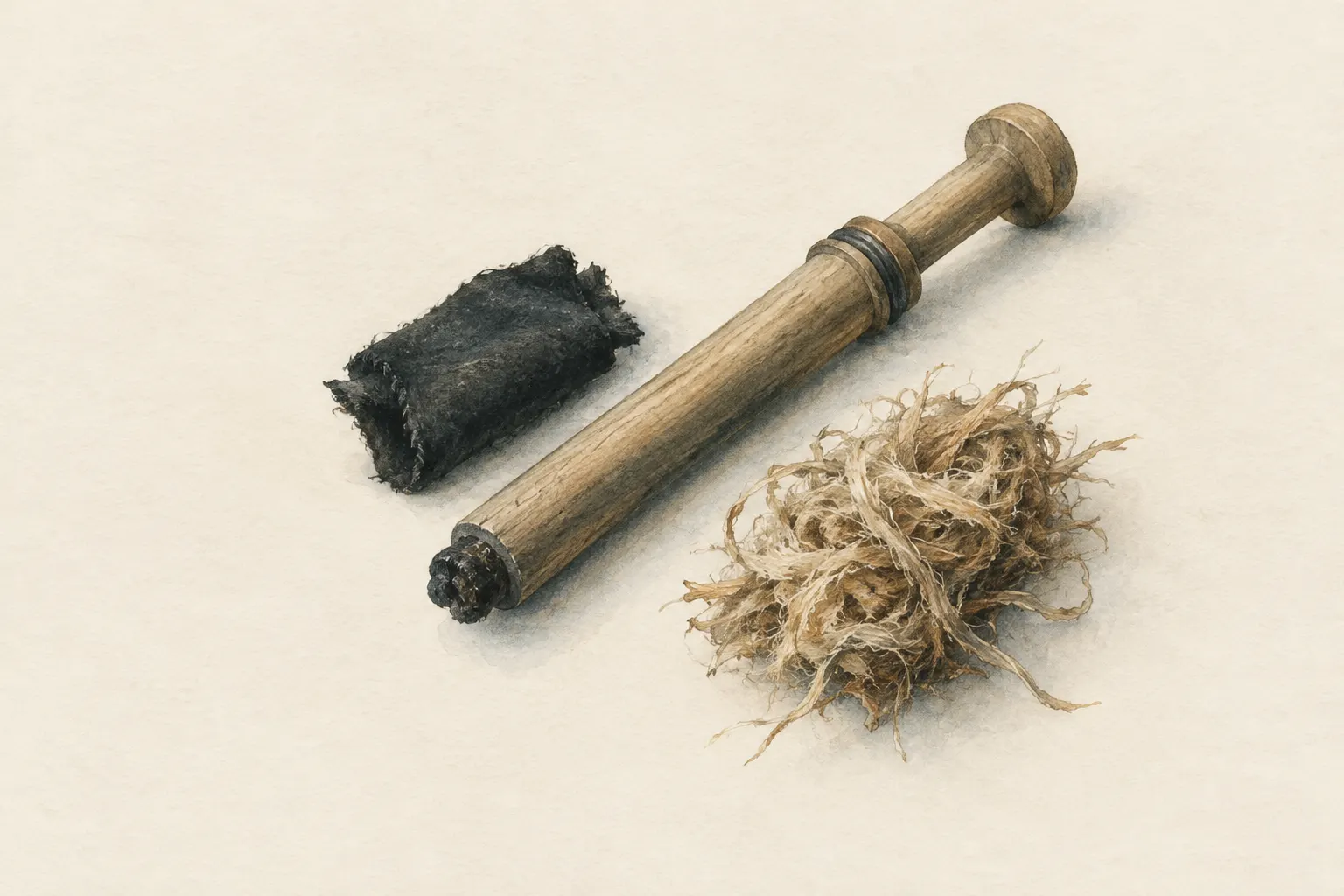
A fire piston is a narrow cylinder closed at one end with a well-sealed piston. When the piston is driven in with a strong, fast push, the trapped air heats up so much that a piece of char cloth in the piston tip begins to smoulder. The ember is then blown to flame in a tinder bundle, as with other ember methods.
- A few strokes with practice; the seal and char cloth must be prepared
Explained simply
Have you ever used a bicycle pump and noticed that it gets warm at the bottom? That is exactly the secret of the fire piston. When you squeeze air together very quickly, it gets hot.
A fire piston is a thick little tube closed at the bottom and a rod that fits exactly inside it. On the tip of the rod sits a small piece of char cloth – charred cotton fabric that starts to glow from just a little heat. If you drive the rod in with a strong, fast push, the air in the tube gets so hot for a moment that the char cloth starts to glow.
That is not a flame yet, though: you have to put the tiny ember into a nest of dry material and blow on it gently. And: never push against your hand or leg, because the piston can slip.
How it works
Air is made of tiny particles that constantly fly around. If you push them into a smaller space, the air gets warmer. If this happens slowly, the heat has time to flow into the walls of the cylinder and hardly anything happens. If it happens in a flash, the heat stays trapped in the air and the temperature rises sharply for a moment. Physicists call this approximately adiabatic compression.
The same effect ignites the fuel in a diesel engine – there is no spark plug there, only strongly compressed, hot air. In a fire piston the heat spike is very short. It is only enough for material that smoulders exceptionally easily, such as char cloth. Ordinary natural tinder such as dry grass usually does not catch.
For this to work, no air may escape past the piston during the push. That is why the piston has a seal, usually a rubber ring or a greased string. If it is dry, dirty or damaged, air escapes and it does not get hot enough.
What really matters
First, speed: a single, fast, decisive push all the way down is better than several half-hearted ones. Slow pressing does not create enough heat. Second, pulling out immediately: there is hardly any oxygen at the bottom of the cylinder, so the fresh ember is smothered if the piston stays in too long.
Third, the char cloth: it must be dry and thoroughly charred and sit firmly in the small recess at the piston tip without sticking out over the edge. Fourth, the seal: a simple test shows whether it is good. Push the piston in a little way and let go – if it springs back, the air is held tight. If it slides in without resistance, the seal needs re-greasing or replacing.
Fifth, preparation: the ember is tiny. The tinder bundle and thin kindling must be ready before you push at all. If you only start gathering afterwards, you will lose the ember. A thin sliver of wood is handy for picking it out.
When it makes sense – and when not
The fire piston is a fascinating piece of hands-on physics and a nice bushcraft exercise. It works without sun, even in the cold, and uses nothing except char cloth. As an additional ignition source alongside a lighter and ferro rod, it can be a supplement.
It is not suitable as the only ignition source in an emergency. Without dry char cloth it hardly works, a broken or dried-out seal makes it useless, and it produces only an ember, not a flame. Lighters, matches and ferro rods are simpler and more reliable – they always go into your pack first.
Safety: what to watch out for
The push takes force, and the piston can slip sideways. So brace the cylinder on a firm surface, such as a tree stump or stone, or hold it in a closed fist. Never push against your palm, thigh or stomach.
For the seal, use only the grease recommended by the manufacturer. Never put petrol, oil or any other fuel liquid into the cylinder – that is dangerous and unnecessary. As with every fire: check the local rules and wildfire danger beforehand, keep extinguishing water ready and cool burns immediately with cool, running water.
Good to know
Fire pistons are described from parts of Southeast Asia. In the 19th century they were also known in Europe as a physics demonstration device to show that compression heats air. Today they are mainly popular with bushcraft enthusiasts.
They are made of wood, horn, metal or plastic. For beginners, ready-made models with a rubber-ring seal are the easiest. If you try a fire piston with children, treat it as a supervised physics experiment – the ember is real and hot.
Step by step
Prepare nest and wood
Form the tinder bundle and lay out kindling. The ember in the piston is tiny and must be used straight away.
- 1
Prepare nest and wood
Form the tinder bundle and lay out kindling. The ember in the piston is tiny and must be used straight away.
- 2
Load the char cloth
Press a small piece of char cloth into the recess in the piston tip. It should sit firmly but not stick out over the edge.
- 3
Check the seal
Insert the piston a little way and let go: if it springs back, the seal is good. If it slides in without resistance, re-grease or replace the seal.
- 4
Push hard and fast
Brace the cylinder and drive the piston all the way in with a single, fast, forceful push. Slow pressing does not create enough heat.
- 5
Withdraw immediately
Pull the piston out quickly straight away so the ember gets oxygen. If the char cloth is glowing, blow on it gently.
- 6
Transfer to the nest
Pick the ember out of the tip with a wood sliver, place it in the tinder bundle and blow it to flame.
Common mistakes
- Pushing too slowly
- Leaving the piston in too long after the stroke so the ember is smothered
- Damp or under-charred char cloth
- A dried-out or dirty seal
- No prepared tinder bundle
Quick view
Materials
Fire piston
Maintain the seal.
Needs char cloth.
Char cloth (charred cotton)
Store dry in a tin.
Make only outdoors.
Tinder
Loose, dry tinder bundle
Carry in waterproof packaging.
Do not use liquid accelerants as tinder.
Waterproof case or bag
Suitable for
- Additional ignition source alongside lighter and ferro rod
- Illustrative physics demonstration
- Bushcraft practice
Not suitable for
- The only ignition source in an emergency
- Without dry char cloth
- With a damaged or dried-out seal
Prerequisites
- A working fire piston with an intact seal
- Dry char cloth
- A prepared tinder bundle and kindling
- Some practice
Safety
- Brace the cylinder on a firm surface or in a closed hand and do not push against your hand, thigh or stomach – the piston can slip.
- Use only the seal grease recommended by the manufacturer. Do not put petrol, oil or any other fuel liquid into the cylinder.
- Cool burns immediately with cool, not ice-cold, running water. For large or deep burns, burns to the face or hands and burns in children, call the local emergency number (112 in the EU).
How it works
When a gas is compressed very quickly, the heat has almost no time to flow into the walls; the temperature of the air rises sharply (approximately adiabatic compression). The same effect ignites the fuel in a diesel engine. In a fire piston the brief heat spike is enough to make very receptive ember material such as char cloth start to smoulder – ordinary natural tinder usually does not catch.
Advantages
- No consumables except char cloth
- Works without sun and in the cold
- Compact and light
Disadvantages
- Needs very receptive ember material
- The seal is delicate and wears out
- Produces only an ember, not a flame
Deep knowledge
Background
Fire pistons are described from parts of Southeast Asia and were also known in 19th-century Europe as a physics demonstration device. Today they are mainly popular with bushcraft enthusiasts.
In an emergency, lighters, matches and ferro rods remain simpler and more reliable; the fire piston is a supplement.
Variants
- Designs
- Fire pistons are made of wood, horn, metal or plastic, with string or rubber-ring seals. For beginners, ready-made models with a rubber-ring seal are the easiest.
Common mistakes
- Pushing too slowly
- Leaving the piston in too long after the stroke so the ember is smothered
- Damp or under-charred char cloth
- A dried-out or dirty seal
- No prepared tinder bundle
Limits and risks
- Hardly successful without char cloth
- A failed seal makes it useless
Material alternatives
Derived from material properties: a substitute must have all relevant properties. Observe the notes on the substitute.
- Fire piston
- Lighter, matches or ferro rod (Observe local fire bans.), Ferro rod (Practise before you need it.), Fire striker and hard stone (Carbon steel, not stainless.), Bow drill set (bow, spindle, hearth board, bearing block) (Use only dry wood.), Burning lens / magnifier (Never leave lying in the sun – fire risk.)
- Char cloth (charred cotton)
- Dry firewood (Collect only where permitted.), Tinder (Carry in waterproof packaging.), Finest-grade steel wool (Store separately from batteries – fire risk.), Fatwood (resin-rich wood) (Collect only dead wood where permitted.), Stove fuel (canister, liquid fuel, alcohol) (Store fuels apart from food and in original containers or bottles intended for them.), Petroleum jelly cotton balls (Use only pure cotton.)
- Tinder
- Dry firewood (Collect only where permitted.), Char cloth (charred cotton) (Store dry in a tin.), Finest-grade steel wool (Store separately from batteries – fire risk.), Fatwood (resin-rich wood) (Collect only dead wood where permitted.), Stove fuel (canister, liquid fuel, alcohol) (Store fuels apart from food and in original containers or bottles intended for them.), Petroleum jelly cotton balls (Use only pure cotton.)
- Waterproof case or bag
- Single-wall stainless steel bottle (Heat only single-wall bottles without paint/plastic; remove the lid before heating.), Double-wall insulated bottle (Never heat directly.), PET bottle (clear, max. 2 litres) (Do not heat or place in a fire.), Food-grade water container (Only use containers that never held chemicals or fuel.), Used chemical or fuel container (Never for drinking water or food – residues cannot be reliably removed.), Galvanised bucket (Do not heat: the zinc coating can release harmful fumes when heated.), Airtight food-grade storage container (Fill only when clean and completely dry; never use containers that previously held chemicals.), Wildlife-resistant food container (Where specific containers are required, use only approved models – check local rules.), Small metal tin with lid (Burn off coated or painted tins outdoors first.), Collapsible water container or bag (Protect from sharp objects.), Food-grade water bag (Use only for drinking water, never for chemicals or fuel.), Fermentation jar or crock (Use only food-grade containers of glass, food-safe glazed stoneware or food-grade plastic – no metal containers for acidic food.), Resealable food bags (Use only bags intended for food; do not use with boiling water unless the manufacturer explicitly allows it.)
Results come exclusively from structured entries. No improvised instructions are generated.
Sources
David Halliday, Robert Resnick, Jearl Walker – John Wiley & Sons: Fundamentals of Physics
Heating of gases during rapid (adiabatic) compression
USDA Forest Service / Ad Council / National Association of State Foresters: Campfire Safety (Smokey Bear wildfire prevention campaign)
General campfire safety rules