Cooking at altitude: lower boiling point, longer cooking
The higher you are, the lower the air pressure – and the earlier water boils. At about 3,000 m it already boils at around 90 °C. Pasta, rice and pulses therefore need longer, more water and more fuel. A lid, a windscreen, soaking, pre-cooked foods and a pressure cooker help. Longer boiling times apply when boiling drinking water at altitude.
- Considerably longer cooking and planning time than in the valley
Explained simply
Higher up in the mountains there is less air above you pressing down on everything – the air pressure is lower. This has a surprising consequence: water boils sooner there. At about 3,000 metres it is already bubbling at around 90 degrees instead of 100 degrees.
That sounds handy, but it is not. Whether pasta gets cooked depends on how hot the water is – not on how hard it bubbles. Boiling water at altitude is simply less hot. That is why pasta, rice and beans need longer there, more water and more fuel.
Very important: never cook inside a closed tent. A stove produces an invisible, poisonous gas. In the mountains, headaches from it are easily confused with altitude sickness.
How it works
Water boils when its vapour pressure equals the pressure of the surrounding air. At sea level this happens at about 100 °C. The higher you climb, the less air there is above you and the lower the air pressure. The water then reaches this point at a lower temperature – roughly 1 °C less per about 300 m of altitude. At about 3,000 m, water boils at around 90 °C.
These values are only rough guides, because air pressure also varies with the weather. What matters is the principle: cooking depends on temperature, not on bubbling. Turning up the heat does not help – the water does not get hotter, it only evaporates faster. Food therefore takes longer to cook at altitude.
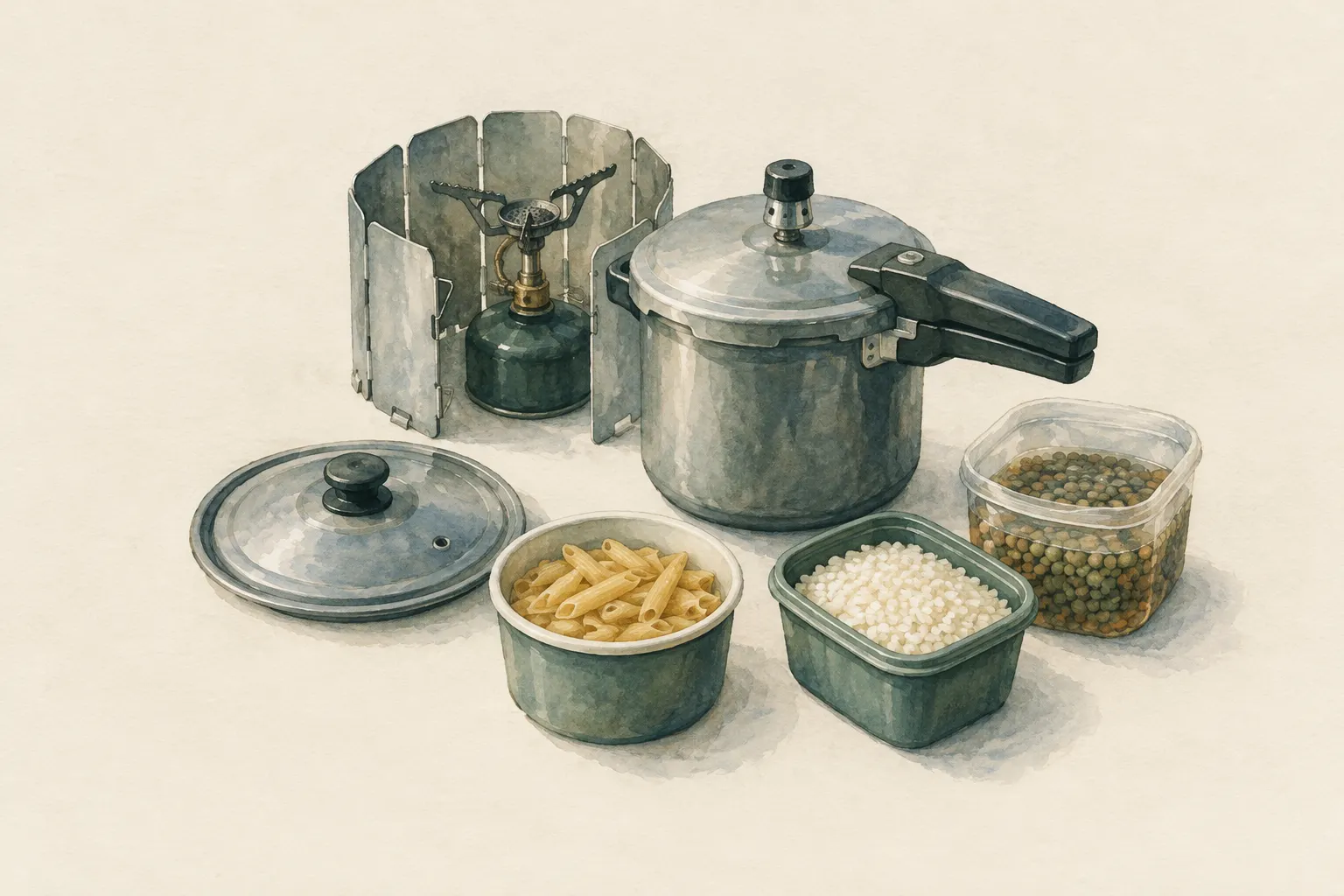
A pressure cooker reverses the effect: it is tightly sealed, the pressure inside rises, and with it the boiling temperature. That is why it is common in homes at high altitude, especially for pulses and stews. It is used only according to the manufacturer's instructions.
What really matters
Plan more fuel and more time than in the valley. Prefer quick-cooking foods such as rolled oats, couscous, instant mash, thin pasta or freeze-dried meals. Take large beans only when there is enough time and fuel – at altitude they too must be boiled vigorously.
Always cook with a lid and shield the stove from the wind. Wind blows heat past the pot and costs a lot of fuel at altitude in particular. But do not fully enclose a gas canister with a windscreen, or the canister can overheat; follow the manufacturer's guidance. Some gas canisters also lose a lot of performance in the cold. If snow has to be melted, that needs a lot of extra fuel.
Longer cooking means more evaporation: add a little more water and keep an eye on the pot. You can soak grains and pasta beforehand and let them finish cooking well wrapped up after boiling. Do not rely on the packet time but taste: is it cooked inside? Meat and fish are always cooked right through.
Safety: what to watch out for
Do not cook inside a closed tent or a snow cave. Stoves produce carbon monoxide, which builds up in confined spaces, and this gas is invisible and odourless. At altitude it is particularly treacherous, because headaches, nausea and drowsiness are easily confused with altitude illness. Ensure ventilation and run the stove outdoors or in a well-ventilated porch where possible.
A longer time also applies when boiling drinking water at altitude: according to the CDC, above about 2,000 m water should be kept at a rolling boil for three minutes instead of one. Water from streams and lakes is not safe drinking water without disinfection, even if it looks clear.
Canning and pressure canning at altitude require adjusted times or pressures from tested instructions. There is no improvising here, because incorrectly canned food can contain dangerous germs. Doughs also behave differently at altitude; there are separate altitude-adjusted recipes for baking.
Typical situations
On a hut tour at high altitude you cook pasta exactly for the packet time – and it is still hard. That is not the stove's fault but the boiling point's. The solution: lid on, cook longer, add a little water and taste. Next time you plan thin pasta or couscous.
At high altitude many people have less appetite. Even so, eating and drinking regularly is important to keep up your strength. Warm, simple meals that cook quickly help with this – and realistic fuel planning makes sure the stove is not empty on the last day.
Step by step
Plan
Plan for more fuel and time; prefer quick-cooking foods (rolled oats, couscous, instant mash, thin pasta, freeze-dried meals).
- 1
Plan
Plan for more fuel and time; prefer quick-cooking foods (rolled oats, couscous, instant mash, thin pasta, freeze-dried meals).
- 2
Lid and windscreen
Always cook with a lid and shield the stove from the wind – wind costs a lot of fuel at altitude. Do not fully enclose gas canisters with a windscreen (overheating).
Follow the manufacturer's guidance on windscreens.
- 3
More water
Longer cooking means more evaporation: add a little more water and keep an eye on the pot.
- 4
Soak and finish with retained heat
Soak grains and pasta beforehand and let them finish cooking wrapped up after boiling. Use beans only when there is enough time and fuel – they still need to be boiled vigorously.
- 5
Check doneness
Do not go by the packet time but taste: is it cooked inside? Cook meat and fish through.
Common mistakes
- Planning fuel for valley conditions
- Cooking without a lid and windscreen
- Cooking in a closed tent
- Blindly following packet cooking times
- Boiling water only briefly at altitude
Quick view
Materials
Stove
Never operate inside a tent, shelter or enclosed room – carbon monoxide and fire risk.
Stove fuel (canister, liquid fuel, alcohol)
Store fuels apart from food and in original containers or bottles intended for them.
Store cool, well ventilated and out of children's reach.
Metal pot (stainless steel, aluminium, titanium)
Hot – scalding risk.
Insulated cooking box (hay box, thermal cooker)
Never put open flame or embers inside – only the hot, closed pot.
Keep the insulation clean and dry.
Suitable for
- Hut and high-mountain tours
- Homes and travel destinations at high altitude
- Planning fuel and food in the mountains
Not suitable for
- Canning without altitude-adjusted, tested instructions
- Cooking inside a closed tent
Prerequisites
- A stove that works reliably in cold and at altitude
- Planning more fuel than in the valley
- Basic knowledge of altitude illness
Safety
- For boiling drinking water at high altitude, the CDC advises a longer rolling boil (above about 2,000 m, three minutes instead of one).
- Canning and pressure canning at altitude require adjusted times or pressures from tested instructions – do not improvise.
How it works
Water boils when its vapour pressure reaches the surrounding pressure. As air pressure falls, this happens at a lower temperature – roughly 1 °C less per about 300 m of altitude. Since cooking depends on temperature, not on bubbling, food cooks more slowly in boiling water at altitude. A pressure cooker raises the pressure inside the pot and thus the boiling temperature again.
Advantages
- Realistic planning saves trouble and fuel
- Fewer undercooked meals
Disadvantages
- More weight due to fuel
- Longer cooking times in cold and wind
Deep knowledge
Background
The USDA FSIS guide "High Altitude Cooking and Food Safety" explains that water boils at a lower temperature at altitude and cooking times therefore need to be extended. The CDC recommends a longer boiling time for drinking water above about 2,000 m.
The physical background – air pressure falling with altitude – is explained in the entry on air pressure and altitude.
Variants
- Pressure cooker at home
- In homes at high altitude a pressure cooker is common for pulses and stews. Use only according to the manufacturer's instructions.
- Baking at altitude
- Doughs behave differently (rising, leavening, moisture). Use altitude-adjusted recipes for this.
Common mistakes
- Planning fuel for valley conditions
- Cooking without a lid and windscreen
- Cooking in a closed tent
- Blindly following packet cooking times
- Boiling water only briefly at altitude
Limits and risks
- Boiling temperatures are rough guide values only; they also vary with the weather
- No altitude-adjusted canning times – use tested instructions
- No treatment of altitude illness
Material alternatives
Derived from material properties: a substitute must have all relevant properties. Observe the notes on the substitute.
- Stove fuel (canister, liquid fuel, alcohol)
- Dry firewood (Collect only where permitted.), Tinder (Carry in waterproof packaging.), Char cloth (charred cotton) (Store dry in a tin.), Finest-grade steel wool (Store separately from batteries – fire risk.), Fatwood (resin-rich wood) (Collect only dead wood where permitted.), Petroleum jelly cotton balls (Use only pure cotton.)
- Metal pot (stainless steel, aluminium, titanium)
- Single-wall stainless steel bottle (Heat only single-wall bottles without paint/plastic; remove the lid before heating.)
- Insulated cooking box (hay box, thermal cooker)
- Sleeping pad, Dry leaves, grass or conifer boughs (Collect only where allowed; no protected plants. Check for ticks and insects.), Backpack, Dry spare clothing (Carry it in waterproof packaging – wet clothing barely insulates.), Wool blanket / duvet (Keep away from candles, stoves and heaters.), Insulated cool box (Keeps cold only for a limited time; without ice packs or ice it is not a fridge.), Sleeping bag (Do not store compressed long-term; do not pack away damp.), Newspaper and cardboard (Flammable – keep away from candles, stoves, heaters and embers.)
Results come exclusively from structured entries. No improvised instructions are generated.
Sources
United States Department of Agriculture – Food Safety and Inspection Service (USDA FSIS): High Altitude Cooking and Food Safety
Lower boiling temperature at altitude and longer cooking times
Centers for Disease Control and Prevention: Making Water Safe in an Emergency
Longer boiling time for drinking water above about 2,000 m
Centers for Disease Control and Prevention: Carbon Monoxide Poisoning – Prevention guidance
No fuel-burning appliances in tents