Hay box: cooking with retained heat
With a hay box, a dish is only briefly brought to the boil on the stove and then finishes cooking in the closed pot inside a well-insulated box, blanket or bag. This saves a lot of fuel – important when gas or wood is scarce. To stay safe, the food must stay hot and, if necessary, be brought back to the boil before eating.
- A few minutes of cooking, then several hours of retained-heat cooking
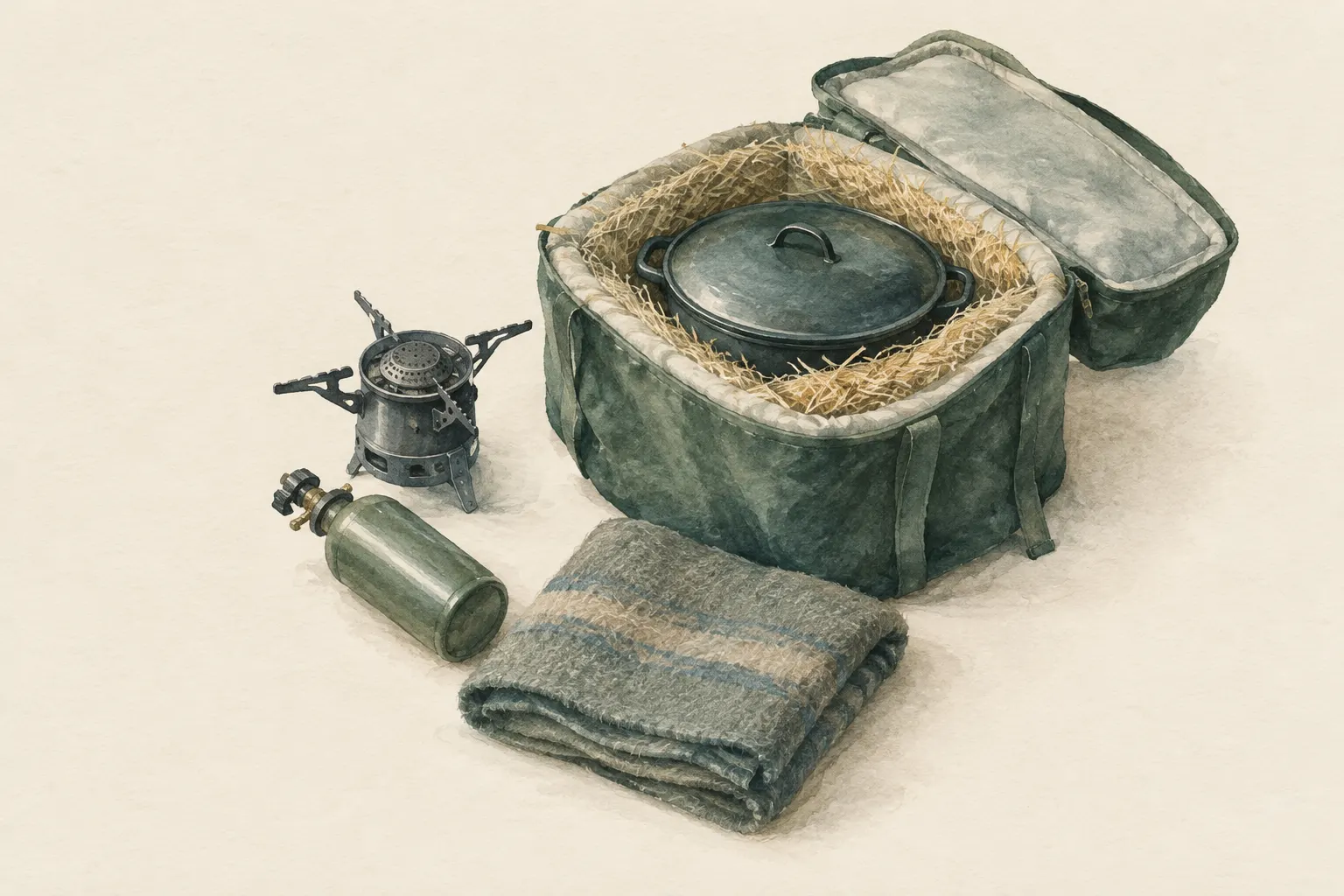
Explained simply
You may know this: a hot-water bottle stays warm for hours under the duvet. A hay box works the same way. You bring a pot of food briefly to the boil, then wrap it with its lid very thickly in blankets, cushions or a sleeping bag. The heat stays inside, and the food carries on cooking by itself – without a flame.
This saves a lot of gas or wood. That matters when fuel is scarce during a power cut. It works well with rice, porridge, lentils or stew.
One rule is important: the food must stay hot. Lukewarm food is like a cosy nest for bacteria. If it is no longer properly hot when you open it, bring it back to a strong boil before eating.
How it works
Cooking needs a certain temperature over a certain time – not necessarily a flame. Water can store a great deal of heat. A full pot that is boiling right through is therefore like a small heat store. Without insulation it quickly gives this heat off to its surroundings; with thick insulation it is lost only slowly.
Insulating materials such as blankets, cushions, wool, straw or hay – hence the name “hay box” – trap a lot of still air. Still air conducts heat poorly. The thicker the layer all round and on top, the longer the dish stays far above room temperature.
Quantity counts too: a large, full pot cools more slowly than a small or half-empty one, because it has stored more heat relative to its surface. That is why a hay box is poorly suited to tiny portions.
What really matters
The pot needs a tight-fitting lid. Bring the ingredients to a rolling boil with enough liquid and let them boil for a few minutes until everything is hot right through. Soak pulses beforehand. Then put the pot straight into the prepared box and wrap it thickly all round and on top.
Keep the lid closed. Every opening lets hot steam escape and costs heat that does not come back. Cooking takes much longer than on the stove and depends on the pot, quantity and insulation – so there are no fixed times. Start with simple dishes such as rice or porridge and learn how your box behaves.
Put the hot pot on a heat-resistant base, for example a wooden board, so that plastic or fabric underneath does not melt or scorch. An old cool box, a laundry basket or a cardboard box with blankets all work well as the box.
Safety: what to watch out for
Lukewarm food is ideal for bacteria. When you open the box, check that the dish is cooked and still properly hot. If it is only lukewarm, bring it back to a rolling boil before eating and then eat it promptly. If it has stood lukewarm for a long time – overnight, say – it is thrown away, because some bacterial toxins survive even reboiling.
The boiling itself is done only with approved appliances in the home or with a stove or grill outdoors. Camping stoves and grills have no place indoors, because carbon monoxide can build up there. The hay box itself does not burn and may stand in the house.
The pot is still hot even after hours, and the contents can spatter when opened. Use oven gloves and keep children away.
When it makes sense – and when not
A hay box is worthwhile for anything that would otherwise have to simmer for a long time: rice, millet, porridge, soaked pulses, stews. It saves fuel, nothing burns and the stove is quickly free again, for example for boiling water. For small portions there is a mini version: let oats or grains soak in a wide-mouthed vacuum flask with boiling water.
It is not suitable for very small quantities that cool quickly, for roasting and baking, or for dishes that would stand lukewarm for hours. This entry deliberately gives no recipes for meat with long cooking times.
Good to know
Hay boxes were common in many households when fuel was expensive, and are used today in aid projects to save wood or charcoal. The principle is pure physics: store heat and slow down its loss.
The WHO's basic food safety rules recommend keeping cooked food piping hot and reheating it thoroughly. Combining this rule with a hay box gives you a simple, safe and economical way of cooking.
Step by step
Prepare the box
Line a box, basket or cool box thickly with blankets, cushions or a sleeping bag. Leave a hollow for the pot and have material ready for the top.
- 1
Prepare the box
Line a box, basket or cool box thickly with blankets, cushions or a sleeping bag. Leave a hollow for the pot and have material ready for the top.
- 2
Bring to the boil
Put the ingredients in the pot with enough liquid, cover, bring to a rolling boil and let it boil for a few minutes until everything is hot throughout. Soak pulses beforehand.
- 3
Transfer quickly
Put the closed pot into the box immediately, do not lift the lid, and wrap it thickly all round and on top.
Hot pot: place it on a heat-resistant base so that plastic or fabric does not melt.
- 4
Let it cook
Leave to rest for several hours. Cooking takes much longer than on the stove; practise with simple dishes such as rice.
- 5
Check and reheat
Open the pot and check that the food is cooked and hot. If it is only lukewarm, bring it back to the boil and then eat promptly.
Common mistakes
- Too little food in a large pot
- Lifting the lid during cooking
- Insulation too thin
- Leaving food lukewarm overnight and eating it cold
Quick view
Materials
Insulated cooking box (hay box, thermal cooker)
Never put open flame or embers inside – only the hot, closed pot.
Keep the insulation clean and dry.
Metal pot (stainless steel, aluminium, titanium)
Hot – scalding risk.
Stove
Never operate inside a tent, shelter or enclosed room – carbon monoxide and fire risk.
Wool blanket / duvet
Keep away from candles, stoves and heaters.
Suitable for
- Rice, millet, porridge, pulses, stews
- Saving fuel during a power cut
- Long cooking times without tending a flame
Not suitable for
- Small quantities that cool quickly
- Dishes that would stand lukewarm for hours
- Roasting and baking
Prerequisites
- Pot with a tight-fitting lid
- Enough insulation (blankets, cushions, a box)
- A safe cooking place outdoors or an approved cooker
Safety
- Lukewarm food is ideal for bacteria. If the dish is no longer properly hot when opened, bring it back to a rolling boil before eating – or discard it if it has stood lukewarm for a long time.
- The pot is still hot after hours. Use oven gloves and keep children away.
How it works
Cooking needs a certain temperature over a certain time – not necessarily a flame. A full, closed pot stores a lot of heat; good insulation slows heat loss so much that the dish stays far above room temperature for hours. The larger and fuller the pot and the thicker the insulation, the longer the heat lasts.
Advantages
- Saves a lot of fuel
- Nothing burns
- The stove is free again quickly
Disadvantages
- Long cooking time, planning needed
- Food safety depends on keeping a high enough temperature
Deep knowledge
Background
Hay boxes were common in many households when fuel was expensive and are used today in aid projects to save fuel. The principle is pure heat storage and insulation.
The WHO's basic food safety rules recommend keeping cooked food piping hot and reheating it thoroughly – this applies to the hay box too.
Variants
- Insulated bag
- Instead of a box, a fabric bag filled with insulation or a sleeping bag can wrap the pot.
- Vacuum flask
- Small portions of porridge or grains can be soaked in a wide-mouthed vacuum flask with boiling water.
Common mistakes
- Too little food in a large pot
- Lifting the lid during cooking
- Insulation too thin
- Leaving food lukewarm overnight and eating it cold
Limits and risks
- No fixed cooking times – they depend on pot, quantity and insulation
- No recipes for meat with long cooking times
Material alternatives
Derived from material properties: a substitute must have all relevant properties. Observe the notes on the substitute.
- Insulated cooking box (hay box, thermal cooker)
- Sleeping pad, Dry leaves, grass or conifer boughs (Collect only where allowed; no protected plants. Check for ticks and insects.), Backpack, Dry spare clothing (Carry it in waterproof packaging – wet clothing barely insulates.), Wool blanket / duvet (Keep away from candles, stoves and heaters.), Insulated cool box (Keeps cold only for a limited time; without ice packs or ice it is not a fridge.), Sleeping bag (Do not store compressed long-term; do not pack away damp.), Newspaper and cardboard (Flammable – keep away from candles, stoves, heaters and embers.)
- Metal pot (stainless steel, aluminium, titanium)
- Single-wall stainless steel bottle (Heat only single-wall bottles without paint/plastic; remove the lid before heating.)
- Wool blanket / duvet
- Sleeping pad, Dry leaves, grass or conifer boughs (Collect only where allowed; no protected plants. Check for ticks and insects.), Backpack, Dry spare clothing (Carry it in waterproof packaging – wet clothing barely insulates.), Insulated cool box (Keeps cold only for a limited time; without ice packs or ice it is not a fridge.), Sleeping bag (Do not store compressed long-term; do not pack away damp.), Newspaper and cardboard (Flammable – keep away from candles, stoves, heaters and embers.), Insulated cooking box (hay box, thermal cooker) (Never put open flame or embers inside – only the hot, closed pot.)
Results come exclusively from structured entries. No improvised instructions are generated.
Sources
World Health Organization (WHO) (2006): Five Keys to Safer Food Manual
Keep cooked food hot and reheat it thoroughly
Centers for Disease Control and Prevention: Carbon Monoxide Poisoning – Prevention guidance
No fuel-burning appliances indoors