Pulses and grains: storing them and cooking with little fuel
Dried beans, lentils, peas, rice and other grains are cheap, keep for a long time and are nutritious – but they need water and fuel. Soaking, choosing the right type, a lid, retained-heat cooking and small batches save a lot of energy. Red kidney beans and many other beans must be boiled vigorously after soaking; merely letting them soften is not enough.
- Soaking overnight, then a short to medium cooking time depending on type
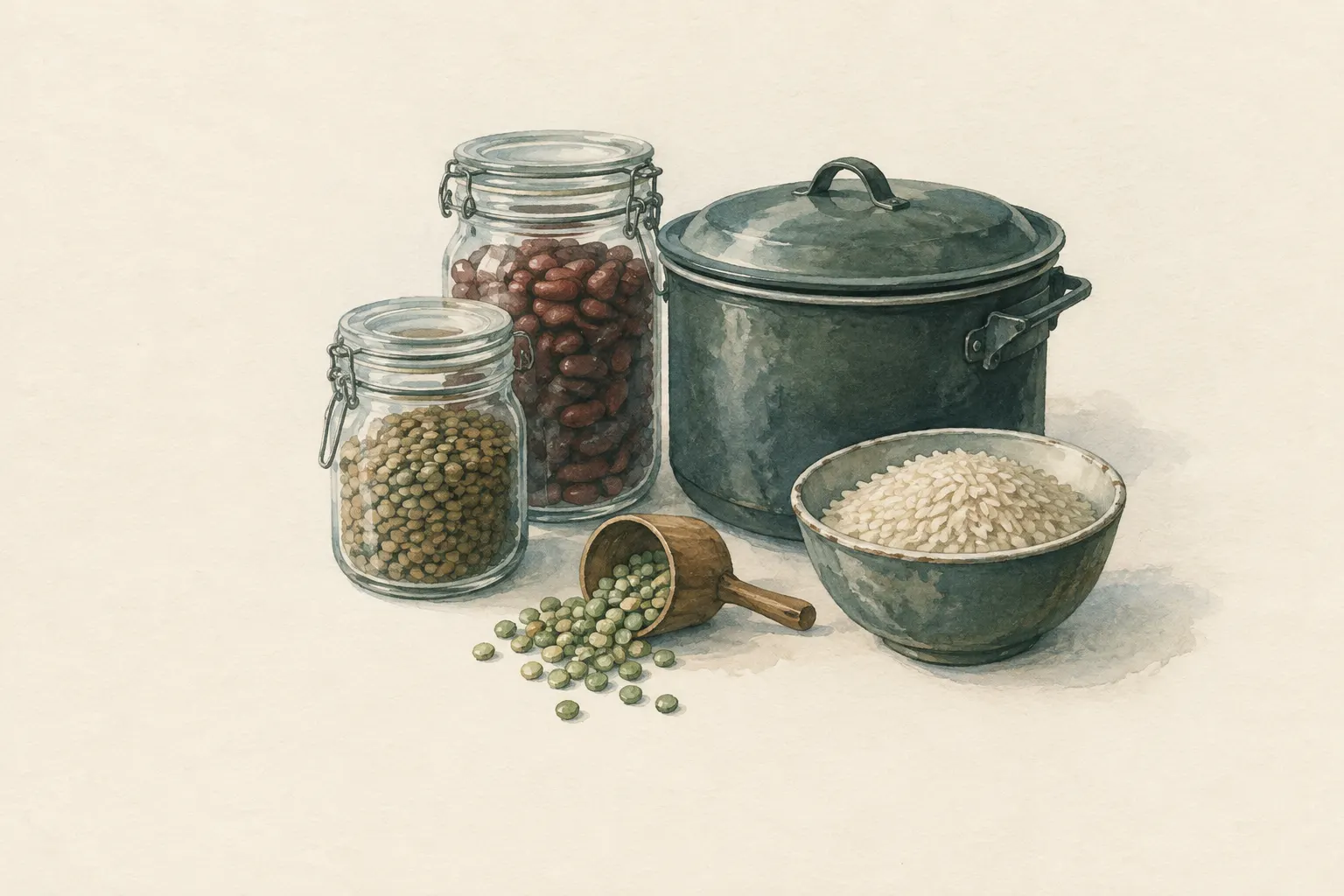
Explained simply
Dried beans, lentils, peas and rice are like little treasure chests: they are cheap, keep for a long time and fill you up. But they are hard and dry. To become soft, they first have to soak up water – like a dry sponge – and then be cooked.
Cooking needs fuel, and in an emergency fuel is often scarce. That is why there are tricks: soak beans overnight, always put a lid on the pot, choose small types such as red lentils that cook quickly, and wrap the pot up warmly after it has boiled so that it keeps cooking by itself.
One rule is very important: red kidney beans and many other beans contain a natural poison when raw. After soaking they must be boiled properly and vigorously in fresh water, otherwise they can make you vomit violently.
How it works
Dry pulses and grains consist mainly of starch and protein enclosed in firm cell walls. To become soft and digestible, water has to move inside and the starch has to swell with heat. For large, whole beans, the water takes a long time to penetrate. Soaking moves this slow step into cold water – without any fuel at all.
Small, hulled or split types have a short way to the centre. Red lentils, split peas, bulgur, couscous, rolled oats and thin pasta therefore cook quickly, red lentils even without soaking. For couscous and rolled oats, hot water to swell in is often enough.
During cooking a lot of heat is lost when the pot is open: the steam carries energy away. A lid keeps it in the pot. Anyone who insulates the closed pot well after boiling – for example in a hay box with blankets – uses the stored heat to keep cooking. A pressure cooker raises the pressure and thus the temperature inside the pot and greatly shortens cooking time.
Safety: what to watch out for
Raw or undercooked red kidney beans contain a natural toxin called phytohaemagglutinin. Even a few beans can cause violent vomiting and diarrhoea. The toxin is destroyed by vigorous boiling, but not by soaking alone or by gentle cooking below boiling point. So the rule is: soak, pour off the soaking water and boil vigorously in fresh water for at least 30 minutes. Only then may the heat be reduced or the cooking finished in a hay box.
Cooked rice and grains also need attention. Spores of certain bacteria survive cooking and can multiply if the food stands lukewarm for hours. So without refrigeration, cook only as much as will be eaten and eat it promptly. Leftovers are cooled quickly and kept cold – or not kept at all.
Gas, spirit or wood stoves and grills are never operated in enclosed spaces, because they produce carbon monoxide. This gas is invisible, odourless and can be deadly. Cooking without electricity therefore means an approved cooker or cooking outdoors.
What really matters: saving fuel
Choose the type according to the fuel you have. If it is scarce, red lentils, split peas, rolled oats, bulgur, couscous and thin pasta are the best choice. Large beans and chickpeas are only worth it when there is time to soak them and enough fuel for the long, vigorous boil. For periods with no way to cook at all, beans in tins or jars are better – they are already cooked.
Then come the small things that add up: always cook with a lid, use only as much water as needed, keep the flame no larger than the base of the pot and shield the stove from wind. After boiling – and, with beans, after the full vigorous boiling time – the pot can finish cooking in a hay box.
At the end, always check that everything is done: squash several beans; nothing inside may be hard or raw and floury. Package times are only guide values, because type, age, pot and altitude change the cooking time. At altitude water boils at a lower temperature and everything takes longer.
Storing them correctly
Pulses and grains keep longest when dry, cool, dark and in tightly closing containers. Moisture encourages mould, and open sacks attract pantry pests such as moths or beetles. Label the containers with contents and date and use them first in, first out.
Beans do not become poisonous over the years, but they do become hard: very old beans often no longer soften properly even after hours of cooking, and swallow a lot of fuel in the process. You notice this better in everyday life than in an emergency. So cook regularly from the stock and replace what you use.
Good to know
Pulses and grains complement each other well: pulses provide a lot of protein, grains a lot of energy. That is why many cuisines of the world have dishes that combine both, such as lentils with rice or beans with maize flatbreads. Official preparedness guides such as the BBK's list both as basic components of the emergency stock.
An unusually large amount of pulses can cause wind at first. People who already eat them regularly in everyday life usually tolerate them better in an emergency. Also keep the water requirement in mind: soaking and cooking water must be safe water and must be counted in the water stock.
Step by step
Store correctly
Store dry, cool and dark in tightly closing containers, label them and use them first in, first out. Very old beans often no longer soften properly even after long cooking.
- 1
Store correctly
Store dry, cool and dark in tightly closing containers, label them and use them first in, first out. Very old beans often no longer soften properly even after long cooking.
- 2
Choose the type by fuel
When fuel is scarce, prefer quick-cooking types: red lentils, split peas, rolled oats, bulgur, couscous, thin pasta. Use large beans and chickpeas only when there is time to soak them and enough fuel.
- 3
Soak
Sort beans and chickpeas (remove small stones), rinse and soak overnight in plenty of safe water. Pour off the soaking water afterwards.
- 4
Boil vigorously
Bring to the boil in fresh water with a lid on, and boil beans vigorously for at least 30 minutes. Only then reduce the heat or finish cooking in a hay box.
With beans, never skip the vigorous boil.
- 5
Finish and check
Simmer or finish with retained heat until the pulses are soft all the way through. Test: squash several beans – nothing inside may be hard or raw and floury.
- 6
Leftovers
Eat cooked pulses and grains promptly. Without refrigeration, do not keep large amounts for the next day.
Common mistakes
- Only soaking kidney beans or cooking them lukewarm
- Reusing the soaking water for cooking
- Cooking without a lid
- Cooking large amounts of rice and leaving it lukewarm
- Discovering too-old, hard stock only in an emergency
Quick view
Materials
Metal pot (stainless steel, aluminium, titanium)
Hot – scalding risk.
Stove
Never operate inside a tent, shelter or enclosed room – carbon monoxide and fire risk.
Airtight food-grade storage container
Fill only when clean and completely dry; never use containers that previously held chemicals.
Insulated cooking box (hay box, thermal cooker)
Never put open flame or embers inside – only the hot, closed pot.
Keep the insulation clean and dry.
Suitable for
- Basis of an emergency stock
- Longer power cuts with a gas or wood stove
- Group catering
Not suitable for
- Situations without water and without any way to cook
- Storage in damp or warm rooms
Prerequisites
- Safe water for soaking and cooking
- Pot with a lid
- An approved cooker or cooking outdoors
Safety
- Do not leave cooked rice and grains standing lukewarm for hours. Spores of certain bacteria survive cooking. Cool leftovers quickly and keep them cold, or eat them straight away; without refrigeration, cook only as much as will be eaten.
How it works
Dry pulses and grains must first absorb water before they soften. Soaking moves this step into cold water and shortens cooking time considerably. Small, hulled or split types (red lentils, split peas, bulgur, rolled oats, couscous) need little energy anyway. A lid, using only as much water as needed and finishing in a hay box after boiling reduce fuel use further.
Advantages
- Cheap, nutritious, long shelf life
- Protein-rich complement to grains
- Little packaging volume
Disadvantages
- Needs water, time and fuel
- Forgetting to boil beans properly is dangerous
- Unfamiliar for some digestive systems
Deep knowledge
Background
The FDA's "Bad Bug Book" describes the bean toxin phytohaemagglutinin in red kidney beans and recommends soaking and boiling briskly for at least 30 minutes; it also names Bacillus cereus as a typical risk with rice kept warm.
Official preparedness guides such as the BBK's list pulses and grains as basic components of an emergency stock.
Variants
- Tinned beans
- Bought beans in tins or jars are already cooked and need neither soaking nor fuel. For periods without any means of cooking they are the better choice.
- Vacuum flask
- Rolled oats, couscous or bulgur can be soaked with boiling water in a wide-mouthed vacuum flask – but not raw beans.
- Pressure cooker
- A pressure cooker greatly shortens the cooking time of pulses. Use only according to the manufacturer's instructions and check the valves regularly.
Common mistakes
- Only soaking kidney beans or cooking them lukewarm
- Reusing the soaking water for cooking
- Cooking without a lid
- Cooking large amounts of rice and leaving it lukewarm
- Discovering too-old, hard stock only in an emergency
Limits and risks
- No fixed cooking times – they depend on type, age, altitude and pot
- No canning recipes for pulses
Material alternatives
Derived from material properties: a substitute must have all relevant properties. Observe the notes on the substitute.
- Metal pot (stainless steel, aluminium, titanium)
- Single-wall stainless steel bottle (Heat only single-wall bottles without paint/plastic; remove the lid before heating.)
- Airtight food-grade storage container
- Single-wall stainless steel bottle (Heat only single-wall bottles without paint/plastic; remove the lid before heating.), Double-wall insulated bottle (Never heat directly.), PET bottle (clear, max. 2 litres) (Do not heat or place in a fire.), Food-grade water container (Only use containers that never held chemicals or fuel.), Collapsible water container or bag (Protect from sharp objects.), Food-grade water bag (Use only for drinking water, never for chemicals or fuel.), Fermentation jar or crock (Use only food-grade containers of glass, food-safe glazed stoneware or food-grade plastic – no metal containers for acidic food.), Resealable food bags (Use only bags intended for food; do not use with boiling water unless the manufacturer explicitly allows it.)
- Insulated cooking box (hay box, thermal cooker)
- Sleeping pad, Dry leaves, grass or conifer boughs (Collect only where allowed; no protected plants. Check for ticks and insects.), Backpack, Dry spare clothing (Carry it in waterproof packaging – wet clothing barely insulates.), Wool blanket / duvet (Keep away from candles, stoves and heaters.), Insulated cool box (Keeps cold only for a limited time; without ice packs or ice it is not a fridge.), Sleeping bag (Do not store compressed long-term; do not pack away damp.), Newspaper and cardboard (Flammable – keep away from candles, stoves, heaters and embers.)
Results come exclusively from structured entries. No improvised instructions are generated.
Sources
U.S. Food and Drug Administration (FDA) (2012): Bad Bug Book: Handbook of Foodborne Pathogenic Microorganisms and Natural Toxins, 2nd edition
Phytohaemagglutinin in kidney beans; soaking and boiling; Bacillus cereus in rice
Bundesamt für Bevölkerungsschutz und Katastrophenhilfe (BBK), Deutschland: Ratgeber für Notfallvorsorge und richtiges Handeln in Notsituationen
Pulses and grains in the emergency stock
Centers for Disease Control and Prevention: Carbon Monoxide Poisoning – Prevention guidance
No fuel-burning appliances indoors