Storing oils and fats: preventing rancidity
Fat is the most energy-dense part of food and valuable in a stock – but oils, nuts, wholemeal flour and rolled oats go rancid over time. Light, heat and air speed this up. Small, dark, well-sealed containers, cool storage and rotation keep fats good for longer. Home-made herb or garlic oils are a separate risk and do not belong in the stock.
- Set up once, then check during rotation
Explained simply
Fat is the part of food that provides the most energy – which is why oil is very valuable in a stock. But fat has a weakness: over time it goes rancid. Then it smells and tastes sharp and bitter, a bit like old paint.
The main culprit is the oxygen in the air. It slowly “nibbles” at the fat, a bit like rust on iron. Light and warmth make this faster. That is why you store oil dark, cool and well closed – and preferably in several small bottles rather than one big one.
Two things matter for safety: home-made garlic or herb oil does not belong in the stock, because dangerous bacteria can thrive in it. And burning fat in a pan is never put out with water, but smothered with a lid.
How it works
Rancidity is mainly a chemical reaction: unsaturated fatty acids react with oxygen, which is called oxidation. This produces substances that smell and taste unpleasant. Light, heat and traces of metals speed up this reaction. In addition, fats are broken down by moisture and natural enzymes, for example in the germ of wholegrain cereals.
Not all fats are equally sensitive. The more polyunsaturated fatty acids an oil contains, the faster it goes rancid – linseed and walnut oil are among the most sensitive. Saturated fats that are solid at room temperature, such as lard or coconut fat, are considerably more stable. Ghee keeps longer than butter without refrigeration, because water and milk protein have been removed from it.
The reaction can be slowed down, but not stopped. Keeping out air, light and heat buys time. That is also why there are no fixed shelf-life periods for all fats: the manufacturer's date and a sensory check are the most reliable guides.
What really matters
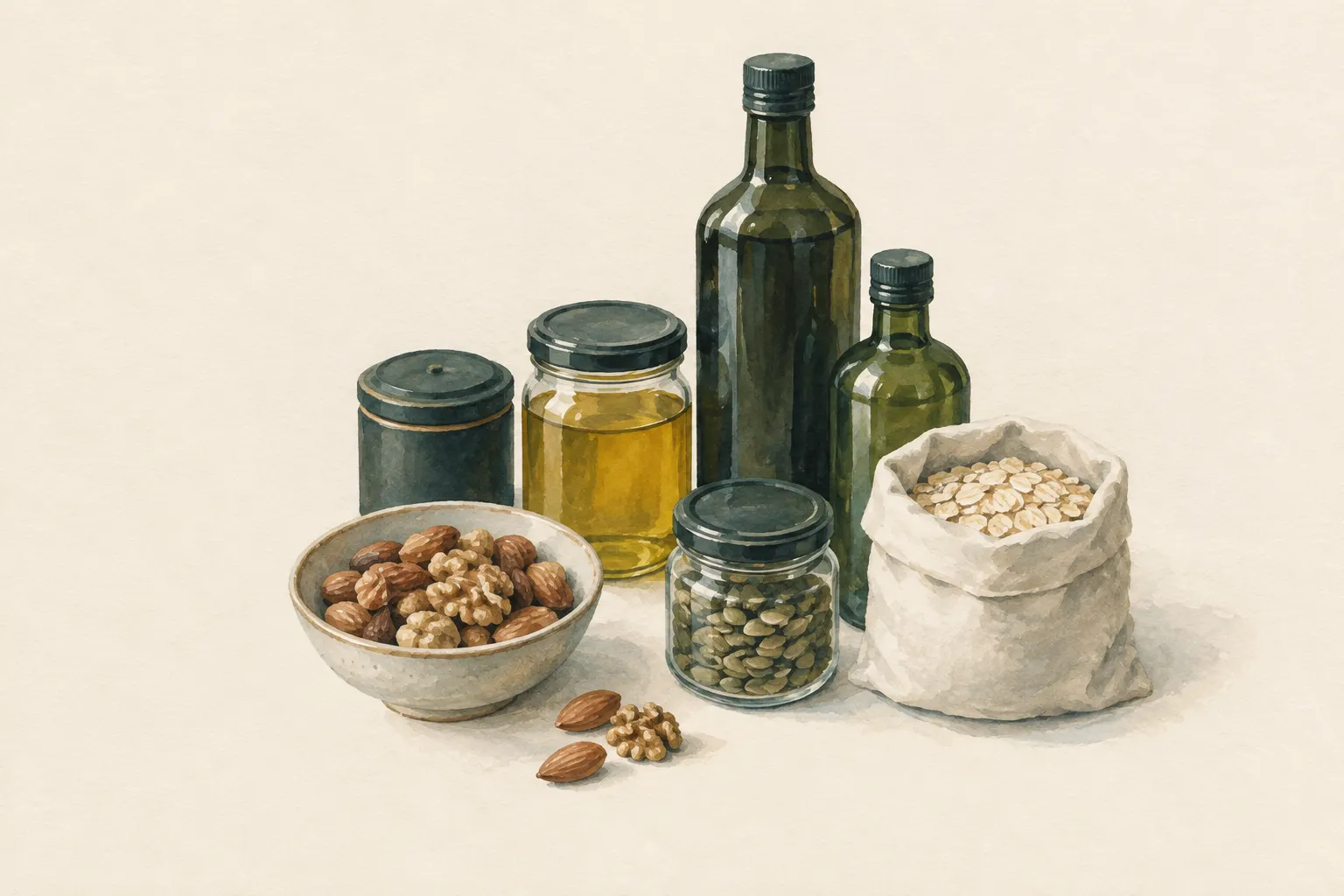
Stable oils and fats that you also use in everyday cooking are the best choice for the stock. Buy sensitive oils only in small amounts for current use. Several small bottles are better than one large can: an opened bottle is finished quickly, while the others stay sealed and protected until then.
The storage place matters a lot. Next to the cooker, a heater or on a windowsill it is warm and bright – exactly what oil does not like. A cool, dark cupboard or cellar is better. Dark glass bottles or metal tins protect against light. Opened containers are closed tightly again after each use.
Also think of “hidden fats”: nuts, seeds, wholemeal flour, rolled oats and muesli contain fat and go rancid too. Store them tightly sealed and cool and include them in the rotation. Where a fridge or freezer is available, nuts and wholemeal flour keep considerably longer there.
Safety: what to watch out for
Home-made oil with garlic, fresh herbs or vegetables is a risk of its own. Under the layer of oil there is little oxygen, and at room temperature this gives botulism bacteria good conditions. Botulism is a rare but very dangerous poisoning, and you cannot taste it. Such oils do not belong in the stock: if at all, they are made only according to tested instructions, kept refrigerated and used quickly.
Rancid fats smell and taste sharp, bitter or like paint. They are no longer suitable for eating and are thrown away. So briefly check smell and taste before use, especially with older containers.
When cooking, oil is never heated unattended. If fat in a pan catches fire, no water may go on it: it turns to steam instantly and throws burning fat out. Instead, cover the pan with a lid and turn off the heat.
Typical situations
While tidying up, you find a half-full bottle of oil at the back of the cupboard that has stood open next to the cooker for months. It smells sharp and like paint – it is thrown away. The lesson: in future, smaller bottles stand in the cool store cupboard, and only one is open at a time.
The pack of walnuts from last winter tastes bitter too. So you prefer to buy nuts in small packs, eat them regularly and replace them. If you label every container with its purchase date and use the oldest first, this hardly ever happens.
Step by step
Choose suitable fats
For the stock, prefer stable oils and fats used in everyday cooking; buy sensitive oils only in small amounts for current use.
- 1
Choose suitable fats
For the stock, prefer stable oils and fats used in everyday cooking; buy sensitive oils only in small amounts for current use.
- 2
Small containers
Buy several small bottles rather than one large one: an opened container is used up faster and the others stay sealed.
- 3
Store dark and cool
Do not store next to the cooker, a heater or in a window. Dark bottles or tins protect against light. Close opened containers tightly.
- 4
Mind hidden fats
Nuts, seeds, wholemeal flour, rolled oats and muesli contain fat and also go rancid – include them in rotation and store them sealed and cool.
- 5
Check during rotation
Note the date, check smell and taste before use and use the oldest containers first.
Common mistakes
- A large can of oil left open for months
- Oil on the shelf next to the cooker
- Storing large amounts of nuts unsealed
- Keeping home-made garlic oil unrefrigerated
Quick view
Materials
Airtight food-grade storage container
Fill only when clean and completely dry; never use containers that previously held chemicals.
Labels and permanent marker
Suitable for
- Cooking oil, ghee, lard, nuts, seeds
- Wholemeal products and rolled oats in the stock
- Households with an emergency stock
Not suitable for
- Butter and margarine without refrigeration for long periods
- Home-made oil infusions with garlic or fresh herbs at room temperature
Prerequisites
- A cool, dark storage place
- An overview of everyday consumption
Safety
- Rancid fats smell and taste sharp, bitter or like paint. They are no longer suitable for eating and should be discarded.
- Never heat oil unattended when cooking; never put out burning fat with water – cover it with a lid and turn off the heat.
How it works
Rancidity is mainly a reaction of unsaturated fatty acids with oxygen (oxidation), accelerated by light, heat and traces of metal; in addition, moisture and enzymes break fats down, for example in wholemeal flour. The more polyunsaturated fatty acids, the more sensitive the fat (e.g. linseed or walnut oil). Keeping out air, light and heat slows the reaction – it cannot be stopped.
Advantages
- Preserves the most energy-dense stocks
- Less waste
- Hardly any effort
Disadvantages
- Fats keep only for a limited time
- Cool storage places are often scarce in flats
Deep knowledge
Background
Standard food chemistry texts such as "Food Chemistry" (Belitz, Grosch, Schieberle) describe lipid oxidation as the main cause of rancidity and name oxygen, light, heat and metal ions as accelerating factors.
The National Center for Home Food Preservation warns against home-made oils with garlic or herbs stored at room temperature.
Variants
- Use the cold
- Where refrigeration is available, nuts and wholemeal flour keep considerably longer in the fridge or freezer.
Common mistakes
- A large can of oil left open for months
- Oil on the shelf next to the cooker
- Storing large amounts of nuts unsealed
- Keeping home-made garlic oil unrefrigerated
Limits and risks
- No fixed shelf-life periods – follow the manufacturer's date and sensory checks
- No recipes for flavoured oils
Material alternatives
Derived from material properties: a substitute must have all relevant properties. Observe the notes on the substitute.
- Airtight food-grade storage container
- Single-wall stainless steel bottle (Heat only single-wall bottles without paint/plastic; remove the lid before heating.), Double-wall insulated bottle (Never heat directly.), PET bottle (clear, max. 2 litres) (Do not heat or place in a fire.), Food-grade water container (Only use containers that never held chemicals or fuel.), Collapsible water container or bag (Protect from sharp objects.), Food-grade water bag (Use only for drinking water, never for chemicals or fuel.), Fermentation jar or crock (Use only food-grade containers of glass, food-safe glazed stoneware or food-grade plastic – no metal containers for acidic food.), Resealable food bags (Use only bags intended for food; do not use with boiling water unless the manufacturer explicitly allows it.)
Results come exclusively from structured entries. No improvised instructions are generated.
Sources
Springer (H.-D. Belitz, W. Grosch, P. Schieberle) (2009): Food Chemistry, 4th edition
Lipid oxidation and accelerating factors
University of Georgia / National Center for Home Food Preservation (USA): National Center for Home Food Preservation – tested guidance on drying and preserving food
Risk of home-made oils with garlic and herbs
U.S. Federal Emergency Management Agency (FEMA): Are You Ready? An In-Depth Guide to Citizen Preparedness
Store food cool, dry and dark and rotate it