Storing honey, sugar and salt
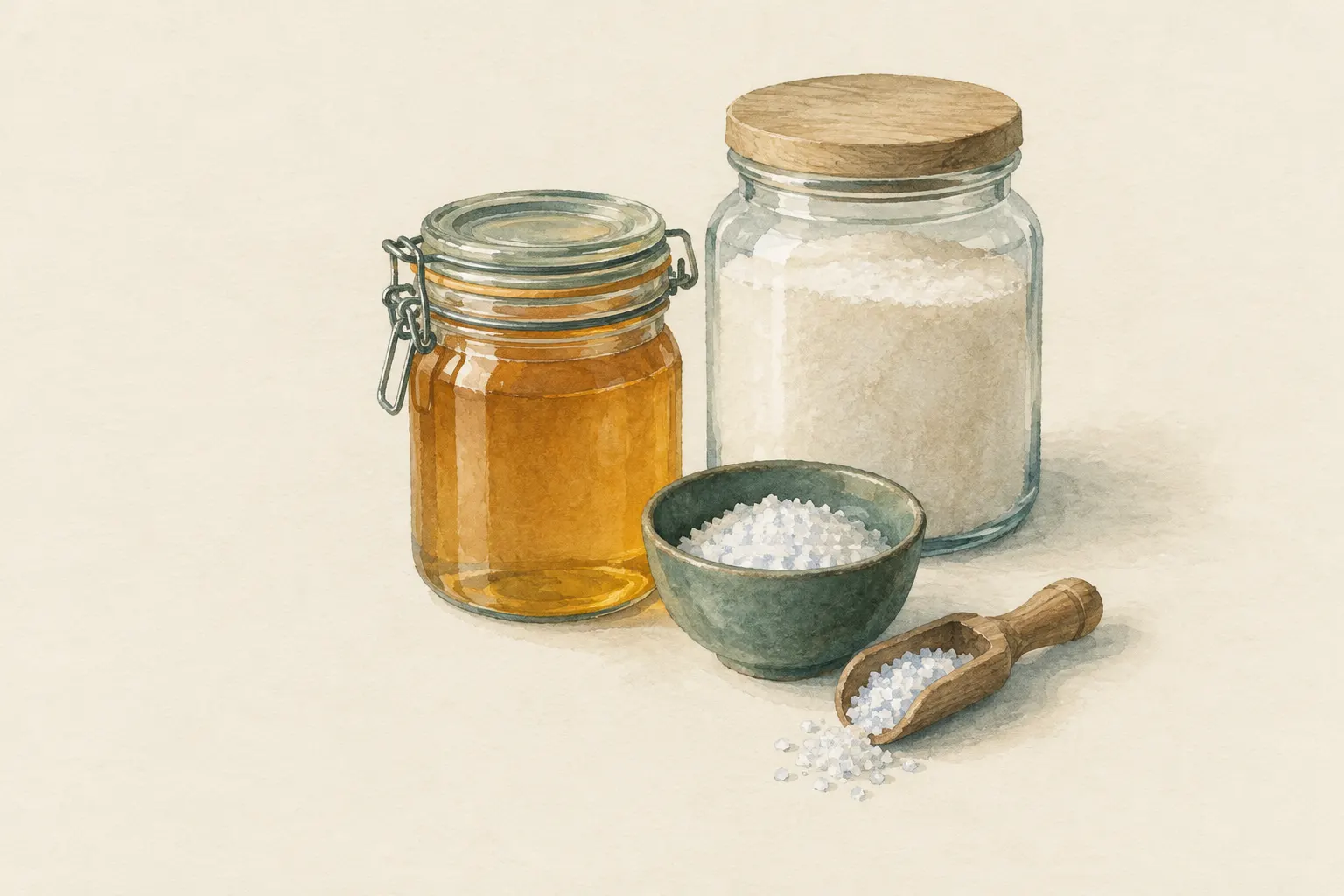
Honey, sugar and salt are among the longest-lasting stocks as long as they stay dry and tightly sealed. Typical problems are caking, crystallisation and moisture – no reason to throw them away. Important: honey is not suitable for infants under 12 months.
- Decant once, then hardly any effort
Explained simply
Honey, sugar and salt are real long-distance runners in the stock. Germs can hardly grow in them, because they lack the free water that germs need to live. As long as these supplies stay dry and well sealed, they keep for a very long time.
Their enemy is moisture. Sugar and salt draw water from the air and then turn into hard lumps. Honey often becomes firm and grainy over time – this is called crystallising, and it is completely normal. In a warm water bath it becomes runny again.
One rule is very important: babies under one year old get no honey, not even in porridge or tea. Honey can contain tiny spores that are dangerous for infants.
How it works
Bacteria, yeasts and moulds need available water to grow. Sugar and salt contain practically none, and in honey the sugar is so concentrated that it binds the water tightly. If a germ gets in, the concentrated surroundings even draw water out of it. For the same reason, sugar and salt have long been used for preserving food – but that requires tested instructions.
The trouble starts when the supplies absorb moisture. Sugar and salt cake, because the grains partly dissolve in damp spots and stick together as they dry. Honey also attracts water. If it becomes too watery, yeasts can get to work: it begins to ferment, foams and smells sour.
Crystallisation of honey, on the other hand, is a natural and harmless process. The sugar in the honey forms fine crystals, and the honey becomes firm and pale. How quickly this happens depends on the type. It changes nothing about taste or shelf life.
What really matters
After opening, decant sugar and salt into jars or tins with tightly closing lids; paper bags let moisture and pests through. Honey stays firmly closed in its original jar. Always use a dry, clean spoon – a wet spoon brings water and crumbs into the honey.
The storage place must be dry. Damp cellars are unsuitable, as is the spot next to the sink or cooker where steam rises all the time. Sugar also attracts ants; a tight lid keeps them out. Brown sugar, by the way, also goes hard when it dries out – then it helps to store it airtight.
If something has happened anyway, it is usually no reason to throw it away. Simply crush caked sugar or salt. Stand crystallised honey in its jar in a warm, not boiling, water bath and let it liquefy slowly; too much heat harms the aroma.
Safety: what to watch out for
Children under 12 months get no honey – not even to sweeten porridge or tea. Honey can contain spores of the bacterium that causes botulism. For older children and adults they are generally harmless, but in an infant's still immature gut they can germinate and produce a dangerous toxin. Health authorities such as the CDC point this out explicitly.
Salt does not relieve thirst and does not replace drinking water. On the contrary, salty food increases water needs. So when water is scarce, use salt sparingly.
Sugar, salt, baking soda, citric acid and some cleaning products look confusingly alike as white powders. Label all containers clearly and store food apart from cleaning products. Throw things away if there is mould, pest infestation, an odd smell, or fermenting, foaming honey.
Good to know
Sugar and honey provide almost nothing but energy, hardly any vitamins or protein. They are valuable in the stock because they make simple emergency food tastier and give quick energy – but they do not replace a balanced diet. Salt seasons food and belongs in almost every dish; iodised table salt is common in everyday use.
Households that rarely use salt or sugar buy small packs and use them up in everyday cooking. A big sack of sugar that sits in a damp cellar for years is more likely to become a lump than a reserve. As with the rest of the stock: label, seal tightly and use the oldest first.
Step by step
Seal tightly
After opening, decant sugar and salt into jars or tins with tight lids; keep honey firmly closed in its original jar.
- 1
Seal tightly
After opening, decant sugar and salt into jars or tins with tight lids; keep honey firmly closed in its original jar.
- 2
Store dry
Do not store in damp cellars or next to the sink or cooker (steam). Always use dry, clean spoons.
- 3
Label
Note contents and date, and keep similar-looking powders apart.
- 4
Caked or crystallised
Crush caked sugar or salt. Liquefy crystallised honey slowly in a warm (not boiling) water bath.
- 5
When to discard
Discard if there is mould, pest infestation, an odd smell, or fermenting, foaming honey.
Common mistakes
- Using honey for baby food
- Sugar in a paper bag in a damp cellar
- Unlabelled white powders
- Using a wet spoon in honey
Quick view
Materials
Airtight food-grade storage container
Fill only when clean and completely dry; never use containers that previously held chemicals.
Labels and permanent marker
Suitable for
- Long-term basic stock
- Energy (sugar, honey) and seasoning (salt) in a simple emergency kitchen
Not suitable for
- Infants under 12 months (honey)
- A substitute for a balanced diet
- Preserving food without tested instructions
Prerequisites
- A dry storage place
- Tightly closing jars or tins
Safety
- Salt does not relieve thirst and does not replace drinking water. Salty food increases water needs – use salt sparingly when water is scarce.
- Label sugar, salt and other white powders (baking soda, citric acid, cleaning products) clearly and store them apart to avoid mix-ups.
How it works
Sugar, salt and honey are so low in available water or so concentrated that microorganisms can hardly grow in them. Their enemy is absorbed moisture: sugar and salt cake, and honey with too much water can ferment. Crystallisation of honey is a natural, harmless process.
Advantages
- Very long shelf life when kept dry
- Cheap
- Improves the taste of simple emergency food
Disadvantages
- Provides hardly any nutrients besides energy (sugar, honey)
- Sensitive to moisture
Deep knowledge
Background
The CDC names honey as a known source of botulism spores in infants and advises not to give honey to children under 12 months.
Because sugar and salt in high concentrations withdraw water from microorganisms, they have long been used for preserving food – but this requires tested instructions.
Variants
- Types of salt
- Iodised table salt is common for everyday use. Households that use little salt buy small packs and use them up in everyday cooking.
Common mistakes
- Using honey for baby food
- Sugar in a paper bag in a damp cellar
- Unlabelled white powders
- Using a wet spoon in honey
Limits and risks
- No preserving recipes with salt or sugar
- No dietary recommendations on amounts of salt or sugar
Material alternatives
Derived from material properties: a substitute must have all relevant properties. Observe the notes on the substitute.
- Airtight food-grade storage container
- Single-wall stainless steel bottle (Heat only single-wall bottles without paint/plastic; remove the lid before heating.), Double-wall insulated bottle (Never heat directly.), PET bottle (clear, max. 2 litres) (Do not heat or place in a fire.), Food-grade water container (Only use containers that never held chemicals or fuel.), Collapsible water container or bag (Protect from sharp objects.), Food-grade water bag (Use only for drinking water, never for chemicals or fuel.), Fermentation jar or crock (Use only food-grade containers of glass, food-safe glazed stoneware or food-grade plastic – no metal containers for acidic food.), Resealable food bags (Use only bags intended for food; do not use with boiling water unless the manufacturer explicitly allows it.)
Results come exclusively from structured entries. No improvised instructions are generated.
Sources
Centers for Disease Control and Prevention (CDC): Botulism – prevention information (including infant botulism)
No honey for infants under 12 months
U.S. Federal Emergency Management Agency (FEMA): Are You Ready? An In-Depth Guide to Citizen Preparedness
Store food dry and tightly sealed