Improvising funnels and scoops
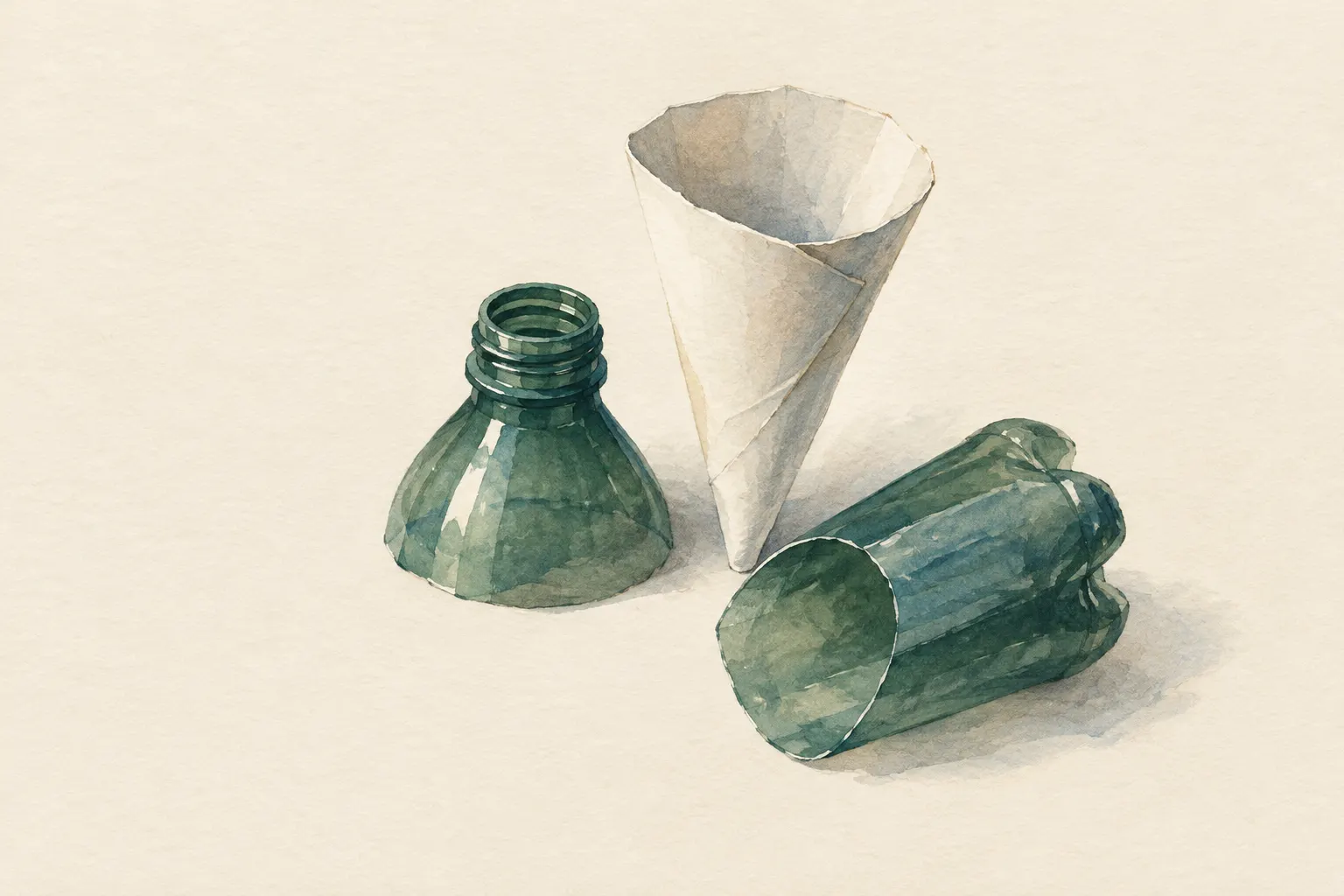
A cut-off bottle neck, a rolled paper cone or a piece of foil make a usable funnel; the lower part of a bottle becomes a scoop. Separation is what matters: anything used for drinking water and food must never come into contact with fuel, chemicals or dirty water.
- 5 minutes
Explained simply
A funnel is like a slide for liquids: it is wide at the top so you can pour in easily and narrow at the bottom so everything runs into a small opening, such as a bottle. You can make a funnel very easily from an old plastic bottle: you cut off the top part with the neck and turn it upside down. The bottom part of the bottle becomes a cup or scoop.
A little trick: to stop it glugging and overflowing, the air must be able to escape from the bottle. So hold the funnel slightly raised so a small gap remains.
The most important rule: a funnel for drinking water or food must never be used for petrol, methylated spirits or cleaning products – and the other way round. And fuel never goes into a drinks bottle, because then someone, especially a child, might drink it by mistake.
How it works
A funnel narrows the cross-section: the liquid hits a wide opening, gathers on the sloping wall and then runs in a concentrated stream through the narrow neck. That way it lands in a small opening in a controlled way instead of running down the side. A scoop works the other way round: it takes liquid out of a large open container so you can pour it on.
Before filling, every bottle is full of air. For liquid to run in, the same amount of air has to come out. If the funnel sits tightly in the opening, the air has to force its way up through the funnel in bubbles – that is the glugging. The funnel then drains slowly and easily slops over.
The solution is simple: lift the funnel slightly while pouring, or put a thin stick between the funnel and the bottle neck. Then the air can escape at the side and the liquid runs smoothly.
How to make it
Take a clean drinks bottle and make sure you know what was in it before. For water and food, only food-grade containers are suitable – that is, ones already meant for drinks or food. Cut the bottle straight across at about the upper third. The top part with the neck is your funnel; the bottom part is a scoop or measuring cup.
Fresh cut edges on plastic are surprisingly sharp. Cut away from your body, ideally with scissors, and then tape the edges or smooth them carefully. This applies even more to metal tins.
For dry things such as rice, sugar or flour, a cone of thick paper or multi-layer foil is enough. Paper does not last long with liquids because it soon goes soggy. Do not pour hot liquids through thin plastic funnels or into thin plastic bottles – they deform.
The separation rule
The most important part of this technique is not the cutting but the separating. Funnels and containers for fuel, oil or chemicals are clearly and permanently labelled and never used for water or food. Store them separately too, for example the fuel funnel in its own bag with the fuel bottles.
Containers that previously held chemicals, oil, fuel or pesticides are off-limits for drinking water and food – even after thorough rinsing. Residues can remain in crevices and in the material. Authorities such as the CDC and Ready.gov advise storing drinking water only in clean, food-grade containers.
Fuel never goes into drinks bottles. A water bottle filled with methylated spirits looks just like a water bottle filled with water – mix-ups can lead to poisoning, especially in children. For fuel, use only containers made and labelled for it.
Water hygiene: what a funnel cannot do
A funnel only transfers water – it does not make it any cleaner. Rainwater, water from a stream or pond and utility water stay exactly as they were. Before you drink water like that, it must be disinfected, for example by boiling. Follow the advice of the authorities when doing so.
So that clean water does not get contaminated while decanting, rinse the funnel beforehand and do not touch the inside. Ideally, use different, labelled funnels for drinking water and for utility water – such as water for flushing the toilet or for the garden.
The scoop made from the bottle base should stay clean too. Do not dip it into a drinking water supply with dirty hands; hold it by the rim, or better pour straight from the jerrycan.
Safety: what to watch out for
Decant fuel only outdoors, away from flames and only once the stove has cooled down completely. Fuel vapours can ignite even when there is no flame right next to them. Let spilled fuel evaporate before you light the stove.
Keep fuel and chemicals out of children's reach, in their labelled original containers or suitable fuel bottles. If someone has swallowed something poisonous, call the local emergency number (112 in the EU) or your regional poison control line.
Watch your fingers when cutting. Cut away from your body on a firm surface and tape sharp edges straight away. A well-made bottle funnel lasts a long time and saves a lot of spilled water.
Step by step
Choose a bottle
A clean drinks bottle whose contents were known. Only food-grade containers for water.
- 1
Choose a bottle
A clean drinks bottle whose contents were known. Only food-grade containers for water.
- 2
Cut
Cut the bottle across at about the upper third. The top with the neck is the funnel, the bottom part a scoop or measuring cup.
- 3
Secure the edges
Tape over the cut edges or smooth them carefully.
- 4
Vent
Lift the funnel slightly while pouring or put a thin stick between funnel and opening so air can escape.
- 5
Label
Store funnels for water and for fuel separately and label them permanently.
Common mistakes
- The same funnel for petrol and water
- Fuel in drinks bottles
- Pressing the funnel tightly into the opening
- Unknown jerrycans for drinking water
Quick view
Materials
PET bottle (clear, max. 2 litres)
Do not heat or place in a fire.
Multitool
Knife or scissors
Rules on carrying blades differ by place – check local rules.
Aluminium foil (heavy-duty)
Edges can be sharp; conducts heat and electricity.
Labels and waterproof marker
Suitable for
- Decanting water into cans or bottles
- Collecting rain or utility water
- Marked separately: decanting fuel
Not suitable for
- Containers that previously held chemicals, oil, fuel or pesticides, for food
- Hot liquids in thin plastic bottles
Prerequisites
- A clean bottle of known origin
- Knife or scissors
Safety
- Fresh cut edges on plastic and tins are sharp. Cut away from the body, tape over the edges.
- Decant fuel only outdoors, away from flames and with the stove cooled down.
How it works
A funnel narrows the cross-section so liquid flows from a large opening into a small one in a controlled way. To stop it glugging and overflowing, air must be able to escape from the receiving container – a gap between funnel and opening or a slightly raised funnel is enough.
Advantages
- Less spilled water
- Made from waste
Disadvantages
- Thin bottles are not very stable
- Risk of mix-ups without labelling
Deep knowledge
Background
Authorities such as the CDC and Ready.gov stress storing drinking water only in clean, food-grade containers and not using containers that previously held toxic substances.
Keeping water and fuel equipment separate is a simple rule that prevents many accidents.
Variants
- Paper or foil cone
- A thick sheet of paper or multi-layer foil rolled into a cone is fine for dry goods like rice or sugar; paper soon softens with liquids.
Common mistakes
- The same funnel for petrol and water
- Fuel in drinks bottles
- Pressing the funnel tightly into the opening
- Unknown jerrycans for drinking water
Limits and risks
- No water treatment
- Not for hot liquids
Material alternatives
Derived from material properties: a substitute must have all relevant properties. Observe the notes on the substitute.
- Aluminium foil (heavy-duty)
- Emergency blanket (Tears easily once punctured; short-term shelter only.), Signal mirror (Do not flash into the eyes of people nearby or of drivers.), High-visibility vest (Keep within reach inside the cabin, not in the boot/trunk.), Warning triangle (Whether warning triangles are mandatory, or should be placed at all on certain roads (e.g. motorways), differs between countries – check local rules.)
Results come exclusively from structured entries. No improvised instructions are generated.
Sources
Centers for Disease Control and Prevention: Making Water Safe in an Emergency
Drinking water only in clean, suitable containers
Ready.gov – U.S. Federal Emergency Management Agency (FEMA): Water (emergency water supply guidance)
No containers that previously held toxic substances