Whiteout on snow: stop or keep going?
In a whiteout, snow and fog merge into one white surface: you see neither terrain nor horizon, and slopes and drop-offs can no longer be recognised. The safest choice is to turn back in time or to stop and wait in shelter. If you must go on, then only on a known track or with a compass, in single file within sight, with snowballs thrown ahead to test the terrain – and well away from ridges with cornices.
- Decide at once; waiting can take hours
Explained simply
Imagine you are inside a giant glass of milk. Everything is white: the ground, the sky, the air. You cannot see where the ground ends and the sky begins, and you cannot tell whether you are going uphill or downhill. That is what a whiteout in snow is like.
In such a situation stopping is often the smartest thing. You find a flat spot, put on warm clothes, sit together in a bivvy bag and wait until you can see again. A whiteout usually ends at some point.
If you really have to go on, there is a trick: throw a snowball a few metres in front of you. Where it lands, you can see the ground. If it suddenly disappears, there is an edge there – then stop at once and go back.
How it works
Our eyes recognise terrain by shadows, edges and contrasts. In thick fog or snowfall over a continuous snow cover, light is scattered evenly from all sides: there are no shadows any more, and snow and sky have the same colour. The eye finds nothing to hold on to, distances and slopes cannot be judged, and some people even feel dizzy.
Navigation by sight then becomes impossible. You can only go on safely with aids that do not depend on seeing: a known track, a line of marker poles, a compass bearing, counted paces and measured time. A thrown snowball is a simple check of where the ground is and which way it falls away.
The hazards in the terrain remain, only invisible: avalanche slopes, drop-offs, crevasses and cornices. Cornices are overhanging roofs of snow that the wind builds on the downwind side of ridges. From above they look like solid ground but can break off far behind the edge.
What really matters
The best decision is made before the whiteout arrives. When fog rolls in or the snowfall thickens, memorise the track and terrain, fix the direction back with the compass and rather turn back than continue into unknown terrain. A turnaround point fixed beforehand takes the difficult decision off you under pressure.
If you are already in the middle of the white and in unknown or steep terrain, stopping is usually safest. Find a flat spot away from slopes and ridges, put on warm clothes before you get cold, sit on your pack or a mat and get into a group shelter bag with the group. Eat and drink something.
If you must go on, then in short legs: compass bearing, count paces, measure time, and stop if you do not arrive where you should. Walk in single file within sight and calling distance; the person behind checks the direction of the one in front. Throw snowballs ahead and probe with a pole. Avoid ridges – or stay well on the side the wind is coming from.
Safety: what to watch out for
In a whiteout you cannot judge slope angle or avalanche danger. Without training, avalanche equipment and knowledge of the current avalanche bulletin, you do not go into steep terrain. You never go onto a glacier without a rope team and training – there the rule in a whiteout is: stop and wait.
A rope between people sounds like safety but can be dangerous: without training and belay technique, one fall on steep ground can pull everyone down. So use ropes only if you are trained to do so. Otherwise keep in sight and calling contact and count heads regularly.
Waiting in snow chills you quickly. Watch for shivering, clumsiness and confusion – those are signs of developing hypothermia. If you cannot go on or someone is very cold, make the emergency call: 112; in Austria you can also reach the mountain rescue on 140.
When it makes sense – and when not
Going on is justifiable if you can follow a known track, a line of marker poles or a compass bearing into flat, known terrain – for example back to a nearby hut on a route you have just come along. Then the snowball test, a tight group and pace counting help.
Stopping is the better choice in unknown, steep or avalanche-prone terrain, on glaciers without a rope team, near ridges and when someone is exhausted. Anyone who is well equipped can often simply sit out a whiteout.
Good to know
Mountaineering textbooks such as 'Mountaineering: The Freedom of the Hills' count whiteout among the hardest situations in mountain navigation. Alpine clubs offer courses in winter navigation, avalanche awareness and glacier travel – this knowledge cannot be replaced by any text.
Plan winter trips so that you come back on a known track, carry a compass with a bearing set for the way back and read the weather and avalanche bulletins before the trip. The European Avalanche Danger Scale explains what the levels in these bulletins mean.
Step by step
React early
When fog rolls in or snowfall thickens, decide while you can still see something: memorise the track and terrain, fix the direction back with the compass, and rather turn back than continue into unknown terrain.
- 1
React early
When fog rolls in or snowfall thickens, decide while you can still see something: memorise the track and terrain, fix the direction back with the compass, and rather turn back than continue into unknown terrain.
- 2
Stop and wait in shelter
If you are in unknown, steep or avalanche-prone terrain, stopping is usually the safest choice. Find a flat spot away from slopes and ridges, put on warm clothing, sit insulated and get into a bivvy bag with the group. Whiteouts often clear after a while.
- 3
Only go on with a fixed aid
Only go on if you can follow a known track, a line of marker poles or a compass bearing into flat, known terrain. Count paces and time for each short leg and stop if you do not arrive where you should.
- 4
Single file within sight
Walk close together in single file, only so far apart that you can still see and hear each other. The person behind checks whether the one in front stays on the bearing and calls corrections. Count heads regularly. Ropes only with the corresponding training.
- 5
Throw snowballs ahead
Throw a firm snowball a few metres ahead of you. Where it lands you see the ground; if it rolls away, it shows which way the slope falls. If it suddenly disappears, there is an edge or a drop – stop at once and go back. Also probe ahead with a pole.
- 6
Avoid ridges and cornices
Cornices overhang on the downwind side of ridges and often break far behind the edge. In a whiteout you do not go onto ridges. If you must follow a ridge, stay well on the side the wind comes from and never near the edge.
- 7
Emergency call and warmth
If you cannot go on, someone is exhausted or very cold, make the emergency call (112, in Austria also 140) and stay where you are. Keep warm together, eat, drink and stay visible.
Common mistakes
- Turning back too late
- Pushing on 'quickly' into unknown terrain
- Letting the group spread out
- Walking on ridges or going to look over the edge
- Waiting without protection from the cold
Quick view
Materials
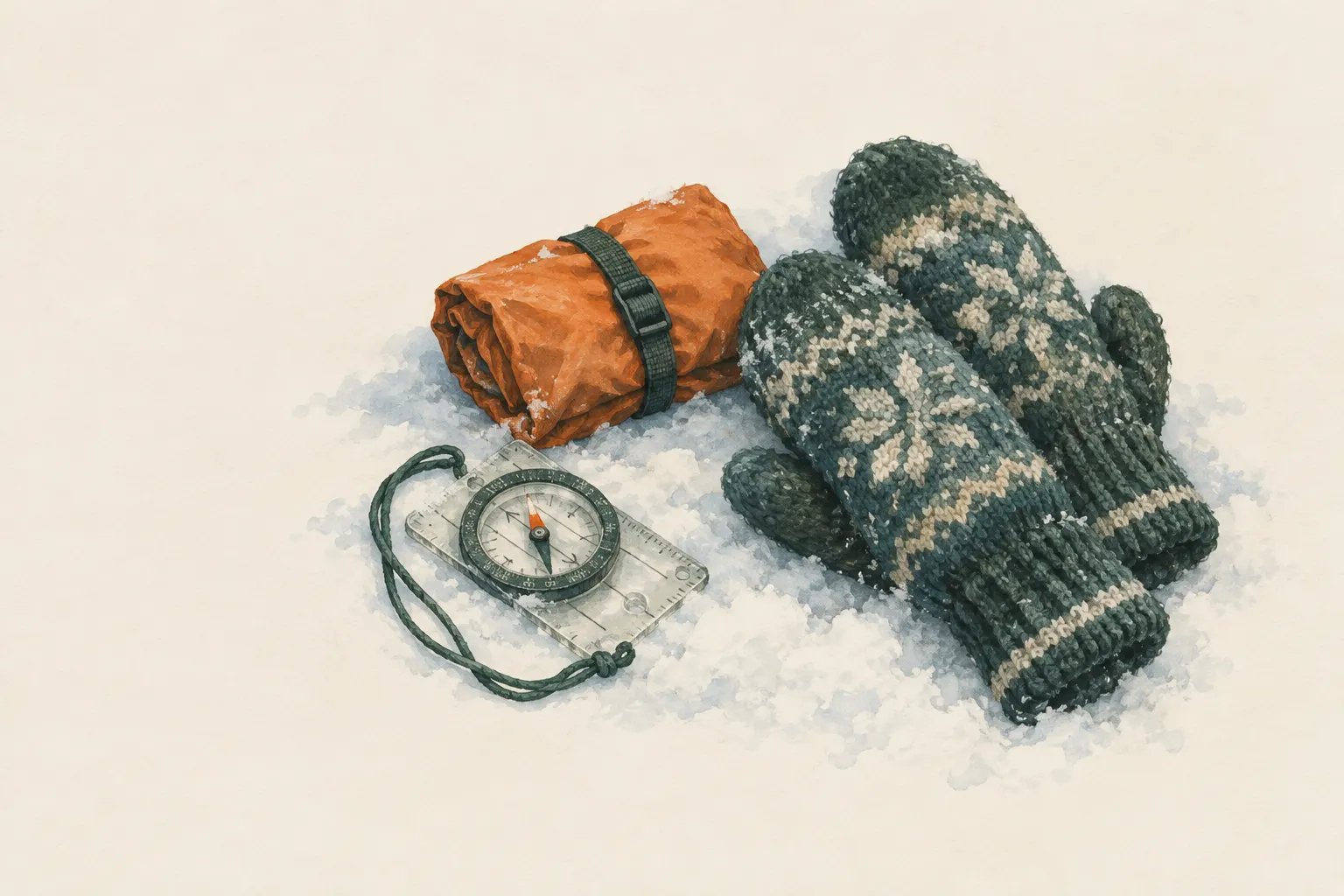
Group shelter bag
Or a bivvy bag for waiting in shelter
Airtight – ventilate regularly.
No stoves or candles inside.
Baseplate compass
With a bearing set beforehand
Metal, magnets and electronics nearby deflect the needle.
Bubbles in the capsule or a sluggish needle indicate a defect.
Snow shovel
Always take it inside when digging a snow shelter.
Trekking poles
For probing the ground
Dry spare clothing
Carry it in waterproof packaging – wet clothing barely insulates.
Suitable for
- Ski tours, snowshoe and winter hikes
- Sudden fog or snowfall on open snowfields
- Groups that must stay together
Not suitable for
- Glaciers without a rope team and training – stop there
- Avalanche terrain without training
- Ridges with cornices
Prerequisites
- Weather and avalanche forecast read
- Turnaround point and time fixed beforehand
- Warm spare clothing and bivouac protection carried
Safety
- Waiting in snow chills you quickly. Put on a layer before you get cold, sit insulated, get into a group shelter bag together and watch for signs of hypothermia. Emergency number 112 (Austria mountain rescue also 140).
- Only tie people together with a rope if you are trained to do so. On steep ground without protection, one fall can otherwise pull everyone down.
How it works
In a whiteout there are no shadows or contrasts: the eye finds no edges, distances and slopes cannot be judged, and often even up and down are unclear. Navigation by sight becomes impossible. Safety comes from giving up on unknown terrain, from fixed aids (a known track, compass, pace counting) and from checks that do not depend on seeing – a thrown snowball shows where the ground is and which way it falls away.
Advantages
- Clear decision rules for a dangerous situation
- The snowball test needs no equipment
- The group stays together
Disadvantages
- Waiting costs warmth and time
- Going on is only safe with a compass or track
- Dangers such as avalanches stay invisible
Deep knowledge
Background
Mountaineering textbooks such as 'Mountaineering: The Freedom of the Hills' describe whiteout as one of the hardest situations in mountain navigation and advise compass, pace counting, close group control and turning back. They treat cornices as a typical, hard-to-recognise hazard on ridges.
The European Avalanche Danger Scale describes the danger levels used in the avalanche bulletins of the Alpine countries. A whiteout does not change the avalanche danger – you just cannot see it any more.
Variants
- Marked winter route
- On winter routes marked with poles you go from pole to pole: only move on when the next one is visible, and keep the last one in sight until then.
- Fog without snow
- General rules for navigating at night and in fog are in a separate entry.
Common mistakes
- Turning back too late
- Pushing on 'quickly' into unknown terrain
- Letting the group spread out
- Walking on ridges or going to look over the edge
- Waiting without protection from the cold
Limits and risks
- No avalanche training – take courses with Alpine clubs
- No glacier or rope technique
- No figures for safe distances from cornice edges
Material alternatives
Derived from material properties: a substitute must have all relevant properties. Observe the notes on the substitute.
- Group shelter bag
- Tarp, Plastic sheet / large bin bag (Tears easily; never pull over the head (suffocation risk).), Emergency blanket (Tears easily once punctured; short-term shelter only.), Document folder (waterproof) (Store securely – contains sensitive personal data.), Rain poncho (When used as a shelter, it no longer protects your body from rain.), Bivy bag (Never fully close off the face.), Tent (Do not cook or heat inside the tent (fire and carbon monoxide danger).), Heavy-duty bin bag (large) (Suffocation risk: never pull plastic bags over the head or face and keep them away from small children.)
- Trekking poles
- Sturdy sticks / poles (Do not cut live wood where prohibited.), Tent pole repair sleeve (Temporary only – have broken sections replaced at home.), Round logs (straight, sound) (Fell or take only with the forest owner's permission.)
- Dry spare clothing
- Sleeping pad, Dry leaves, grass or conifer boughs (Collect only where allowed; no protected plants. Check for ticks and insects.), Backpack, Wool blanket / duvet (Keep away from candles, stoves and heaters.), Insulated cool box (Keeps cold only for a limited time; without ice packs or ice it is not a fridge.), Sleeping bag (Do not store compressed long-term; do not pack away damp.), Newspaper and cardboard (Flammable – keep away from candles, stoves, heaters and embers.), Insulated cooking box (hay box, thermal cooker) (Never put open flame or embers inside – only the hot, closed pot.), Long-stemmed thatch (reed, grass, rushes) (Extremely flammable – no open fire and no sparks nearby.)
Results come exclusively from structured entries. No improvised instructions are generated.
Sources
The Mountaineers Books (2017): Mountaineering: The Freedom of the Hills, 9th edition
Navigating in whiteout, compass and group control; cornices on ridges
European Avalanche Warning Services (EAWS): European Avalanche Danger Scale
Avalanche danger levels and avalanche bulletins
Headquarters, Department of the Army (USA) (2001): FM 3-25.26 Map Reading and Land Navigation
Pace counting and short legs in poor visibility
Wilderness & Environmental Medicine (Wilderness Medical Society) (2019): Wilderness Medical Society Clinical Practice Guidelines for the Out-of-Hospital Evaluation and Treatment of Accidental Hypothermia: 2019 Update
Preventing hypothermia while waiting in the cold