Sleep and daily structure in prolonged crises
A power cut lasting several days, an evacuation or long isolation wear people down above all through uncertainty and lack of sleep. A simple daily structure, protected rest times, watch and rest shifts in the group, daylight, movement and fixed news times help you stay able to act over days and weeks.
- Plan once, then stick to it daily
Explained simply
Imagine your body is like a phone battery. During the day it runs down, and during sleep it charges up again. When a crisis lasts many days – a long power cut, for example – people often forget to recharge. They stay up late, keep checking the news and worry. Then the battery gets emptier and emptier: you become irritable and anxious, make more mistakes and argue more quickly.
What helps is a simple daily plan, like at school: fixed times for getting up, eating, working, playing, listening to the news and sleeping. During the day go outside into the daylight, move about, and in the evening do something calm, such as reading aloud. If someone has to stay awake at night, take turns so that everyone can get enough sleep.
Very important: never use a grill, gas stove, outdoor heater or generator to warm a room where people sleep. These devices make an invisible gas called carbon monoxide that you cannot smell and that can kill during sleep.
How it works
In long crises the biggest problem is usually not the single moment of shock but the ongoing strain. Uncertainty, noise, cold, unfamiliar sleeping places and worry rob people of sleep. Lack of sleep in turn makes people more irritable, more anxious and slower in their thinking. This creates a cycle: if you sleep badly you worry more – and if you worry more you sleep worse.
The body has an internal clock that is set mainly by light. Daylight in the morning and during the day signals “be awake”, darkness in the evening signals “sleep soon”. When usual routines disappear – work, school, regular meals – this clock easily gets out of step. Fixed times and daylight help it keep the beat.
A daily structure also affects the mind. When the day has a clear sequence, there are fewer empty hours for brooding, and everyone knows what comes next. The US Army survival manual names fatigue, uncertainty and isolation as stressors in their own right – a daily structure works against all three at once.
What really matters
Write down a simple daily plan and put it up where everyone can see it: getting up, meals, tasks, news times, rest time, sleep. It doesn't have to be perfect, just reliable. For children in particular it is reassuring to see: after lunch there is play, after supper comes the story.
If someone has to stay awake at night – because of a small child, a sick person, a fire in the stove or for safety – set up shifts. The aim is for everyone to get an unbroken block of sleep, instead of everyone dozing half awake all night. If you are alone, agree fixed contact times with relatives or neighbours as far as communication allows.
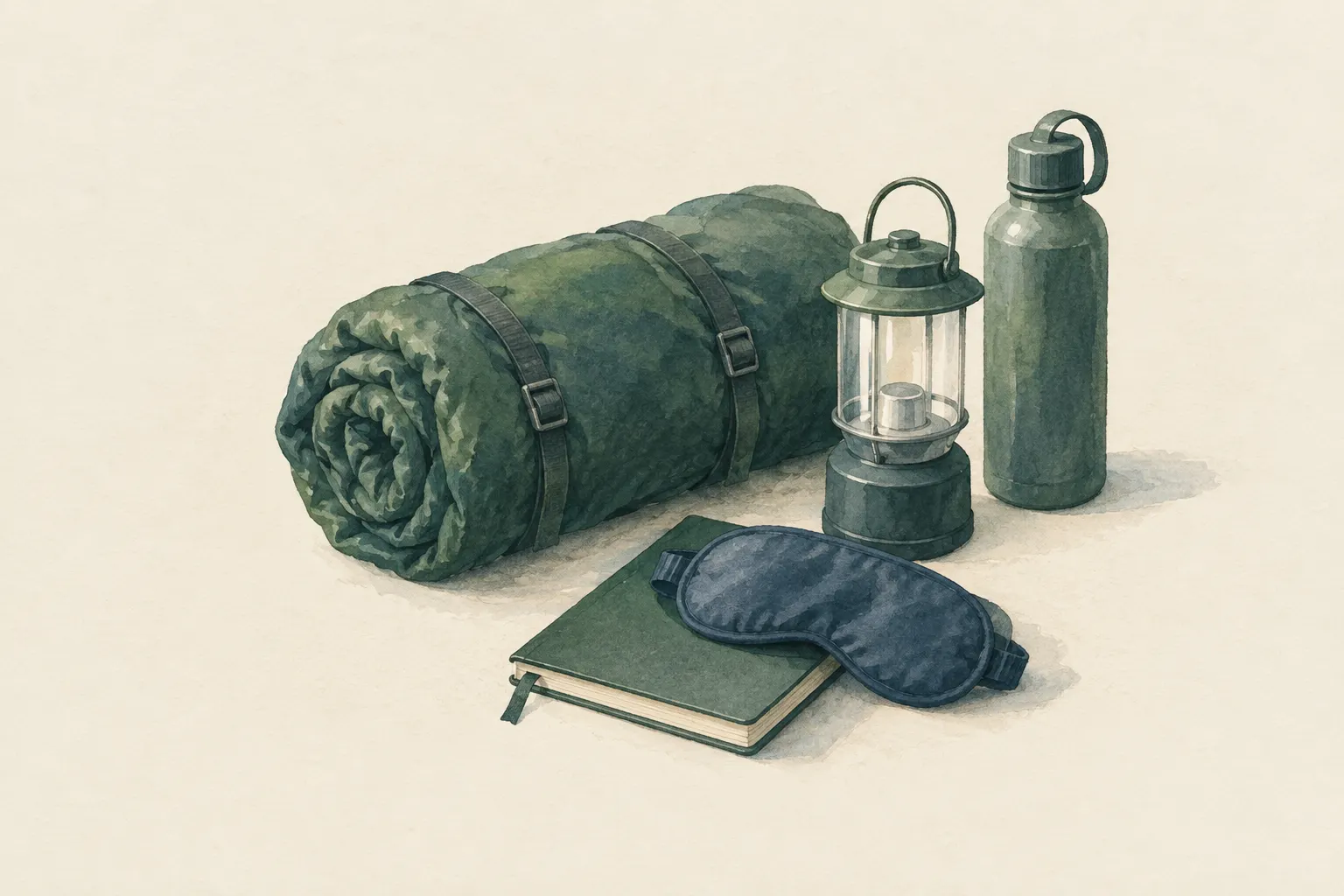
Improve the sleeping place: warm, dry, as dark and quiet as possible. A sleeping mat or blankets against the cold from below, an eye mask against light. Head torches with a red or dimmed mode disturb others less. Listen to the news at fixed times instead of constantly – one person can follow the situation and pass on what matters.
Winding down in the evening
The body needs a transition from day to night. It helps to make the last hour before sleep calm: reading aloud, talking quietly, a game without excitement, calm breathing. Difficult conversations and crisis news are better placed during the day.
Caffeine from coffee, black tea, cola or energy drinks keeps working for many hours – better to avoid it late in the day. Alcohol may make you sleepy, but it worsens sleep in the second half of the night and your judgement the next day. It is not a sleep aid.
If sleep is missing at night, short rests during the day help – especially before demanding or risky tasks. Anyone who wants to take sleeping pills or sedatives, or who has been hardly sleeping for some time, should discuss it with a doctor. Deliberately, no recommendations on this are given here.
Safety: what to watch out for
Severe tiredness is dangerous. It slows reactions and impairs judgement, often without you noticing it yourself. When overtired, do not drive, do not handle tools, fire, stoves or generators, and do not make risky decisions alone. Anyone who “pushes through” for days without sleep puts themselves and others at risk.
Carbon monoxide (CO) forms when something burns incompletely – for example in grills, gas stoves, outdoor heaters or generators. The gas is invisible and odourless and can be fatal during sleep, because you don't notice warning signs such as headache and dizziness. Such devices never belong in living or sleeping rooms. A CO alarm is a sensible safeguard. If you suspect CO, get into fresh air immediately and call the emergency number (112 in the EU).
Earplugs are only fine if warnings, alarms or calls will still be noticed – for example because someone is keeping watch. Children should sleep close to familiar people so they can find someone if they wake up at night.
Typical situations
During a longer power cut, daily routines often shift on their own: it gets dark, cold and quiet early, TV and internet are gone. Evenings become long. A deliberate plan – a shared supper, reading aloud by candle or lamp light, a fixed bedtime – turns that time into recovery instead of brooding.
Emergency shelters are often noisy, bright and crowded. Not everything can be controlled there, but some things can: an eye mask, earplugs (if someone is keeping watch), a corner for the family, familiar objects for children. Agreements with the neighbours on the next camp bed help too.
In long isolation, for example in quarantine or in cut-off places, structure is especially important. Fixed times for movement, tasks, contact with others and breaks hold the day together. Sleep and contact with other people are not side issues here but the foundation for staying able to act over days and weeks.
Step by step
Set a daily plan
Agree fixed times for getting up, meals, tasks, news, rest and sleep, and write them down where everyone can see them.
- 1
Set a daily plan
Agree fixed times for getting up, meals, tasks, news, rest and sleep, and write them down where everyone can see them.
- 2
Watch and rest shifts
If someone has to stay awake (children, sick people, security, a fire in the stove), set up shifts so that everyone gets an unbroken block of sleep.
- 3
Improve the sleeping place
Warm, dry, as dark and quiet as possible: insulation from the ground, blankets, an eye mask, earplugs if appropriate. Let children sleep close to familiar people.
- 4
Daylight and movement
During the day seek daylight and move about as far as safely possible. This helps many people fall asleep more easily in the evening.
- 5
Ration the news
Listen to official information at fixed times instead of constantly. One person follows the situation and passes on what matters.
- 6
Wind down in the evening
Avoid caffeine late in the day, do not use alcohol as a sleep aid, do something calm before sleep (reading aloud, talking, calm breathing).
- 7
Short rests when needed
If sleep is missing at night, plan short rest periods during the day – especially before demanding or risky tasks.
Common mistakes
- "Pushing through" for days without sleep
- Constantly following news and social media
- Using alcohol to fall asleep
- Dangerous heat sources in the sleeping room
- No sharing of tasks – one person carries everything
Quick view
Materials
Earplugs and eye mask
Only use if warning signals, alarms or calls will still be heard – e.g. when someone is keeping watch.
Sleeping pad
Wool blanket / duvet
Keep away from candles, stoves and heaters.
Headlamp / flashlight
Red or dimmed mode disturbs others' sleep less
Suitable for
- Longer power or heating failures
- Emergency shelters, evacuation, quarantine, long waits while travelling
Not suitable for
- Treating sleep disorders or using sleeping pills – get medical advice for that
Prerequisites
- A safe place to sleep
- Agreement within the group or family
Safety
- Only use earplugs if warnings, alarms or calls will still be noticed – for example because someone is keeping watch.
How it works
In prolonged crises the main problem is not the single moment of shock but the ongoing strain. Lack of sleep, irregularity and constantly following the news amplify fear, irritability and mistakes. A fixed structure gives the day something to hold on to, spreads the burden across the group and creates islands of recovery. The US Army survival manual also lists fatigue as a stressor in its own right.
Advantages
- Preserves performance and judgement
- Reduces conflict and mistakes
- Easy to put into practice
Disadvantages
- Hard to implement in noisy, crowded shelters
- Requires discipline from the whole group
Deep knowledge
Background
The US Army manual FM 3-05.70 names fatigue alongside cold, heat, hunger, thirst, uncertainty and isolation as typical stressors in survival situations. Guides to psychosocial support in emergencies stress that basic needs, structure and social connection are the foundation of psychological stability.
During a longer power cut, daily routines often shift on their own: darkness, cold and a lack of distraction make evenings long. A deliberate plan turns that time into recovery instead of brooding.
Variants
- Alone
- If you are alone, agree fixed contact times with relatives or neighbours as far as communication allows. Structure and contact protect against the feeling of isolation.
Common mistakes
- "Pushing through" for days without sleep
- Constantly following news and social media
- Using alcohol to fall asleep
- Dangerous heat sources in the sleeping room
- No sharing of tasks – one person carries everything
Limits and risks
- No treatment of sleep disorders
- No recommendations on sleeping pills or sedatives
- No fixed hour figures – individual needs differ
Material alternatives
Derived from material properties: a substitute must have all relevant properties. Observe the notes on the substitute.
- Sleeping pad
- Dry leaves, grass or conifer boughs (Collect only where allowed; no protected plants. Check for ticks and insects.), Backpack, Dry spare clothing (Carry it in waterproof packaging – wet clothing barely insulates.), Wool blanket / duvet (Keep away from candles, stoves and heaters.), Insulated cool box (Keeps cold only for a limited time; without ice packs or ice it is not a fridge.), Sleeping bag (Do not store compressed long-term; do not pack away damp.), Newspaper and cardboard (Flammable – keep away from candles, stoves, heaters and embers.), Insulated cooking box (hay box, thermal cooker) (Never put open flame or embers inside – only the hot, closed pot.)
- Wool blanket / duvet
- Sleeping pad, Dry leaves, grass or conifer boughs (Collect only where allowed; no protected plants. Check for ticks and insects.), Backpack, Dry spare clothing (Carry it in waterproof packaging – wet clothing barely insulates.), Insulated cool box (Keeps cold only for a limited time; without ice packs or ice it is not a fridge.), Sleeping bag (Do not store compressed long-term; do not pack away damp.), Newspaper and cardboard (Flammable – keep away from candles, stoves, heaters and embers.), Insulated cooking box (hay box, thermal cooker) (Never put open flame or embers inside – only the hot, closed pot.)
- Headlamp / flashlight
- Mobile phone (The battery drains quickly in cold and with continuous screen and GPS use.), Battery lantern / LED light
Results come exclusively from structured entries. No improvised instructions are generated.
Sources
Headquarters, Department of the Army (USA) (2002): FM 3-05.70 Survival
Fatigue and isolation as stressors in survival situations
Inter-Agency Standing Committee (IASC) (2007): IASC Guidelines on Mental Health and Psychosocial Support in Emergency Settings
Basic needs, structure and social support as the basis of psychosocial stability