A basic household tool kit
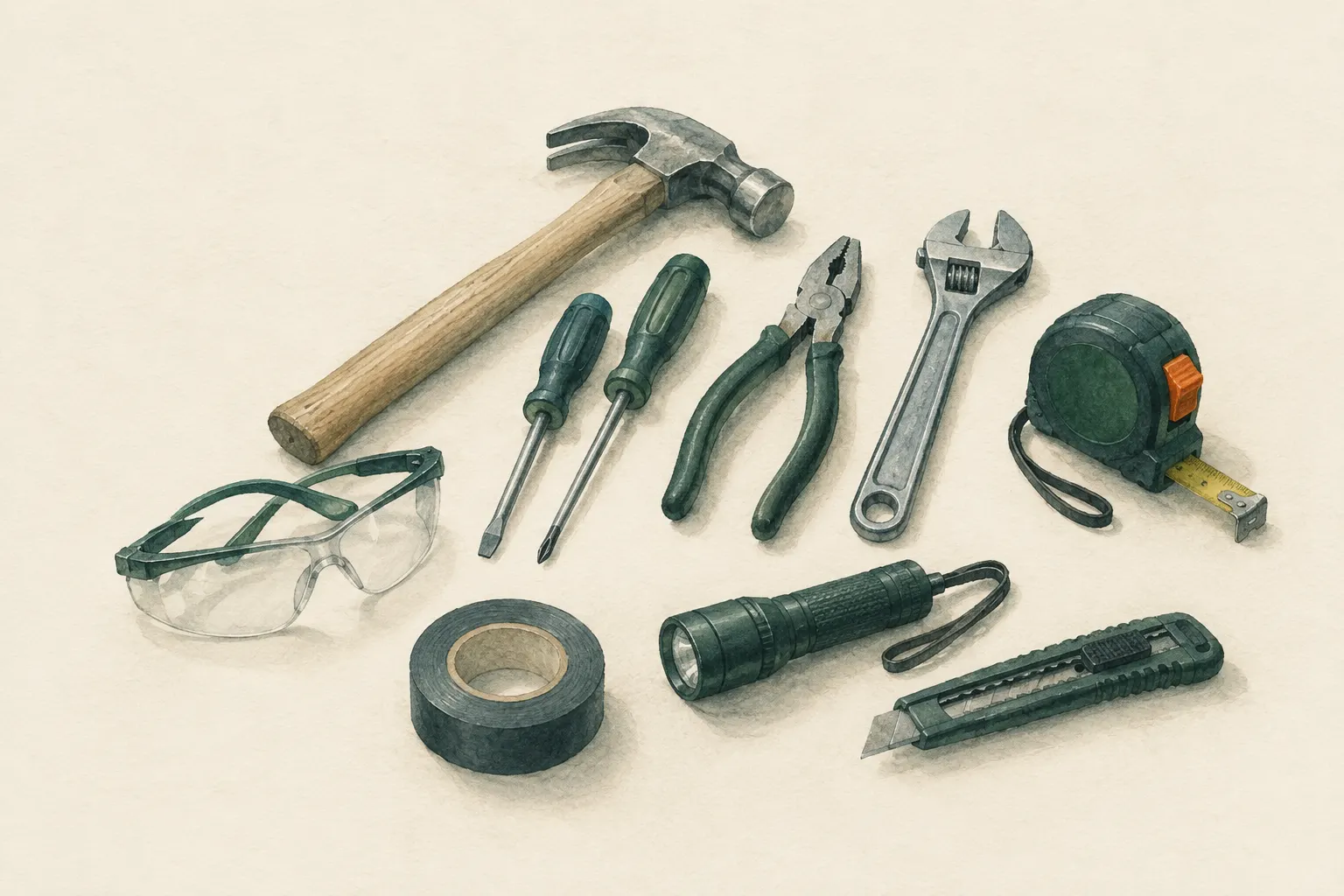
A modest tool kit covers most small repairs: hammer, screwdrivers, pliers, spanners or an adjustable wrench, utility knife, tape measure, tape, torch and safety glasses. More important than lots of tools is that they are in a fixed place, work and that you know how to use them.
- A few hours to put together
Explained simply
A tool kit is like a first-aid kit for your home. When a cupboard wobbles, a chair leg is loose or a screw falls out, you have the right thing to hand straight away. You do not need much: a hammer, a few screwdrivers, pliers, an adjustable wrench, a utility knife, a tape measure, tape, a light and safety glasses.
More important than lots of tools is that they are always in the same place. Imagine the lights go out at night and water is dripping somewhere – you do not want to search in the dark. That is why a head torch belongs in the kit too: a lamp you wear like a headband, so both hands stay free.
And one more thing: tools do not automatically make you a professional. Safety glasses protect your eyes when hammering and cutting. Work on electrics, gas and heating is always a job for professionals.
What goes in – and what for
Most household tasks come down to a few basic movements: turning, striking, gripping, cutting, measuring, holding and seeing. A good tool for each is enough. Screwdrivers come with different tips – flat (slotted), cross-shaped and other forms. A set with interchangeable bits covers many screw heads. If the tip does not fit exactly, it slips and damages the screw head.
Combination pliers grip, bend and hold; needle-nose pliers reach into tight corners. An adjustable wrench can be set to different nut sizes. It should fit snugly, otherwise it rounds off the corners of the nut. A utility knife cuts cardboard, plastic sheeting and tape; retract the blade after every cut. A tape measure and spirit level help when putting up shelves.
Then come consumables: duct tape, cable ties, cord, wire, glue and screws and wall plugs in common sizes. With these a lot can be secured temporarily until a proper repair is possible.
What really matters
A fixed, dry place is half the tool. If you know where the kit is during stress or a power cut, you save minutes that can matter – for example when water is leaking and the tap has to be shut off. Rust is caused by moisture, so do not store tools in a damp cellar, or oil them lightly from time to time.
Quality is worth more than quantity. A screwdriver whose tip bends on the first firm turn, or pliers that do not close, do not help. You do not need the most expensive, but tools should feel solid and sit well in the hand.
And you have to know how to use them. A tool you have never held is of little use in an emergency. Small everyday jobs – hanging a picture, adjusting a cupboard door – are the best practice.
For emergencies: know your shut-offs
Emergency guides recommend keeping a wrench or pliers to hand to turn off utilities. But for that you need to know where the shut-offs are: the main water stopcock, the isolation valves under basins and the consumer unit. Note these places and keep the note with the tools.
With gas, restraint matters. Gas is only shut off if you smell gas or the authorities or the supplier tell you to – and only as the supplier describes. It is turned back on by professionals. If you smell gas, getting out of the building comes before any other action.
Safety: what to watch out for
When hammering, drilling and cutting, splinters, nail heads or shavings can fly off. Safety glasses cost little and protect the eye, which cannot be replaced. Work gloves protect against splinters and sharp edges, but do not belong near rotating machines where they can be caught.
Always move blades away from your body and keep your other hand out of the cutting line. Clamp workpieces rather than holding them by hand. Keep tools, especially knives and small parts, out of children's reach.
The most important boundary: tools do not replace expertise. Work on electrical wiring, gas pipes, heating and load-bearing structures belongs to professionals – even if the right tool is in the box.
Care and light
A head torch with spare batteries belongs in every tool kit, because many repairs happen in the dark or under the sink. Batteries can leak if left in a device for a long time, so check them regularly or store them separately.
A cordless drill makes many jobs easier but needs charged batteries. During a longer power cut it is only of limited use – hand tools always work. Once a year it is worth looking through the kit: replace blunt blades, remove rust, restock what is missing.
Step by step
Core set
Hammer, set of screwdrivers (flat and cross-head) or a bit set, combination pliers, needle-nose pliers, adjustable wrench, utility knife, tape measure, spirit level.
- 1
Core set
Hammer, set of screwdrivers (flat and cross-head) or a bit set, combination pliers, needle-nose pliers, adjustable wrench, utility knife, tape measure, spirit level.
- 2
Consumables
Duct tape, cable ties, screws and wall plugs in common sizes, cord, wire, glue.
- 3
Protection and light
Safety glasses, work gloves, head torch with spare batteries.
- 4
For emergencies
Tools that fit your own shut-off devices kept with the tool kit; note where the shut-offs are.
- 5
Store and maintain
Store dry, remove rust, replace blades, check batteries. Keep out of children's reach.
Common mistakes
- Tools scattered all over the home
- Cheap tools that fail the first time
- No light in the tool kit
- Working without safety glasses
Quick view
Materials
Household tool kit
Store tools out of children's reach; wear safety glasses for striking and cutting work.
Duct tape
Do not use on power cables, gas lines or as a wound dressing.
Adhesive can soften in heat and leave residue.
Headlamp / flashlight
Close-fitting safety goggles
Sturdy work gloves
When handling flood mud or chemicals, also wear waterproof gloves.
Suitable for
- Every household
- Small repairs during crises
- Shutting off utilities as instructed by the supplier
Not suitable for
- Work on gas, electrical wiring or load-bearing structures
Prerequisites
- A fixed, dry storage place
- Knowing where your own shut-off valves and fuses are
Safety
- Wear safety glasses when hammering, drilling and cutting; cut away from your body.
- Tools do not replace expertise. Gas, electrical and heating work remains a job for professionals.
How it works
A few good tools cover the most common tasks: turning screws, driving nails, gripping, cutting, measuring, fixing and seeing. A fixed place ensures you can find them in the dark and under stress.
Advantages
- Quick help with small damage
- One-off purchase
Disadvantages
- Cost and space
- Only useful with practice
Deep knowledge
Background
Ready.gov lists, among other things, a wrench or pliers to turn off utilities, duct tape and a flashlight for the emergency kit.
The rest of the selection is general household practice; scope and quality depend on the type of home and skills.
Variants
- Cordless drill
- A cordless drill makes many jobs easier but needs charged batteries – only of limited use during a power cut.
Common mistakes
- Tools scattered all over the home
- Cheap tools that fail the first time
- No light in the tool kit
- Working without safety glasses
Limits and risks
- No product recommendations
Material alternatives
Derived from material properties: a substitute must have all relevant properties. Observe the notes on the substitute.
- Headlamp / flashlight
- Mobile phone (The battery drains quickly in cold and with continuous screen and GPS use.), Battery lantern / LED light
Results come exclusively from structured entries. No improvised instructions are generated.
Sources
Ready.gov – U.S. Federal Emergency Management Agency (FEMA): Build A Kit
Wrench or pliers to turn off utilities, duct tape, flashlight