Learning and sharing skills: courses, repair cafés, swapping
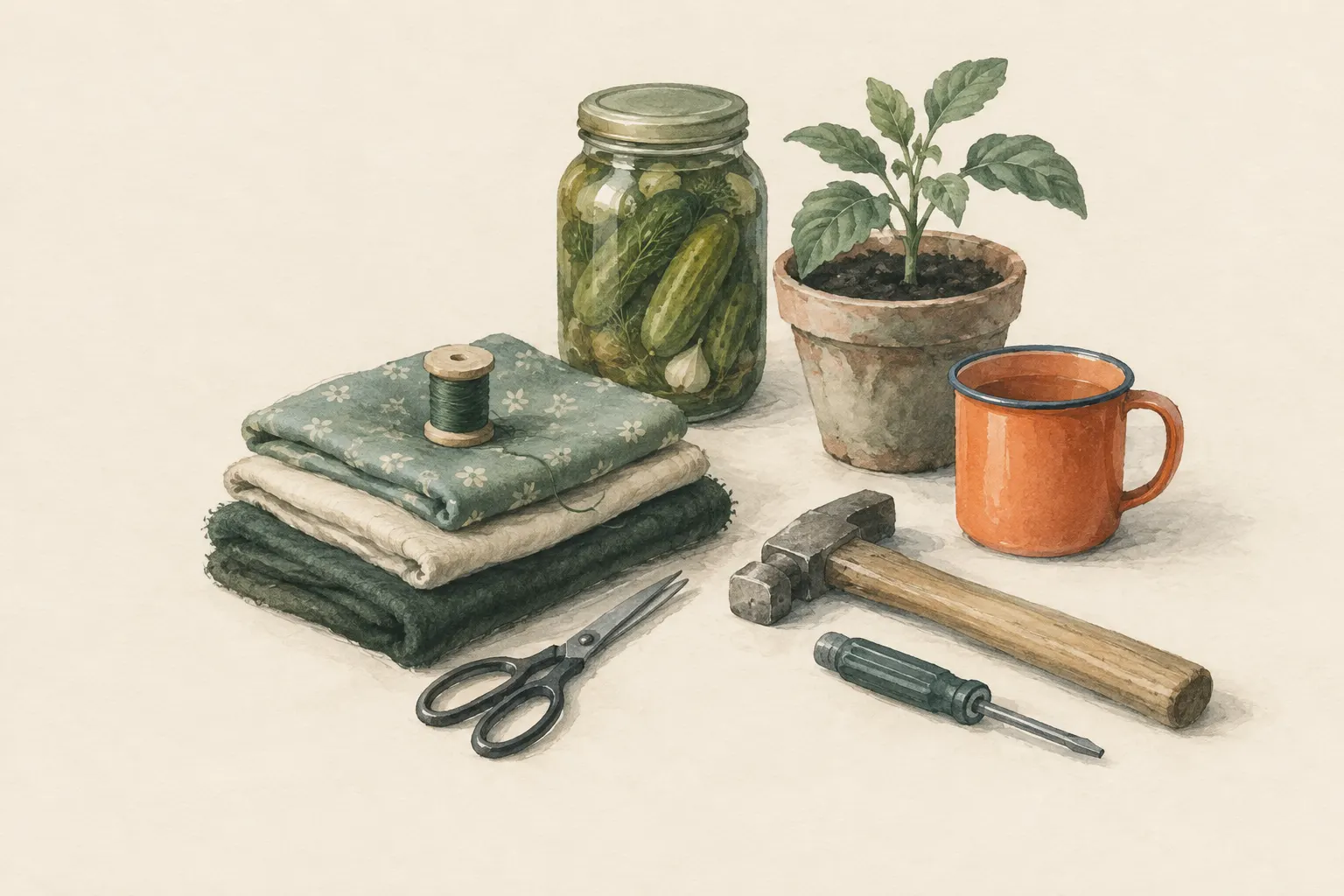
Nobody can do everything. Self-reliance works better in a neighbourhood where people share their skills: preserving, sewing, repairing, gardening, first aid. Courses by adult-education centres, clubs and relief organisations, repair cafés, swap and time-bank groups and tool libraries are good ways to learn skills and share equipment – before a crisis.
- Ongoing, a few hours a month
Explained simply
Nobody can do everything. One neighbour sews beautifully, another repairs bikes, a third knows all about vegetable beds, and someone has done a first-aid course. When everyone shares what they know, the whole neighbourhood is stronger – just as a jigsaw only makes a picture when all the pieces are together.
Learning works best when someone shows you something and you then try it yourself. There are many places for this: courses at adult-education centres, clubs, relief organisations that teach first aid, and repair cafés. These are meetings where people repair broken things together. There are even tool libraries where you can borrow tools like books.
The most important thing: you make contacts before anything happens. If you already know your neighbours, you know whom to ask in an emergency. And some things, like preserving food in jars, you only learn from tested recipes, because mistakes can make people ill.
Why sharing works better
A single household cannot have every skill and tool it might need in a crisis. Across a community, however, they are spread widely: what one family cannot do, another can. Tools that everyone needs only rarely do not have to be bought by everyone. That saves money, space and resources.
Then there is trust. Networks that already exist in everyday life also hold up in an emergency. People who know each other ask for help sooner and offer it sooner. That is why emergency guides repeatedly stress the importance of neighbours and community involvement in preparedness.
Sharing is not a one-way street. Everyone has something to contribute – time, patience, a skill, a tool or simply the willingness to help out at a meeting.
Where you can learn
Adult-education centres and similar institutions often offer low-cost courses, for example in sewing, cooking, gardening or bike repair. Gardening clubs share knowledge about growing, seeds and storage. Relief organisations offer first-aid courses – one of the most valuable skills of all, and one you should refresh regularly.
Repair cafés are meetings where volunteers repair broken things together with visitors: clothes, bikes, toys, small furniture. You learn how things are built and often take away more than just the repaired item. Tool libraries lend out tools you rarely need. Libraries and local initiatives sometimes offer workshops too.
What is on offer varies from place to place. Looking through local council programmes, notice boards or local news helps you find what suits you.
What really matters
It starts with an honest inventory: what can I already do, and what would I like to learn? A sheet of paper with two columns is enough. Perhaps you bake well but cannot sew – then that is a swap offer and a learning goal at the same time.
You learn best by doing it yourself under guidance and then practising regularly. Videos can help, but they do not replace trying it yourself. What you have only watched rarely sticks when it counts.
A network needs looking after. Note contacts and who can do what, meet now and then, and stay in touch. That way you know whom to ask in an emergency – and the others know they can ask you.
Safety: what to watch out for
Some activities are dangerous if learned wrongly. Preserving, especially canning, is learned only from tested recipes. Unsafe methods can cause serious food poisoning. Dangerous work with tools, fire or heights is learned only with qualified instruction.
Community does not replace professionals. Work on gas, electrical installations and load-bearing structures remains a job for professionals, even if someone in the neighbourhood “knows about it”. Medical treatment belongs to doctors – first aid only bridges the gap until then; in an emergency call the local emergency number (112 in the EU).
Hygiene, safety and legal rules apply when exchanging food, appliances or medicines. Do not pass on medicines. For swap groups and time banks, where hours are exchanged instead of money, clarify the rules and possible tax questions – check local rules.
Passing it on yourself
Sharing also means offering something yourself: a small workshop, help for an older neighbour, a seed or tool swap. You do not have to be a professional to show others how to sew on a button or patch a bike inner tube. Explaining something often helps you understand it even better yourself.
Such encounters have a value beyond the individual skill. They build trust and togetherness. In a crisis especially, the feeling of not being alone matters as much to many people as supplies and tools.
Step by step
Take stock
Write down what you can do and what you would like to learn, e.g. sewing, preserving, bikes, first aid, gardening.
- 1
Take stock
Write down what you can do and what you would like to learn, e.g. sewing, preserving, bikes, first aid, gardening.
- 2
Find courses
Adult-education centres, gardening clubs, relief organisations (first aid), libraries and local initiatives often offer low-cost courses.
- 3
Repair café and tool library
Learn to repair together and borrow tools instead of buying.
- 4
Pass it on
Offer your own skills: a workshop, help in the neighbourhood, seed or tool swaps.
- 5
Maintain the network
Note contacts and their skills, meet regularly, and know whom to ask in a crisis.
Common mistakes
- Learning only from videos without practice
- Dangerous tasks without qualified instruction
- Looking for a network only once the crisis hits
Quick view
Materials
Field notebook and pencil
Suitable for
- Learning new skills safely
- A neighbourhood network for crises
- Sharing equipment instead of buying
Not suitable for
- Replacing professionals for gas, electrics and structures
- Medical treatment
Prerequisites
- Willingness to learn and give time
- An overview of your own skills and gaps
Safety
- Learn preserving only from tested recipes. Unsafe canning methods can cause serious food poisoning.
- Hygiene, safety and legal rules apply when exchanging food, medicines or appliances. Do not pass on medicines; check local rules.
How it works
Skills are spread more widely across a community than within a single household. People who learn by doing under guidance retain more. Networks that already exist in everyday life also hold up in a crisis – people who know each other help each other faster.
Advantages
- Learning with guidance is safer
- Strengthens community
- Saves money and resources
Disadvantages
- Takes time
- Offers vary by region
Deep knowledge
Background
In its guide "Are You Ready?" FEMA highlights the importance of neighbours and community involvement in preparedness, for example through volunteer training programmes.
Repair cafés and tool libraries have appeared in many towns; swap groups and time banks have existed for decades.
Variants
- Swap groups and time banks
- Some communities exchange hours instead of money. Clarify the rules and possible tax questions – check local rules.
Common mistakes
- Learning only from videos without practice
- Dangerous tasks without qualified instruction
- Looking for a network only once the crisis hits
Limits and risks
- No list of specific providers
- No legal or tax advice
Sources
U.S. Federal Emergency Management Agency (FEMA): Are You Ready? An In-Depth Guide to Citizen Preparedness
Neighbours and community involvement in preparedness