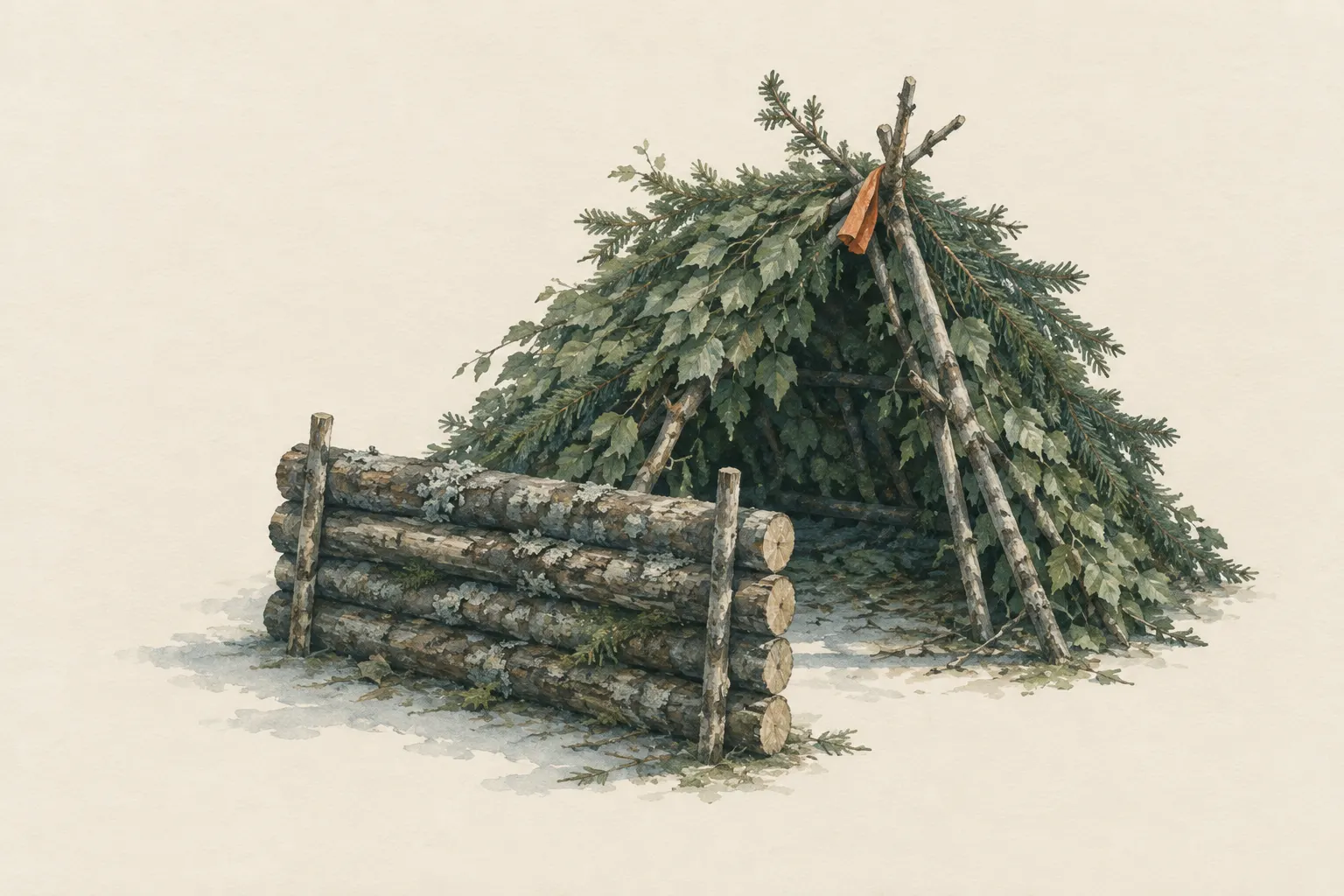
Natural lean-to with fire reflector
A lean-to of poles with a dense covering of branches or leaves, with a small fire burning in front; a wall of logs or rocks behind the fire throws radiant heat back. It is labour-intensive, needs constant fire supervision and is only permissible where fires and collecting material are allowed.
- Several hours plus firewood for the night
Explained simply
A campfire warms you mainly through radiation – just as the sun warms your face even when the air is cold. That warmth flies off in all directions. If you build a wall of logs or rocks behind the fire, part of the warmth is thrown back towards you, a bit like a mirror throwing back light.
It comes with a lean-to of poles, thickly covered with branches or leaves. It keeps off rain and wind, and the sloping roof also directs some warmth towards you.
Most important: a roof of dry material burns very easily. The fire must be small, at a distance and always watched. And it may only burn where fires are allowed – never in drought or wind.
How it works
Heat can be transferred in three ways: by conduction (direct contact), by convection (moving warm air) and by radiation. With an open fire, the hot air mostly rises and escapes upwards. What warms you in front of the fire is mainly radiation, which travels in straight lines.
Without a reflector, most of that radiation is lost to the surroundings. A wall of stacked logs or rocks behind the fire catches part of it, warms up and gives warmth back towards the shelter. The sloping back of the lean-to acts in a similar way from the other side. The person lies in between.
At the same time the roof does its actual job: it keeps off rain and wind. For water to run off, it is covered from bottom to top so that each layer overlaps the one below – like roof tiles.
Safety: what to watch out for
The biggest danger is that the shelter itself catches fire. Dry branches and leaves burn very quickly. Keep enough distance between fire and roof, watch for sparks, keep extinguishing material ready – such as water or soil – and never leave the fire unattended. There is no fixed distance figure: it depends on the size of the fire, the wind and the material.
No fire is lit in drought, wind or under a wildfire warning. Fire bans and local rules always take precedence. In many parts of Central Europe open fires in forests are generally prohibited or strictly regulated.
Smoke can collect under the roof. If you get a headache, dizziness or nausea, move into fresh air at once. Anyone who wants to sleep must first extinguish the fire completely or arrange a watch – embers can smoulder for a very long time. And as always: look up before building to check for dead branches overhead.
What really matters
A small fire is better than a large one. A large fire uses a lot of wood, throws more sparks and is harder to control. A small, steady fire with a reflector often warms more pleasantly and more safely.
Do not underestimate how much wood you need. A fire that is meant to burn through a whole cold night needs a great deal of firewood – more than most people estimate. It has to be collected before dark, and someone has to be there to feed it.
The fire site belongs on bare mineral soil, clear of leaves, roots and dry grass. Building uses deadwood and loose material, not branches from living trees. Stones from streams or very wet stones are unsuitable for the fire ring and reflector, because they can crack or burst when heated.
When it makes sense – and when not
This design comes from regions with plenty of wood and was developed for cold nights in which several people take turns tending the fire. It can make sense in a group, at a place where fires and collecting are permitted, and in damp, calm weather.
For a person alone who needs to sleep it is hardly suitable, because the fire needs constant supervision. In protected areas, under a fire ban, in drought or in wind it is out of the question. In a real emergency, an emergency bivouac with carried gear – emergency blanket, bivy bag, sleeping pad, warm clothing – is usually safer and much less strenuous.
How to practise it
Practise only at designated fire sites or with the landowner's explicit permission. You can also try out the reflector effect without a shelter: sit by a permitted campfire, once with and once without a wall of rocks or wood behind it, and feel the difference.
Dismantle the shelter after practice, scatter the material and extinguish the fire completely until no embers are warm. That way you learn the technique without leaving traces or hazards behind.
Step by step
Check permission and risk
Only build where fires and collecting are permitted. Do without a fire in drought or wind.
- 1
Check permission and risk
Only build where fires and collecting are permitted. Do without a fire in drought or wind.
- 2
Build the frame
Lay a sturdy ridgepole between two trees or forked supports and lean roof poles back at an angle to the ground, back to the wind.
- 3
Thatch densely
Cover from bottom to top like roof tiles with branches or leaves so rain runs off. Use deadwood and loose material.
- 4
Make the fire site
Make the fire site at a distance in front of the shelter on bare mineral soil and clear the surroundings of combustible material.
- 5
Build the reflector
Build a wall of stacked logs or rocks behind the fire to throw heat back towards the shelter.
- 6
Fire watch and extinguishing
Keep the fire small and supervise it constantly. Anyone going to sleep must first extinguish it completely or arrange a watch.
Embers can smoulder for a long time – extinguish completely.
Common mistakes
- Fire too close to the roof
- Fire too large
- Too little firewood for the night
- Damaging living trees
- Leaving the fire unattended when falling asleep
Quick view
Materials
Sturdy sticks / poles
Ridgepole, roof poles, wood for the reflector
Do not cut live wood where prohibited.
Dry leaves, grass or conifer boughs
To cover the roof
Collect only where allowed; no protected plants. Check for ticks and insects.
Dry firewood
Enough for the whole night, collected before dark
Collect only where permitted.
Lighter, matches or ferro rod
Observe local fire bans.
Water for extinguishing (bucket, canister or pot)
Have water or soil ready for extinguishing
Have several litres ready before lighting.
Plastic sheet / large bin bag
Tears easily; never pull over the head (suffocation risk).
Do not use for drinking water unless food-grade.
Suitable for
- Cold, dry nights in emergencies where fires are permitted
- Groups who can take turns keeping fire watch
Not suitable for
- Drought, wind and wildfire danger
- Protected areas and places with fire bans
- Lone individuals who need to sleep
Prerequisites
- Fires are expressly permitted at the location and there is no wildfire warning
- Safe fire lighting and extinguishing
- Many hours of daylight
Safety
- Smoke can collect under the roof. If you get a headache, dizziness or nausea, move into fresh air.
How it works
A fire gives off heat mainly as radiation, which travels in straight lines. Without a reflector, most of it is lost. A wall behind the fire and the sloping roof of the shelter direct part of the radiation towards the person. At the same time the roof keeps off rain and wind.
Advantages
- Radiant warmth without a closed structure
- Well ventilated, no carbon monoxide build-up as in enclosed spaces
- Clothing can be dried
Disadvantages
- Very high demand for work and wood
- Fire risk
- Fire watch prevents unbroken sleep
- Not permitted in many places
Deep knowledge
Background
The lean-to with fire reflector is described in FM 3-05.70 and in bushcraft literature. It comes from regions with plenty of wood and was developed for cold nights in which people take turns tending the fire.
In Central Europe, open fires in forests are generally prohibited or strictly regulated. Practise only at designated places with permission. In an emergency, an emergency bivouac with carried gear is usually safer.
Variants
- With a tarp instead of a natural roof
- A tarp as the roof saves work but must be kept out of reach of sparks and heat because it can melt and burn.
Common mistakes
- Fire too close to the roof
- Fire too large
- Too little firewood for the night
- Damaging living trees
- Leaving the fire unattended when falling asleep
Limits and risks
- No distance figures – depends on fire size, wind and material
- Legal situation varies greatly by region
Material alternatives
Derived from material properties: a substitute must have all relevant properties. Observe the notes on the substitute.
- Dry leaves, grass or conifer boughs
- Sleeping pad, Backpack, Dry spare clothing (Carry it in waterproof packaging – wet clothing barely insulates.), Wool blanket / duvet (Keep away from candles, stoves and heaters.), Insulated cool box (Keeps cold only for a limited time; without ice packs or ice it is not a fridge.), Sleeping bag (Do not store compressed long-term; do not pack away damp.), Newspaper and cardboard (Flammable – keep away from candles, stoves, heaters and embers.), Insulated cooking box (hay box, thermal cooker) (Never put open flame or embers inside – only the hot, closed pot.)
- Dry firewood
- Tinder (Carry in waterproof packaging.), Char cloth (charred cotton) (Store dry in a tin.), Finest-grade steel wool (Store separately from batteries – fire risk.), Fatwood (resin-rich wood) (Collect only dead wood where permitted.), Stove fuel (canister, liquid fuel, alcohol) (Store fuels apart from food and in original containers or bottles intended for them.), Petroleum jelly cotton balls (Use only pure cotton.)
- Lighter, matches or ferro rod
- Ferro rod (Practise before you need it.), Fire striker and hard stone (Carbon steel, not stainless.), Bow drill set (bow, spindle, hearth board, bearing block) (Use only dry wood.), Burning lens / magnifier (Never leave lying in the sun – fire risk.), Fire piston (Maintain the seal.)
- Plastic sheet / large bin bag
- Tarp, Emergency blanket (Tears easily once punctured; short-term shelter only.), Document folder (waterproof) (Store securely – contains sensitive personal data.), Rain poncho (When used as a shelter, it no longer protects your body from rain.), Bivy bag (Never fully close off the face.), Tent (Do not cook or heat inside the tent (fire and carbon monoxide danger).), Heavy-duty bin bag (large) (Suffocation risk: never pull plastic bags over the head or face and keep them away from small children.), Group shelter bag (Airtight – ventilate regularly.)
Results come exclusively from structured entries. No improvised instructions are generated.
Sources
Headquarters, Department of the Army (USA) (2002): FM 3-05.70 Survival
Field-expedient lean-to with fire reflector
USDA Forest Service / Ad Council / National Association of State Foresters: Campfire Safety (Smokey Bear wildfire prevention campaign)
Campfire safety and complete extinguishing
Leave No Trace Center for Outdoor Ethics: The Seven Principles of Leave No Trace (Principle 5: Minimize Campfire Impacts)
Principles for low-impact camping