Sleeping on snow: insulation from below
On snow the ground draws heat from the body all night. What matters is two pads or a pad rated for winter conditions, dry clothing, boot liners and water bottle protected from frost, and a sleep system you have tested beforehand.
- Preparation before the trip; 10–20 minutes in the evening
Explained simply
When you sleep on snow, the tricky part is not the cold air but the cold ground. It draws warmth out of your body all night – quietly, hour after hour. Imagine lying on a giant ice pack. Your sleeping bag can hardly protect you from it, because under your weight it gets squashed flat like a cushion you sit on.
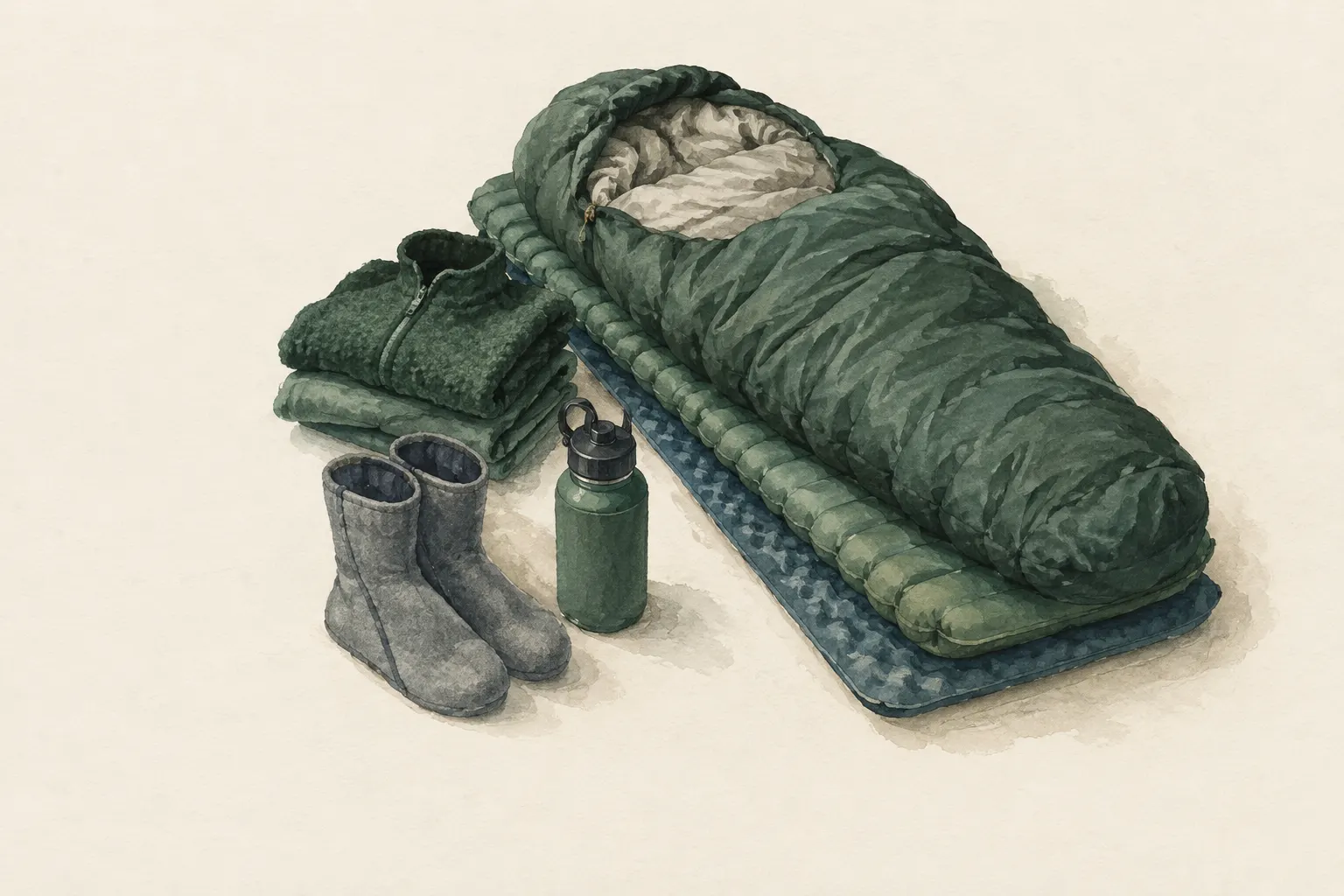
That is why warmth from below comes from the sleeping pad. On snow it is best to use two pads stacked: a firm foam one underneath, an inflatable one on top. If the inflatable one gets a hole during the night, the foam pad keeps insulating anyway.
Before sleeping, put on dry clothes and a hat, eat something and move around briefly without sweating. If you get very cold during the night, take it seriously: more clothing under and over you, check the pad – and if it does not get better or someone seems confused, get help.
How it works
Heat always flows from warmer to colder. Your body is warm; the snow beneath you is at most zero degrees, often colder. Where you lie on it, heat passes into the ground through contact – this is called conduction. Unlike cold air, which you can keep out with clothing, this heat loss does not stop as long as you lie there.
Sleeping pads slow this flow because they hold air in small chambers or cells. Many manufacturers now state how well a pad insulates as an insulation value, the so-called R-value, measured according to a common test standard. Higher means better insulated. If you stack two pads, their values roughly add up.
The fill in a sleeping bag, whether down or synthetic, only keeps you warm because it is fluffy and traps a lot of air. Where you lie on it, it is squashed and hardly insulates any more. That is why even the warmest sleeping bag cannot make up for a poor pad.
What really matters
The proven combination is a closed-cell foam pad underneath and an inflatable pad on top. The foam pad is robust, cannot burst and protects the inflatable pad from sharp ice crystals. The inflatable pad adds comfort and extra insulation. A repair kit always belongs with it.
Dry clothing is almost as important as the pad. Damp socks and sweaty underwear conduct heat away and make the sleeping bag damp from inside as well. Change into dry sleep clothes before sleeping, put on a hat, and do not breathe into the sleeping bag, because your breath brings moisture in too.
Your body is the stove. It needs fuel and should already be warm when you lie down. Eat something in the evening, drink enough and move briefly before lying down – squats or a few steps – without breaking a sweat. Anyone who climbs into the sleeping bag already chilled often takes a long time to warm up.
Safety: what to watch out for
Hypothermia often develops slowly over the night. The first signs are persistent cold and shivering; it becomes dangerous when someone becomes clumsy, confused, very drowsy or listless, or stops shivering even though it is cold. Then the person must be protected from further heat loss, and it is time to get help via the local emergency number (112 in the EU).
Anyone who wakes up badly chilled in the morning should take it seriously and not simply carry on as if nothing had happened. Warming up, eating, drinking and reassessing the situation is wiser then than an ambitious plan for the day.
When sleeping on snow, too: no stove, no heater and no candle in a closed tent or snow cave. Carbon monoxide is invisible and odourless and can poison during sleep. Warm – not boiling hot – water in a tightly closed bottle that is suitable for it, wrapped in a piece of clothing, is a safer alternative for pre-warming the sleeping bag.
Typical situations
In a winter tent the pad lies on the stamped platform. Smooth out bumps beforehand, because otherwise the pad arches over ridges and air gaps form. Take boot liners, batteries and a water bottle into the sleeping bag or the foot area so they are not frozen in the morning.
In an emergency bivouac without a winter pad, anything that fits between you and the snow is valuable: backpack, rope, clothing or – where permitted – dry boughs. Hips and shoulders matter most, because that is where most of your weight presses down. This does not replace a proper pad but noticeably reduces heat loss.
If the pads are shorter than you, your feet rest on the snow. An empty backpack or a coiled rope under your feet closes this gap.
How to practise it
Try out your sleep system first in less extreme conditions – for example on a cool autumn night in the garden or near a hut. That way you learn how your pads feel, when you start to get cold and what helps you. Afterwards, note down what went well and what did not.
Get to know the insulation values of your own pads and practise repairing an inflatable pad in the dark. Anyone who has done this once with cold fingers stays calmer when it matters. Experience of winter bivouacs cannot be learned from texts; go the first few times with experienced companions or on a course.
Step by step
Smooth the base
Stamp and smooth the lying area so that no hollows or ridges form.
- 1
Smooth the base
Stamp and smooth the lying area so that no hollows or ridges form.
- 2
Stack pads
Foam pad below, inflatable pad on top. Put the backpack or rope under the feet if the pads are short.
- 3
Dry sleep clothing
Change into dry clothing before sleeping, put on a hat; do not wear damp socks in the sleeping bag.
- 4
Protect items from frost
Take boot liners, batteries and a bottle of water into the sleeping bag or the foot area so they do not freeze.
- 5
Go to bed warm
Eat and move briefly before lying down, without breaking a sweat.
- 6
Adjust during the night
Anyone who is cold adds extra clothing under or over themselves and checks whether the pad still holds air.
Common mistakes
- Only one thin pad
- Damp clothing in the sleeping bag
- Water bottle left outside – frozen by morning
- Breathing into the sleeping bag
- Getting to know the pad only on the trip
Quick view
Materials
Sleeping pad
Ideally a closed-cell foam pad under an inflatable one
Sleeping bag
Do not store compressed long-term; do not pack away damp.
Dry spare clothing
Carry it in waterproof packaging – wet clothing barely insulates.
Backpack
Under the feet as extra insulation
Suitable for
- Winter camping in a tent, snow trench or bivouac
- An emergency bivouac on snow
Not suitable for
- A single thin summer pad as the only insulation
- Soaked clothing with no dry change
Prerequisites
- Knowing the insulation ratings of your own pads
- A trial night in less extreme conditions
Safety
- An inflatable pad can lose air during the night; a foam pad underneath keeps insulating even then. A repair kit belongs with it.
How it works
Conduction to the snow does not stop as long as you lie down. Pad insulation ratings (R-values) roughly add up when two pads are stacked. Sleeping bag fill is compressed under the body and hardly insulates there – so insulation below must come from the pad.
Advantages
- The most effective single measure against cold from below
- A foam pad is robust and puncture-proof
Disadvantages
- More weight and bulk
- Foam pads are bulky
Deep knowledge
Background
Many manufacturers now state insulation values according to a common test standard, which makes comparison easier. The basic rule of using two pads on snow is found in many winter guides.
Hypothermia often develops gradually over the night. Anyone who is very cold in the morning should take the situation seriously and get help rather than simply carrying on.
Variants
- Without a winter pad (emergency)
- Put backpack, rope, clothing or dry spruce boughs (where permitted) under the body – especially under hips and shoulders. This does not replace a pad but reduces heat loss.
Common mistakes
- Only one thin pad
- Damp clothing in the sleeping bag
- Water bottle left outside – frozen by morning
- Breathing into the sleeping bag
- Getting to know the pad only on the trip
Limits and risks
- No recommendation of specific R-values for specific temperatures
- No substitute for experience in winter bivouacs
Material alternatives
Derived from material properties: a substitute must have all relevant properties. Observe the notes on the substitute.
- Sleeping pad
- Dry leaves, grass or conifer boughs (Collect only where allowed; no protected plants. Check for ticks and insects.), Backpack, Dry spare clothing (Carry it in waterproof packaging – wet clothing barely insulates.), Wool blanket / duvet (Keep away from candles, stoves and heaters.), Insulated cool box (Keeps cold only for a limited time; without ice packs or ice it is not a fridge.), Sleeping bag (Do not store compressed long-term; do not pack away damp.), Newspaper and cardboard (Flammable – keep away from candles, stoves, heaters and embers.), Insulated cooking box (hay box, thermal cooker) (Never put open flame or embers inside – only the hot, closed pot.)
- Sleeping bag
- Sleeping pad, Dry leaves, grass or conifer boughs (Collect only where allowed; no protected plants. Check for ticks and insects.), Backpack, Dry spare clothing (Carry it in waterproof packaging – wet clothing barely insulates.), Wool blanket / duvet (Keep away from candles, stoves and heaters.), Insulated cool box (Keeps cold only for a limited time; without ice packs or ice it is not a fridge.), Newspaper and cardboard (Flammable – keep away from candles, stoves, heaters and embers.), Insulated cooking box (hay box, thermal cooker) (Never put open flame or embers inside – only the hot, closed pot.)
- Dry spare clothing
- Sleeping pad, Dry leaves, grass or conifer boughs (Collect only where allowed; no protected plants. Check for ticks and insects.), Backpack, Wool blanket / duvet (Keep away from candles, stoves and heaters.), Insulated cool box (Keeps cold only for a limited time; without ice packs or ice it is not a fridge.), Sleeping bag (Do not store compressed long-term; do not pack away damp.), Newspaper and cardboard (Flammable – keep away from candles, stoves, heaters and embers.), Insulated cooking box (hay box, thermal cooker) (Never put open flame or embers inside – only the hot, closed pot.)
- Backpack
- Sleeping pad, Dry leaves, grass or conifer boughs (Collect only where allowed; no protected plants. Check for ticks and insects.), Dry spare clothing (Carry it in waterproof packaging – wet clothing barely insulates.), Wool blanket / duvet (Keep away from candles, stoves and heaters.), Insulated cool box (Keeps cold only for a limited time; without ice packs or ice it is not a fridge.), Sleeping bag (Do not store compressed long-term; do not pack away damp.), Newspaper and cardboard (Flammable – keep away from candles, stoves, heaters and embers.), Insulated cooking box (hay box, thermal cooker) (Never put open flame or embers inside – only the hot, closed pot.)
Results come exclusively from structured entries. No improvised instructions are generated.
Sources
The Mountaineers Books (2017): Mountaineering: The Freedom of the Hills, 9th edition
Camping, tents and bivouacs in the mountains and in snow
Wilderness & Environmental Medicine (Wilderness Medical Society) (2019): Wilderness Medical Society Clinical Practice Guidelines for the Out-of-Hospital Evaluation and Treatment of Accidental Hypothermia: 2019 Update
Wind, wet and ground contact as factors in hypothermia; calling for help at signs of hypothermia