Snow cave in a drift
A cave dug into a deep, consolidated snowdrift insulates best of all snow shelters. But it needs very deep snow, a shovel, practice and a lot of time – and drifts often lie exactly where there is avalanche and cornice danger. In emergencies a snow trench is usually the safer choice.
- Several hours
Explained simply
A snow cave is dug into a large, firm snowdrift – a mountain of snow that the wind has piled up. Inside you are completely out of the wind, and the thick snow roof above you holds warmth surprisingly well. Of all snow shelters, it insulates best.
But: you need very deep snow, a shovel, practice and a lot of time. And snowdrifts often lie exactly where avalanches can come down – on slopes onto which the wind has blown snow.
So the rule is: without avalanche training, do not dig a cave into a slope. When in doubt, a snow trench in flat terrain is the safer choice. Never dig alone, and never use a stove or candle inside.
How it works
A cave with a thick snow roof protects you completely from wind, and the snow slows heat loss because it contains a lot of trapped air. Your body and breath warm the air in the small space a little, and that warmth lasts longer than under a thin sheet.
Physics helps here: warm air rises, cold air sinks. So the sleeping surface is built higher than the entrance. The lower entrance tunnel acts as a cold trap – the cold air collects there and does not flow to you.
The ceiling is shaped domed and smooth. On a smooth dome, meltwater runs down the walls instead of falling in drops onto you and your sleeping bag. The ventilation hole in the roof is vital: it lets stale air escape and fresh air flow in.
Safety: what to watch out for
For the untrained, the biggest danger is often not the building itself but the choice of site. Snowdrifts tend to form on lee slopes – exactly where wind slab and avalanche danger develop. Wind slab is snow transported by the wind that can easily slide off as a slab avalanche. Without avalanche training and a current avalanche forecast, nobody digs into slopes, under cornices or in gullies.
Never dig alone. One person stays outside, and the shovel is always at hand, inside at night as well. Stoves, candles and burners can produce lethal amounts of carbon monoxide in the cave and use up oxygen. You cannot see or smell carbon monoxide. The ventilation hole must be open and poked clear regularly with a stick, and the entrance is never fully closed.
Digging makes you wet and sweaty. Take off insulating layers first and work slowly. At signs of hypothermia – strong shivering, clumsiness, confusion – call the local emergency number (112 in the EU). Mark the site clearly outside.
What really matters
The snowdrift must be deep and firm enough for a load-bearing roof to remain. A ceiling that is too flat or too thin is one of the most common sources of error. This entry deliberately gives no building instructions with fixed dimensions, because snow type, temperature and terrain vary too much.
The order matters: first an entrance tunnel, then the room enlarged upwards so that the sleeping surface lies higher than the entrance. Then the ceiling is domed and smoothed and the ventilation hole pushed through.
A ventilation hole can drift shut, especially in wind and fresh snow. Check it regularly, at night too. Take the shovel inside and put it where you can find it in the dark.
When it makes sense – and when not
A snow cave is a technique for trained people on planned winter trips who find deep, firm snow at a site safe from avalanches and have enough time. Then it offers the warmest protection of all snow shelters.
It is unsuitable for untrained people, on slopes, in gullies, under cornices, on lee slopes with wind slab, in wet snow and thaw, and for people travelling alone. In a real emergency without these conditions, a snow trench in flat terrain is usually the safer choice.
Good to know
Snow caves are described in mountaineering literature such as “Mountaineering: The Freedom of the Hills” and in FM 3-05.70, each with clear emphasis on ventilation and avalanche danger.
Avalanche knowledge is a specialist field. Anyone travelling in wintry mountain terrain should know the regional avalanche forecast, be trained accordingly and carry the appropriate emergency gear. Courses run by alpine clubs and mountain schools are the best way to learn snow caves and terrain assessment together.
Step by step
Assess the terrain
Only with training and an avalanche forecast. No digging under cornices, in gullies or on steep lee slopes. If in doubt: a snow trench in flat terrain.
- 1
Assess the terrain
Only with training and an avalanche forecast. No digging under cornices, in gullies or on steep lee slopes. If in doubt: a snow trench in flat terrain.
- 2
Dig entrance and room
Dig an entrance tunnel, then enlarge the room upwards so that the sleeping platform is higher than the entrance. Work slowly, shed layers.
- 3
Dome and smooth the ceiling
Shape the ceiling domed and smooth so meltwater runs down the walls instead of dripping.
- 4
Make the vent
Push a ventilation hole through the roof and keep it clear regularly with a stick.
No stove or candle in the enclosed space.
- 5
Gear and marking
Shovel inside, entrance not fully closed, location clearly marked outside.
Common mistakes
- Digging in avalanche or cornice terrain
- Ceiling too flat or too thin
- Vent drifted shut
- Digging alone
- Sleeping platform lower than the entrance
Quick view
Materials
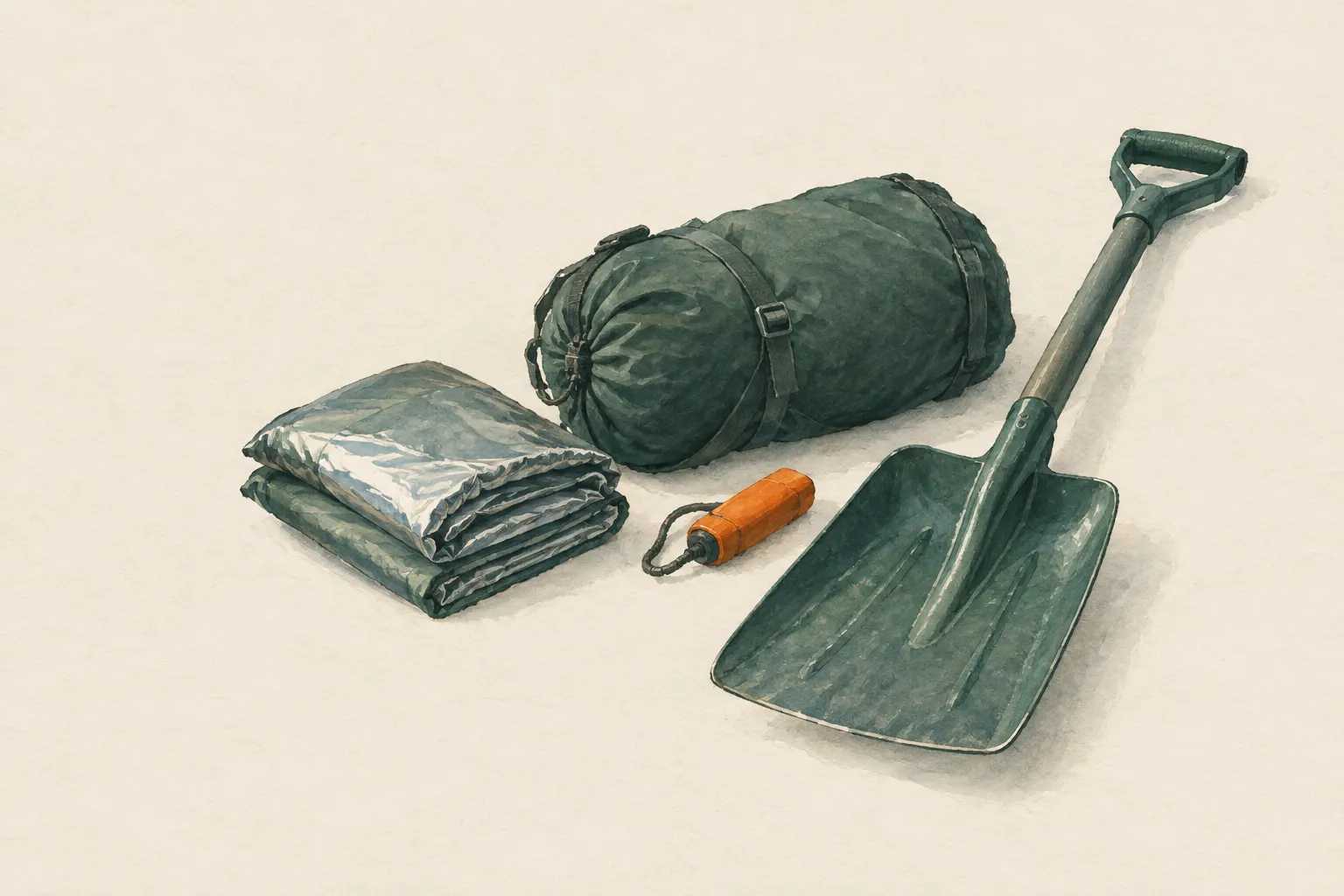
Snow shovel
Always take it inside when digging a snow shelter.
Sleeping pad
Sturdy sticks / poles
Ventilation stick and marker
Do not cut live wood where prohibited.
Dry spare clothing
Carry it in waterproof packaging – wet clothing barely insulates.
Headlamp / flashlight
Suitable for
- Planned high-alpine tours and winter expeditions with training
- Prolonged storms when safe terrain is available
Not suitable for
- Untrained people
- Slopes, gullies, cornices and lee slopes with wind slab
- Wet snow and thaw
- Alone
Prerequisites
- Avalanche training and the current avalanche forecast
- Practical training under instruction
- A very deep, consolidated drift in safe terrain
- At least one other person
How it works
In a cave with a thick snow roof you are completely out of the wind, and the snow slows heat loss. Warm air rises: the sleeping platform is higher than the entrance, and the entrance acts as a cold sink. A domed, smoothed ceiling lets drips run down the walls. The ventilation hole is vital.
Advantages
- Best insulation of the snow shelters
- Completely sheltered from wind
- Holds up through long storms
Disadvantages
- Needs very deep snow, often in avalanche terrain
- Very high effort
- Collapse, suffocation and CO danger
- Getting soaked
Deep knowledge
Background
Snow caves are described in mountaineering literature such as "Mountaineering: The Freedom of the Hills" and in FM 3-05.70, each with clear emphasis on ventilation and avalanche danger. For the untrained, the biggest risk is often not the building itself but the choice of site.
Avalanche knowledge is a specialist field. Anyone travelling in wintry mountain terrain should know the regional avalanche forecast and be trained accordingly.
Common mistakes
- Digging in avalanche or cornice terrain
- Ceiling too flat or too thin
- Vent drifted shut
- Digging alone
- Sleeping platform lower than the entrance
Limits and risks
- No building instructions with dimensions
- No assessment of avalanche terrain
Material alternatives
Derived from material properties: a substitute must have all relevant properties. Observe the notes on the substitute.
- Sleeping pad
- Dry leaves, grass or conifer boughs (Collect only where allowed; no protected plants. Check for ticks and insects.), Backpack, Dry spare clothing (Carry it in waterproof packaging – wet clothing barely insulates.), Wool blanket / duvet (Keep away from candles, stoves and heaters.), Insulated cool box (Keeps cold only for a limited time; without ice packs or ice it is not a fridge.), Sleeping bag (Do not store compressed long-term; do not pack away damp.), Newspaper and cardboard (Flammable – keep away from candles, stoves, heaters and embers.), Insulated cooking box (hay box, thermal cooker) (Never put open flame or embers inside – only the hot, closed pot.)
- Dry spare clothing
- Sleeping pad, Dry leaves, grass or conifer boughs (Collect only where allowed; no protected plants. Check for ticks and insects.), Backpack, Wool blanket / duvet (Keep away from candles, stoves and heaters.), Insulated cool box (Keeps cold only for a limited time; without ice packs or ice it is not a fridge.), Sleeping bag (Do not store compressed long-term; do not pack away damp.), Newspaper and cardboard (Flammable – keep away from candles, stoves, heaters and embers.), Insulated cooking box (hay box, thermal cooker) (Never put open flame or embers inside – only the hot, closed pot.)
- Headlamp / flashlight
- Mobile phone (The battery drains quickly in cold and with continuous screen and GPS use.), Battery lantern / LED light
Results come exclusively from structured entries. No improvised instructions are generated.
Sources
The Mountaineers Books (2017): Mountaineering: The Freedom of the Hills, 9th edition
Snow caves, ventilation and site choice
Headquarters, Department of the Army (USA) (2002): FM 3-05.70 Survival
Snow cave as a cold-weather shelter
European Avalanche Warning Services (EAWS): European Avalanche Danger Scale
Avalanche danger levels and avalanche forecasts
World Health Organization, Regional Office for Europe (2010): WHO guidelines for indoor air quality: selected pollutants (carbon monoxide chapter)
Carbon monoxide in enclosed spaces