The car as an emergency shelter in winter
If you get stuck in snow, you are usually better protected in the vehicle than outside on foot, and you are easier to find there. It is vital to keep the exhaust pipe clear of snow and to run the engine only intermittently, because carbon monoxide can otherwise enter the cabin.
- Can be applied immediately; pack equipment in advance
Explained simply
If your car gets stuck in snow in winter, the car is usually the best protection. It keeps off wind and wet, and rescuers find a car far more easily than a person walking alone through a blizzard. So the rule is: stay with the vehicle.
You keep warm mainly with clothing, blankets and by huddling close together. The heater runs only now and then for a short time.
Most important of all: the exhaust pipe must stay clear of snow. If it is snowed in, a poisonous gas called carbon monoxide can get into the car. You cannot smell or see it, but it can be deadly. Also call the local emergency number (112 in the EU).
How it works
A vehicle is a ready-made, closed shell: it protects from wind and wet, and it is large, often coloured and easy for rescuers to see. Anyone who sets off on foot into a blizzard quickly loses orientation, gets cold and is much harder to find.
What has to keep you warm is mainly what you have on your body: all clothing layers, a hat, gloves, blankets and emergency blankets. People sitting close together warm each other. Feet should not rest directly on the cold floor – a floor mat, bag or blanket underneath helps.
The heater is used only intermittently. That saves fuel and limits the danger from carbon monoxide, a colourless, odourless gas produced by combustion in the engine. Official winter guides mention short running periods of about ten minutes per hour.
Safety: what to watch out for
Carbon monoxide is the greatest danger. A snowed-in exhaust can direct exhaust gases into the cabin. Before every engine start and regularly in between, check that the exhaust is clear and clear it if necessary. Run the engine only intermittently and open a window slightly while it runs. Never fall asleep with the engine running – in groups, take turns staying awake.
Stay with the vehicle unless help is safely visible and very close. Call the local emergency number (112 in the EU), give your location as precisely as possible and then save battery by using the phone only briefly.
If you have to get out, for example to clear the exhaust, watch for traffic, wear a hi-vis vest and secure the vehicle as far as it is safe to do so. If the vehicle itself is in danger – on an unsecured carriageway, on fire or in floodwater – the rule “stay in the car” does not apply: then get yourself to safety.
What really matters
Make yourself visible: hazard lights if needed, a bright cloth on the antenna or window, and at night the interior light from time to time while the engine is running. That way snowploughs and rescuers can see that someone is in the car.
Keep warm before you get really cold: put on all layers, use blankets and emergency blankets, huddle together, insulate your feet from the floor. Move a little – wiggle toes and fingers, circle your arms – without breaking into a sweat. Drink enough, because the body loses fluid in the cold too.
Plan in cycles: heater briefly on, check the exhaust, window open a crack, heater off again. There are no fixed figures for how long fuel or battery will last – they depend on the vehicle, how much is in the tank and the weather.
Gear and materials
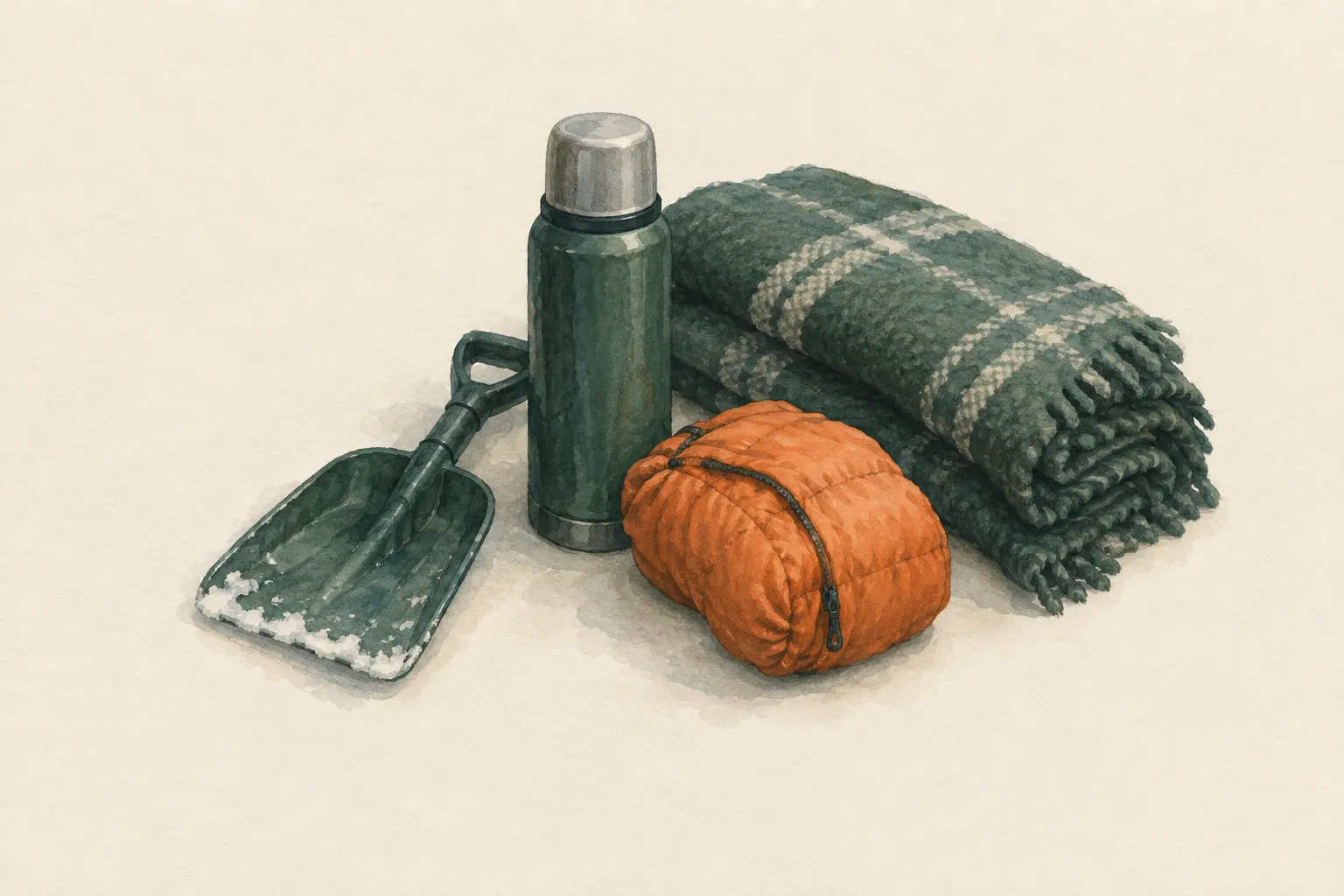
The best emergency shelter is the one you packed. In winter the car should contain: blankets or a sleeping bag, warm clothing with a hat and gloves, a shovel, water, long-life snacks, a lamp with spare batteries, a hi-vis vest and a charging cable for the phone. An emergency blanket weighs almost nothing and fits in any glovebox.
Before a winter drive it is worth checking the weather forecast and road conditions, setting off with a full tank and telling someone which route you are taking and when you expect to arrive. Anyone without winter tyres and gear is better off not setting off at all when a blizzard warning is in force.
Good to know
Official winter guides such as Ready.gov recommend staying with the stuck vehicle, keeping the exhaust clear and running the engine only intermittently. The US health authority CDC points out that carbon monoxide from vehicles is a poisoning hazard in enclosed or snowed-in situations.
This entry applies to cold. In heat a vehicle is not protection but a danger: in the sun a closed car heats up dangerously very quickly. Never leave children or animals there. How to behave after a breakdown in hot regions is a separate topic and not part of this entry.
Step by step
Emergency call and location
Call emergency services, give the location, then use the phone sparingly.
- 1
Emergency call and location
Call emergency services, give the location, then use the phone sparingly.
- 2
Make yourself visible
Hazard lights if needed, a bright cloth on the antenna or window; at night switch on the interior light from time to time while the engine is running.
- 3
Keep the exhaust clear
Check that the exhaust is clear before every engine start and regularly.
- 4
Engine intermittently
Run the engine and heater only for short periods, with a window slightly open. Official guides mention about ten minutes per hour.
- 5
Keep warm
Put on all clothing layers, use blankets and emergency blankets, huddle together, insulate feet from the cold floor, move a little, drink enough.
- 6
Take turns staying awake
In groups take turns staying awake, especially while the engine is running.
Common mistakes
- Not checking the exhaust
- Running the engine continuously and falling asleep
- Leaving the vehicle on foot in a blizzard
- Setting off without winter equipment
Quick view
Materials
Vehicle emergency kit
Which equipment (e.g. warning triangle, high-visibility vest, first-aid kit) is mandatory differs between countries – check local rules.
Wool blanket / duvet
Or a sleeping bag
Keep away from candles, stoves and heaters.
Emergency blanket
Tears easily once punctured; short-term shelter only.
Conductive – keep away from power lines.
Snow shovel
To keep the exhaust clear
Always take it inside when digging a snow shelter.
High-visibility vest
Keep within reach inside the cabin, not in the boot/trunk.
Mobile phone
The battery drains quickly in cold and with continuous screen and GPS use.
Do not plan on it as your only means of navigation or emergency calls.
Suitable for
- Getting stuck in snow or a blizzard
- Closed roads with waiting times
Not suitable for
- Vehicle in danger, e.g. on an unsecured carriageway, on fire or in floodwater
- Heat – vehicles heat up dangerously in the sun
Prerequisites
- Winter equipment in the vehicle
- Full tank or charge before driving under winter warnings
Safety
- Watch for traffic when getting out, wear a hi-vis vest and secure the vehicle as far as it is safe to do so.
How it works
The vehicle provides protection from wind and wet and is easy for rescuers to see. Warmth comes mainly from clothing, blankets and huddling together; the heater is used only intermittently to save fuel and limit the carbon monoxide risk. Official winter guides recommend short running periods each hour.
Advantages
- Immediately available
- Easy to find
- Protection from wind and wet
Disadvantages
- Carbon monoxide danger with combustion engines
- Metal cools down quickly
- Limited fuel or battery
Deep knowledge
Background
Ready.gov and other official winter guides recommend staying with the vehicle when stuck, keeping the exhaust clear and running the engine only intermittently. The CDC points out that carbon monoxide from vehicles is a poisoning hazard in enclosed or snowed-in situations.
The best emergency shelter is the one you packed: blankets, warm clothing, a shovel, water, snacks and a lamp belong in the car in winter.
Variants
- Electric vehicle
- Without combustion the vehicle itself produces no carbon monoxide. Use heating sparingly and keep an eye on the charge level.
Common mistakes
- Not checking the exhaust
- Running the engine continuously and falling asleep
- Leaving the vehicle on foot in a blizzard
- Setting off without winter equipment
Limits and risks
- No fuel or battery ranges
- No advice for heat – vehicles in the sun are dangerous
Material alternatives
Derived from material properties: a substitute must have all relevant properties. Observe the notes on the substitute.
- Wool blanket / duvet
- Sleeping pad, Dry leaves, grass or conifer boughs (Collect only where allowed; no protected plants. Check for ticks and insects.), Backpack, Dry spare clothing (Carry it in waterproof packaging – wet clothing barely insulates.), Insulated cool box (Keeps cold only for a limited time; without ice packs or ice it is not a fridge.), Sleeping bag (Do not store compressed long-term; do not pack away damp.), Newspaper and cardboard (Flammable – keep away from candles, stoves, heaters and embers.), Insulated cooking box (hay box, thermal cooker) (Never put open flame or embers inside – only the hot, closed pot.)
- High-visibility vest
- Emergency blanket (Tears easily once punctured; short-term shelter only.), Signal mirror (Do not flash into the eyes of people nearby or of drivers.), Warning triangle (Whether warning triangles are mandatory, or should be placed at all on certain roads (e.g. motorways), differs between countries – check local rules.), Aluminium foil (heavy-duty) (Edges can be sharp; conducts heat and electricity.)
- Mobile phone
- Headlamp / flashlight, Battery lantern / LED light
Results come exclusively from structured entries. No improvised instructions are generated.
Sources
Ready.gov – U.S. Federal Emergency Management Agency (FEMA): Winter Weather
What to do when stranded in a vehicle in winter
Centers for Disease Control and Prevention: Carbon Monoxide Poisoning – Prevention guidance
Carbon monoxide from vehicles and poisoning risk
Wilderness & Environmental Medicine (Wilderness Medical Society) (2019): Wilderness Medical Society Clinical Practice Guidelines for the Out-of-Hospital Evaluation and Treatment of Accidental Hypothermia: 2019 Update
Wind, wet and ground contact as factors in hypothermia