When networks are overloaded: messages instead of calls
After major events, everyone tries to phone at once and networks become overloaded. Short text messages then often get through when calls do not. With an agreed contact person outside the area, short status messages and lines kept free for emergency calls, you reach your family more reliably.
- Plan once; seconds per message during an event
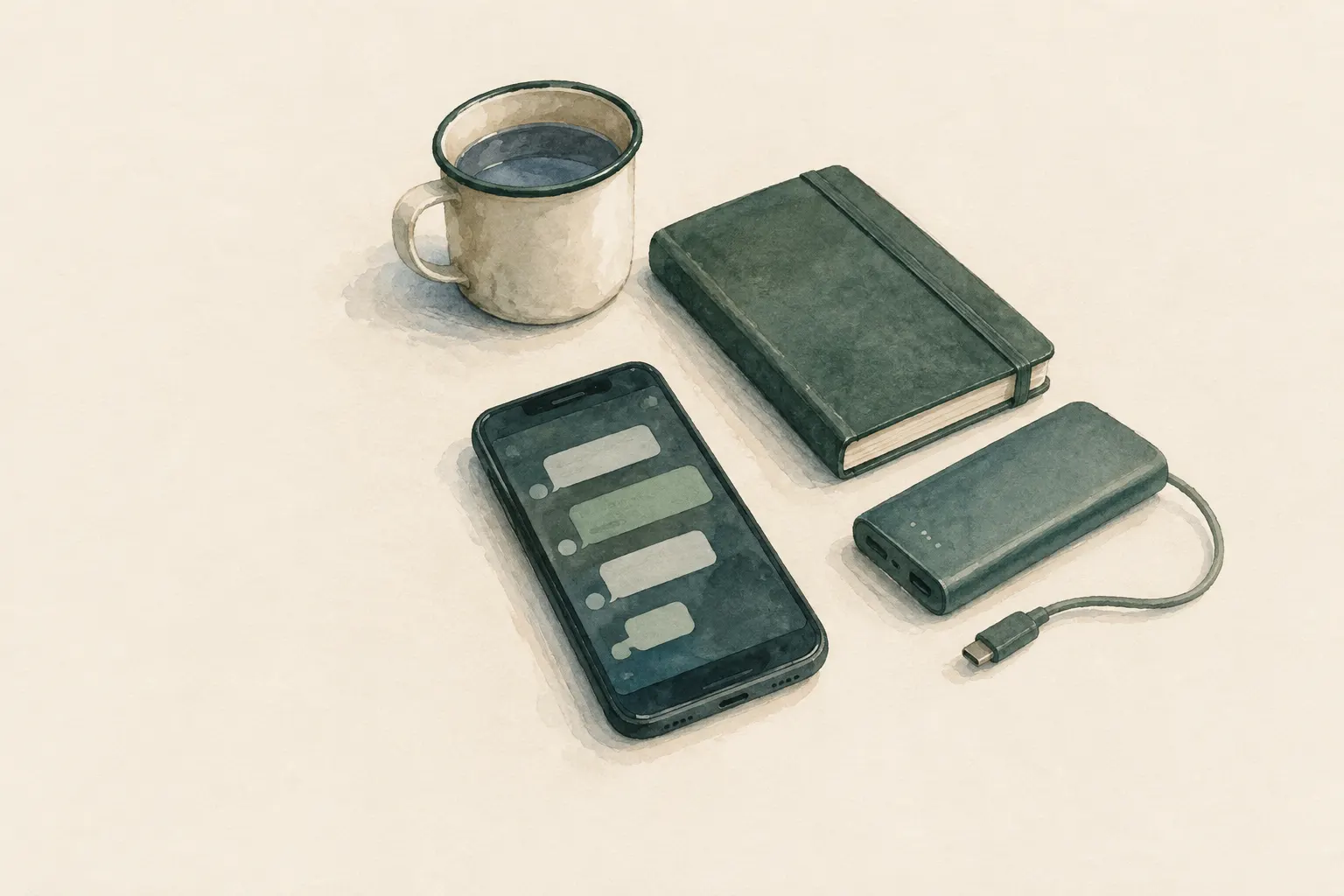
Explained simply
Imagine a road where suddenly every car in town wants to drive at the same time: traffic jam. That is roughly what happens to the mobile network after a big event such as a storm or earthquake. Everyone wants to call at once, and many calls do not get through.
A call is like a car that blocks a lane the whole time. A short text message is more like a letter that is pushed through in a moment and, if necessary, waits briefly until there is room again. That is why messages often get through when calls do not.
So rather send your family a short note: ‘At home, unhurt, will report at 6 pm.’ That keeps the network free for people who urgently need help. And if you yourself are in danger to life, call the emergency number straight away – 112 in the EU.
How it works
Each cell of a mobile network can only handle a limited number of connections at the same time. A phone call occupies a connection for the whole length of the conversation. When very many people suddenly call at once, capacity is full and further calls fail or drop.
A text message, on the other hand, needs network capacity only for a short moment. If it does not get through at once, it can be stored by the network or the phone and delivered later. That is why official preparedness guidance recommends using messages instead of calls in emergencies.
Every call you avoid also helps others. When thousands refrain from dialling again and again, there is more room for emergency calls and for people who really have to phone.
What really matters: planning ahead
Agree a contact person outside your region whom everyone in the family reports to. During a local event, the network in your own area is often overloaded, while connections to another region may still work better. The contact collects the messages and passes them on.
Write important numbers on paper too, for example on a card in your wallet or emergency bag. If the phone is flat, lost or broken, hardly anyone knows their relatives' numbers by heart.
Decide what a short status message looks like: where you are, whether you are unhurt, when you will report again. For example: ‘At work, unhurt, will report at 8 pm.’ One such message to the family or an agreed group saves many individual calls.
During an event: what to do
Send a short message first instead of calling. Write text, not long voice or video messages, because these need much more data. If a call is really necessary, keep it short and say the most important thing first.
Do not call again and again when it does not connect. Each new attempt adds to the network load and drains your battery. Better wait a few minutes and try again, or send a message that can be delivered later.
If the mobile network does not work but Wi-Fi does, for example a public hotspot set up by authorities after a disaster, messaging apps can send messages over it. Save your battery while doing so: dim the screen, close unnecessary apps and check at agreed times.
Safety: what to watch out for
In acute danger, do not rely on messages to relatives. Then call the local emergency number at once, 112 in the EU. The emergency line is there for real emergencies and nothing else.
Never use the emergency number for general questions, such as how long the power cut will last or which roads are closed. Every such question blocks a line that someone in danger to life needs. For information there is radio, warning apps and the authorities' websites; during major incidents dedicated public information lines are sometimes set up as well.
Information from official sources takes priority over anything forwarded in chats. Rumours spread fast in such situations and can put people in danger. Do not forward anything you did not get from a reliable source.
Limits and alternatives
Messages instead of calls only help when the network is overloaded but still there. If it fails completely, for example because masts have no more power after a long outage, no message gets through either. Delivery can also be delayed, and real-time back-and-forth is not possible.
Such cases need other routes: handheld radios for short distances within the family and neighbourhood, satellite devices in remote areas and a battery radio to hear official information. A meeting point agreed in advance helps you find each other again even without any connection.
Ideally, practise the plan once when nothing is wrong: send each other a test status message, check that everyone has the numbers on paper, and settle who the out-of-area contact is.
Step by step
Plan beforehand
Agree a contact person outside the region whom everyone reports to. Store numbers on paper and in the phone.
- 1
Plan beforehand
Agree a contact person outside the region whom everyone reports to. Store numbers on paper and in the phone.
- 2
Message first
After an event, send a short message: 'At [place], unhurt, will report at [time]'.
- 3
Keep calls short
If a call is necessary, keep it short and say the essentials first.
- 4
Share status once
One status update to the family or an agreed group saves many individual calls.
- 5
Save battery
Dim the screen, close unnecessary apps, check at agreed times.
Common mistakes
- Calling again and again when it does not connect
- Long voice and video messages
- Numbers only in the phone
- Forwarding rumours
- Blocking the emergency line with information requests
Quick view
Materials
Mobile phone
The battery drains quickly in cold and with continuous screen and GPS use.
Do not plan on it as your only means of navigation or emergency calls.
Power bank
Do not use damaged or swollen batteries; do not charge while covered.
Field notebook and pencil
Important numbers on paper
Suitable for
- After storms, earthquakes, major incidents
- Large events
- Partial network outages
Not suitable for
- Acute danger to life – then call the local emergency number (112 in the EU) immediately
Prerequisites
- An agreed family communication plan
- Important numbers on paper too
Safety
- Information from official sources (warning apps, radio, authority websites) takes priority over forwarded messages in chats.
How it works
A text message needs network capacity only for a moment and can be stored and delivered later; a call needs a continuous connection. A few short messages to one central contact spread information without adding to the network load.
Advantages
- Better chance of getting through
- Frees the network for emergency calls
- Saves battery
Disadvantages
- Delivery may be delayed
- No real-time back-and-forth
Deep knowledge
Background
Official preparedness guidance recommends using text messages in emergencies because they often still get through during network disruption, and naming an out-of-area contact person.
The family communication plan with meeting points is described in more detail in the family section.
Variants
- Over Wi-Fi
- If the mobile network fails but Wi-Fi works (e.g. public hotspots after disasters), messaging apps can send messages over it.
Common mistakes
- Calling again and again when it does not connect
- Long voice and video messages
- Numbers only in the phone
- Forwarding rumours
- Blocking the emergency line with information requests
Limits and risks
- No statements on technical prioritisation in specific networks
- Ineffective when the network is completely down
Material alternatives
Derived from material properties: a substitute must have all relevant properties. Observe the notes on the substitute.
- Mobile phone
- Headlamp / flashlight, Battery lantern / LED light
Results come exclusively from structured entries. No improvised instructions are generated.
Sources
Ready.gov – U.S. Federal Emergency Management Agency (FEMA): Make A Plan
Text messages during network disruptions, out-of-area contact
U.S. Federal Emergency Management Agency (FEMA): Are You Ready? An In-Depth Guide to Citizen Preparedness
Family communication plan
European Commission: 112 – the European emergency number
Europe-wide emergency number 112