Handheld two-way radios for groups and families: use and radio etiquette
Simple handheld radios (in Europe e.g. PMR446, elsewhere other systems) keep groups and families in touch over short distances without a mobile network. For them to work in an emergency you need permitted devices, an agreed channel with a backup channel, fixed call times and short, clear messages. Anyone listening hears everything – radio is not private.
- Set up and practise once, then a few minutes per call
Explained simply
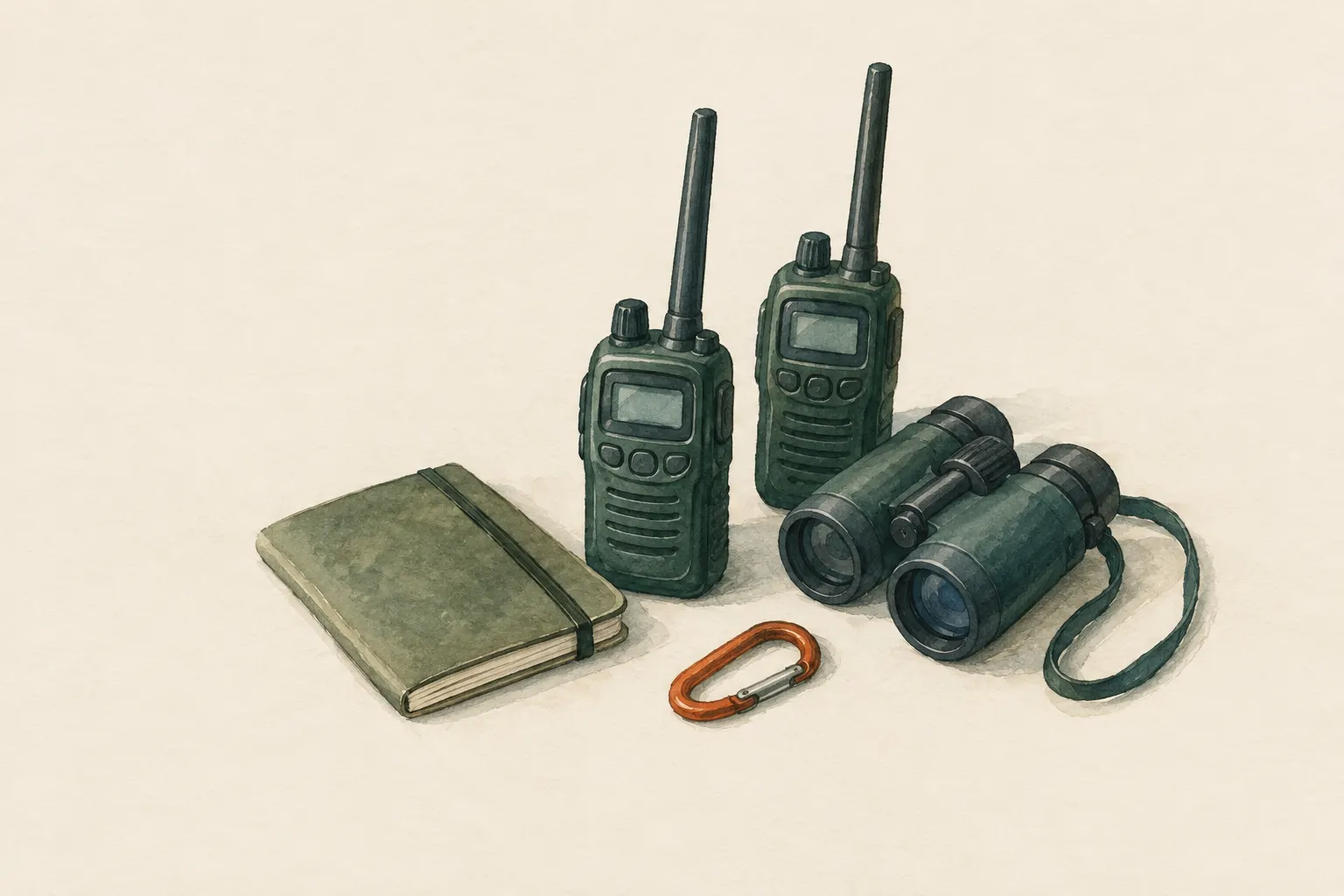
A handheld radio, often called a walkie-talkie, works without any mobile network. The devices talk directly to each other, like two tin cans on an invisible string. Families or groups can use them to stay in touch, for example when hiking or when the mobile network stops working during a power cut.
With radio, only one person can speak at a time. That is why there are rules: first listen whether the channel is free, then speak briefly and clearly and say ‘over’ at the end so the other person knows it is their turn. And remember: anyone listening on the same channel hears everything. Radio is not private.
Radio is regulated by law, and which devices are allowed differs from country to country – check the rules where you are. In an emergency, try the emergency number first (112 in the EU), because nobody is necessarily listening on a radio channel.
How it works
A handheld radio is transmitter and receiver in one. When you press the talk button, it sends your voice as a radio wave. All devices set to the same channel and within range receive it. There is no mast and no network in between – that is why the devices still work when the mobile network fails.
Range depends very strongly on the surroundings. The radio waves of typical handheld radios travel, much like light, mainly in line of sight. On a hill or across open water they go far; in a deep valley, dense forest or between concrete walls much less. An elevated position, such as an upper-floor window or a rise in the ground, often helps more than anything else.
Because everyone on a channel shares the same frequency, only one can transmit at a time. If two talk at once, the signals overlap and nobody is understood. That is where the rules of radio etiquette come from.
Permitted devices: check local rules
Radio frequencies are a shared resource and regulated by law so that users – such as emergency services, aviation and marine radio – do not interfere with each other. In Europe, PMR446 is a common radio service for simple handheld radios that may be used without a licence in many countries. Other regions have their own systems, such as FRS in the USA, with their own rules.
Which devices are licence-free, at what power and on which frequencies differs by country. A device permitted in one country may be prohibited in another. So buy devices approved for your country, and check the rules of your destination before travelling.
CB radio is also open to everyone in many countries, but there too channels, power and modes differ. Amateur radio offers far more options but usually requires an exam and licence. Many amateur radio clubs are involved in emergency communication and welcome newcomers.
What really matters: radio etiquette
Set all devices to the same channel beforehand and, if used, the same sub-code. Also agree a backup channel in case the first is busy or disturbed, and write both on a card everyone carries. A sub-code only filters what your device plays to you – it does not make the conversation secret. Others can still listen in.
Before transmitting, listen briefly to check whether the channel is free. Then press the talk button, wait a moment and only then speak, or the beginning is cut off. A clear structure helps: who is calling whom, the message, ‘over’. Have important details such as place and time read back to rule out misunderstandings.
Agree fixed call times, for example on the hour, when everyone switches on. This saves battery, and everyone still knows when they can reach the others. Spare batteries are part of the kit.
Safety and emergencies
A handheld radio is not an emergency call system. Nobody is necessarily listening on general radio channels, and certainly not emergency services automatically. So in an emergency, try the local emergency number (112 in the EU) first. At sea there is marine radio with its own distress procedures for this.
If you hear on your channel that someone is in distress, that takes priority: keep the channel clear, listen, note details and alert help, for example by phone. Never send distress calls as a joke or a test. A false alarm can tie up rescuers who are urgently needed elsewhere.
Always remember that radio is not private. Do not say things over the radio that strangers should not know, such as that your home is empty right now.
Typical situations
In a group in the field: the front and back of a hiking group stay in contact even when they cannot see each other. Radio helps when someone strays from the path or the group has to wait for a straggler.
In the family and neighbourhood during a network outage: if the mobile network fails during a longer power cut, family members nearby can keep talking to each other. Agree channel, backup channel and call times beforehand and try it out once while everything still works.
At events or work sites: handheld radios are ideal for short arrangements between several people at once. Over long distances and in terrain with many obstacles, though, they quickly reach their limits.
Step by step
Set up
Set all devices to the same channel (and the same sub-code if used), agree a backup channel and write both on a card.
- 1
Set up
Set all devices to the same channel (and the same sub-code if used), agree a backup channel and write both on a card.
- 2
Agree call times
Agree fixed times (e.g. on the hour) when everyone switches on. This saves battery.
- 3
Listen before you talk
Before transmitting, listen briefly to check the channel is free. Press the talk button, wait a moment, then speak.
- 4
Short and clear
Who is calling whom, the message, 'over'. Have important details (place, time) read back.
- 5
Emergencies have priority
If you hear an emergency, keep the channel clear and help, e.g. by alerting help by phone.
Common mistakes
- Thinking sub-codes provide privacy
- No backup channel agreed
- Always switched on, battery flat
- Long conversations blocking the channel
- Buying devices that are not permitted
Quick view
Materials
Handheld two-way radio
Permitted devices, frequencies and licence requirements differ by country – check local rules.
Spare batteries
Store cool and dry, observe the expiry date; keep button cells out of children's reach.
Suitable for
- Groups in the field
- Families and neighbourhoods during network outages
- Coordination at events and work sites
Not suitable for
- Emergency calls to authorities – use a phone, emergency systems or marine radio for that
- Long distances and terrain with many obstacles
Prerequisites
- Devices permitted in your country
- An agreed channel and backup channel
Safety
- Radio is regulated by law. Which devices are licence-free, at what power and on which frequencies differs by country. Check local rules; devices bought in other countries are not automatically permitted.
- Nobody is necessarily listening on general radio channels. In an emergency, try the local emergency number (112 in the EU) first.
How it works
Handheld radios transmit directly from device to device, without a network. Range depends strongly on terrain, buildings and antenna height: line of sight and elevated positions help, valleys and concrete walls weaken the signal. Because only one person can speak at a time, discipline and short messages matter.
Advantages
- Independent of the mobile network
- Easy to use
- Calls everyone at once
Disadvantages
- Limited range
- Not private
- Legal differences between countries
Deep knowledge
Background
In Europe, PMR446 is a common radio service for simple handheld radios that is licence-free in many countries; other regions have their own systems with their own rules. Official guidance generally recommends planning several communication routes for emergencies.
Radio etiquette – listen first, speak briefly, give way to emergencies – comes from professional radio traffic and makes even simple devices much more useful.
Variants
- Amateur radio
- Amateur radio offers far more options but usually requires an exam and licence. Many amateur radio clubs support emergency communication.
- CB radio
- CB radio is open to everyone in many countries, but the rules (channels, power, modes) differ – check local rules.
Common mistakes
- Thinking sub-codes provide privacy
- No backup channel agreed
- Always switched on, battery flat
- Long conversations blocking the channel
- Buying devices that are not permitted
Limits and risks
- No range, channel or power figures
- No legal advice
Sources
U.S. Federal Emergency Management Agency (FEMA): Are You Ready? An In-Depth Guide to Citizen Preparedness
Several communication routes in an emergency plan
Bundesamt für Bevölkerungsschutz und Katastrophenhilfe (BBK), Deutschland: Ratgeber für Notfallvorsorge und richtiges Handeln in Notsituationen
Preparing for communication outages