Reading tracks in snow, mud, sand and dust
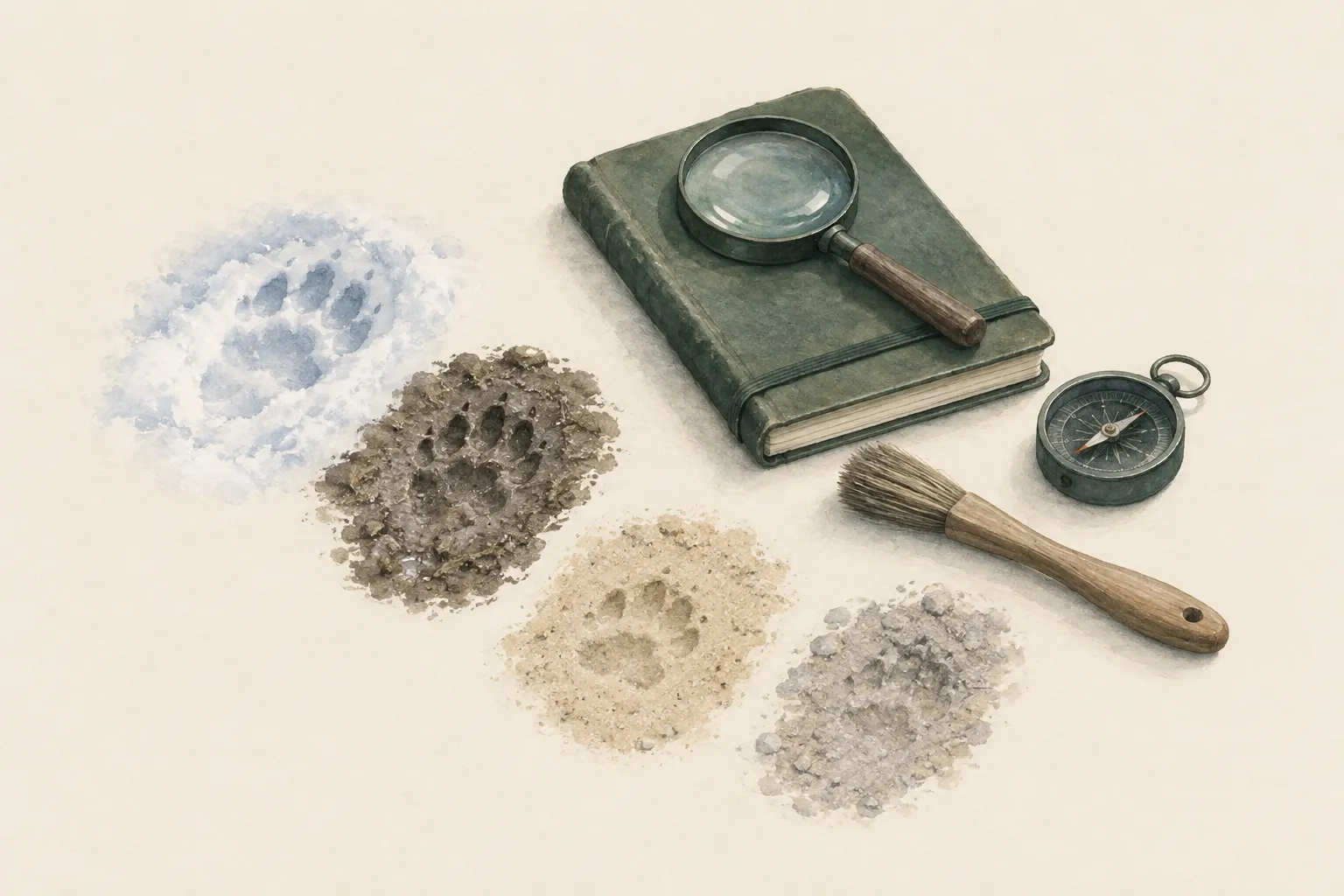
The same foot leaves very different prints depending on the ground: snow enlarges and blurs, damp mud shows the finest detail, dry sand loses it quickly, and on dust and hard ground tracks only show in raking light. Knowing the quirks of each substrate avoids the most common misidentifications.
- Practice over several seasons
Explained simply
Press your hand once into play dough, once into flour and once into wet sand. Each time it is the same hand, but the prints look completely different. It is the same for animals: a fox leaves a sharp, precise print in mud, only a soft dent in dry sand, and in snow sometimes a print that looks much bigger than its foot.
The substrate – the ground the track is on – is therefore just as important as the foot itself. Damp, fine ground shows many details. Snow that thaws in the sun makes tracks bigger and rounder. And on dust or hard ground you often only see tracks when the light comes very low from the side.
When looking for tracks, watch carefully where you step. Ice on lakes and streams, mudflats by the sea and bogs can give way. No track is worth stepping onto unsafe ground for.
How it works
A print is created by the interplay of three things: the foot, the movement and the substrate. Soft, damp, fine-grained ground gives way under the foot and keeps the shape, much like play dough. Loose or coarse ground, by contrast, trickles back as soon as the foot is gone and loses the fine details. How fast the animal was moving also changes the print: running pushes soil backwards, slipping distorts the print.
Snow is a special case because it keeps changing after the print is made. Sun and wind thaw or blow away the edges; the track becomes bigger, rounder and blurrier. When new snow falls, it fills old tracks. If a track thaws and refreezes at night, it can become hard and glassy. That is why two tracks of the same animal on a sunny slope and in the shade often look completely different.
On hard ground, dust or tarmac, a foot leaves hardly any depth, only tiny differences in the surface: flattened dust, shifted grains, a damp print. These are best seen in raking light – light that falls very low across the ground. Then even the smallest bumps and dips cast shadows.
What really matters: substrate by substrate
Mud and clay often show the finest details: individual toe pads, claws, sometimes even skin texture. The best prints are often found at the edges of puddles or on stream banks, where the ground is damp but not liquid. Because animals slip easily in mud, you should always compare several prints before forming a judgement.
Sand varies greatly with moisture. Damp sand shows the shape quite well, dry sand usually only an outline, because the grains trickle back. Wind blurs sand tracks quickly. The early morning hours are therefore often the best time: animals active at night have left fresh tracks, and the wind is often still light.
In snow, depth and age matter. Best are a few centimetres of fresh snow on a firm base – then the print is clear. In deep snow animals sink in and individual prints say little; then the whole trail pattern – spacing, arrangement and width of the trail – is more informative. Thawed tracks are always bigger than the foot that made them.
How to practise it
Raking light is your most important tool. Hold a torch or headlamp very low over the ground, almost at ground level, and move it slowly back and forth. Or use the low sun in the morning and evening. Look at the print from different directions – sometimes it only appears when you move around it. In midday sun from above, by contrast, you see almost nothing.
An excellent exercise is your own tracking plot: a smoothed area of sand or soil in the garden. Here you can watch how the same species – often it is the neighbour's cat – prints on different days and at different moisture levels. You can also press your own hands or shoes into different substrates and compare.
For each track, note the substrate, how damp it was, the temperature and the weather since the last rain or snowfall. These details often explain later why a track looked bigger, smaller or different than expected. Experienced trackers collect comparison images of the same animal in different substrates over years.
Safety: what to watch out for
The best tracks are often exactly where the ground is unsafe: on banks, on frozen water, on tidal flats or in bogs. Banks can be undercut and collapse, ice can be thinner than it looks, and mud can hold you fast. Never follow a track onto ice or into tidal flats or bogs. On tidal flats the tide also comes in, often faster than expected.
There are risks indoors too. Tracks in dusty attics or cellars often come from mice or rats. Their droppings and urine can contain pathogens that can be inhaled with the dust. So do not stir up dust, wear a mask and gloves if needed and wash your hands afterwards.
Typical mistakes
The classic winter mistake: a thawed track is taken for that of a much bigger animal. That is how many stories about huge animals in the snow arise. So always compare tracks on the sunny and shaded sides and check whether the edges are sharp or rounded.
Just as common: looking at only a single print. A print can be slipped, smudged or overlaid by a second one. Only several prints in a row give a reliable picture. In leaf litter and grass, by the way, hardly any clear prints form – there you read disturbance signs instead, such as overturned leaves or flattened grass.
Step by step
Look for the best prints
Along the trail, look for the clearest print – often at puddle edges, in damp mud or in thin, fresh snow on a firm base.
- 1
Look for the best prints
Along the trail, look for the clearest print – often at puddle edges, in damp mud or in thin, fresh snow on a firm base.
- 2
Interpret snow correctly
In deep snow measure the trail pattern rather than single prints. Thawed tracks are larger than the foot; compare the shaded and sunny sides.
- 3
Mud and clay
Details such as toe pads and claws are clear, but slipping distorts. Compare several prints.
- 4
Sand
Damp sand shows shape, dry sand only outlines. Wind blurs quickly – use the early morning.
- 5
Use raking light
On dust, firm ground or tarmac hold the light low over the ground or use low sun and look at the print from different directions.
- 6
Record the substrate
Note substrate, moisture, temperature and weather since the last precipitation – they often explain differences in size and shape.
Common mistakes
- Mistaking thawed snow tracks for those of a larger animal
- Looking at only one print
- Searching from above in midday light
- Not recording the substrate
Quick view
Materials
Tape measure or folding rule
Headlamp / flashlight
As a low-angle light source
Field notebook and pencil
Mobile phone
The battery drains quickly in cold and with continuous screen and GPS use.
Do not plan on it as your only means of navigation or emergency calls.
Suitable for
- Tracking all year round
- Riverbanks, farm tracks, snowfields, attics and cellars
Not suitable for
- Leaf litter and grass – read disturbance signs rather than prints there
Prerequisites
- Basic knowledge of gaits and track patterns
Safety
- Banks, frozen water and mudflats can give way. Do not follow a track onto ice or into tidal flats or bogs.
- Tracks in attics and cellars may come from rodents – do not stir up dust, wear a mask and gloves if needed.
How it works
A print is the interplay of foot, movement and substrate. Soft, damp, fine-grained ground records detail; loose or coarse ground collapses. Snow keeps changing after the print is made: sun and wind enlarge and round tracks, new snow fills them. Low-angle light casts shadows into the smallest depressions and makes them visible.
Advantages
- Fewer misidentifications
- Applicable all year round
Disadvantages
- Experience takes time
- Many prints remain unidentifiable
Deep knowledge
Background
In 'Mammal Tracks & Sign', Elbroch explains how substrate and weather change prints and recommends looking at several prints and the whole trail pattern.
Experienced trackers collect comparison images of the same animal in different substrates over years.
Variants
- Your own tracking plot
- A smoothed sand or soil plot shows how the same species prints in different substrates.
Common mistakes
- Mistaking thawed snow tracks for those of a larger animal
- Looking at only one print
- Searching from above in midday light
- Not recording the substrate
Limits and risks
- No identification of single prints
- Regional differences in wildlife
Material alternatives
Derived from material properties: a substitute must have all relevant properties. Observe the notes on the substitute.
- Headlamp / flashlight
- Mobile phone (The battery drains quickly in cold and with continuous screen and GPS use.), Battery lantern / LED light
- Mobile phone
- Headlamp / flashlight, Battery lantern / LED light
Results come exclusively from structured entries. No improvised instructions are generated.
Sources
Mark Elbroch – Stackpole Books (2003): Mammal Tracks & Sign: A Guide to North American Species
Influence of substrate and weather on prints