Boil-water notices and water during floods
Under a boil-water notice, tap water is microbiologically unsafe; boiled or bottled water is used for drinking, brushing teeth, ice cubes, infant formula and food preparation. Under a do-not-drink notice, boiling does not help. Flood water is almost always contaminated with sewage and chemicals.
- Ongoing for the duration of the notice
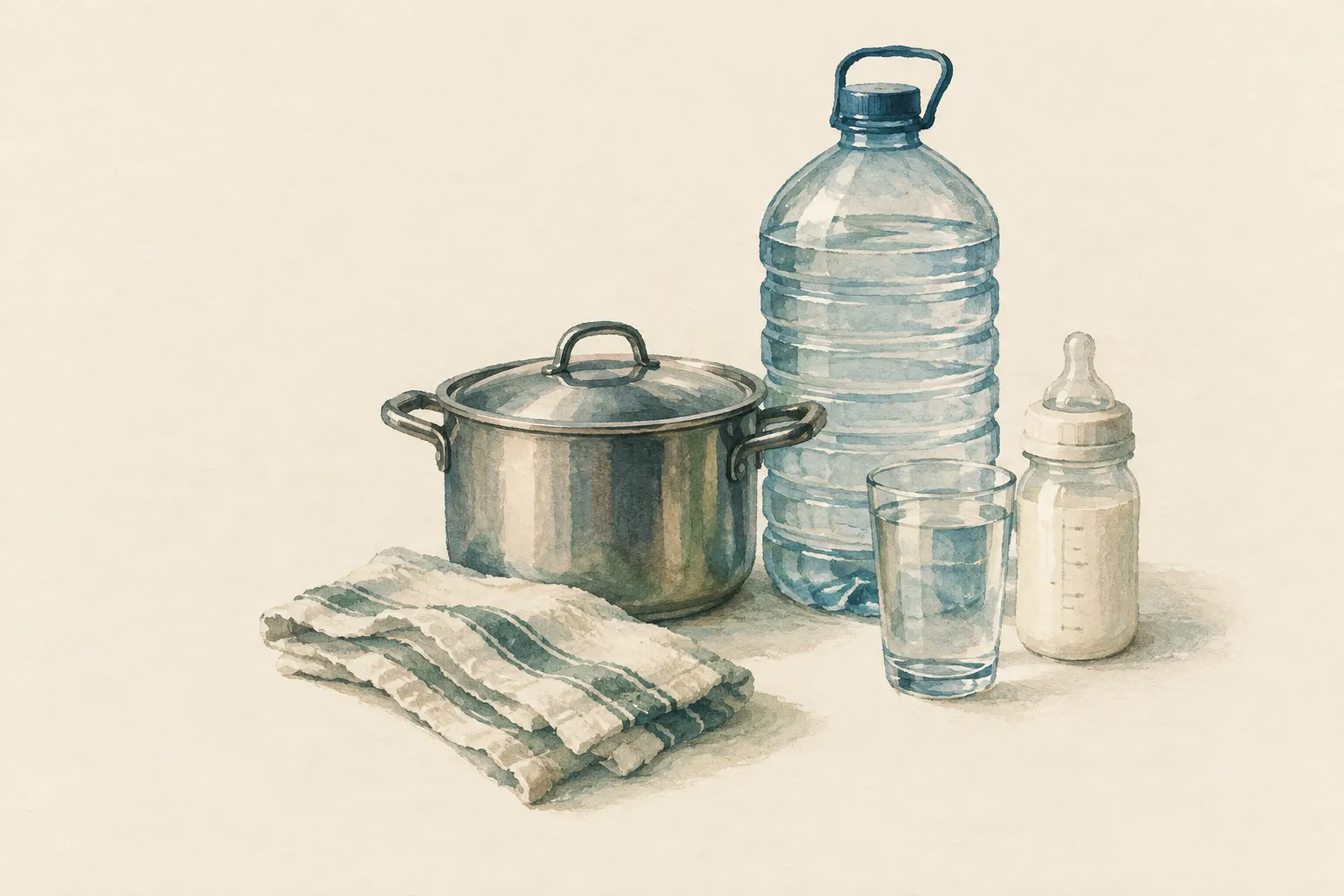
Explained simply
Sometimes the water company or the health authority says: ‘Please boil your tap water.’ That means there might be tiny germs in the water that you cannot see, smell or taste. They can cause stomach ache and diarrhoea. If you bring the water to a proper rolling boil, these germs are killed.
But there is a different kind of warning too: ‘Do not drink’ or ‘do not use’. Then there is usually a substance in the water, for example a chemical. It does not disappear when you boil the water – it stays in the pot, and because water evaporates it can even become stronger. Then only bottled water or water from a distribution point helps.
The most important thing: read carefully which warning applies. And flood water – the brown water that flows through streets and cellars during a flood – you never drink and, if you can, do not touch. It often contains sewage from the drains, oil and dirt.
How it works
Tap water is normally one of the most closely monitored foods. The pipe network is kept under pressure so that nothing gets sucked in from outside. If a main bursts, pressure drops or flood water enters wells and treatment plants, germs from soil or sewage can get into the network. If germs are found, or even just feared, the authority issues a boil-water notice.
Boiling works through heat: bacteria, viruses and parasites such as Giardia cannot survive water at a rolling boil and are made harmless. What matters is a real, vigorous boil, not just warm water or a few bubbles at the bottom of the pot. At high altitude water boils at a lower temperature; there the authorities recommend boiling for longer.
Chemicals, fuels, heavy metals or salts, on the other hand, are not destroyed by heat. When water boils only the water itself evaporates; the dissolved substance stays behind and becomes more concentrated. That is exactly why there are two different kinds of notice – and why the type of notice is the most important piece of information of all.
What really matters
Under a boil-water notice a simple rule applies: everything that goes into the mouth needs boiled or bottled water. That includes not only drinks but also brushing teeth, ice cubes, infant formula, cooking and washing fruit and vegetables that are eaten raw. Brushing teeth in particular is often forgotten because it is a habit.
A fixed routine helps: in the morning, bring a large pot of water to a rolling boil, let it cool covered and pour it into clean, labelled bottles or jugs. A note on the tap reminds everyone in the household that nobody drinks from the tap right now. Throw away ice cubes made before or during the notice.
When the notice is lifted, the job is not quite finished. The utility usually says how long the pipes should be flushed. Filter cartridges in fridges or jug filters may have picked up germs and are replaced according to the manufacturer. Appliances with a water connection are also treated as the authority advises.
Flood water: why it is so dangerous
During a flood, sewers, treatment basins, heating-oil tanks, cars and garages fill with water. The water that then flows through streets and cellars is therefore almost always a mixture of sewage, mud, fuel and chemicals. You cannot see what is in it, and no household method makes it safe to drink.
So the rule is: do not drink flood water, avoid contact as far as possible and wash your hands thoroughly after touching it. Food, drinks and containers that were in flood water are thrown away or cleaned as the authority says. Even sealed bottles can be dirty on the outside, especially around the cap.
A private well in a flooded area counts as contaminated until it has been tested or disinfected as instructed. Until then, use bottled water or water from official distribution points.
Safety: what to watch out for
The biggest danger is a mix-up: anyone who boils water under a ‘do not drink’ notice feels safe and may drink a concentrated mixture. So always read the exact wording of the notice and check via official channels such as a warning app, the radio or the utility's website which area it covers.
Boiling water causes severe scalds. Turn pot handles inwards, keep children away from the stove and hot pots, and let the water cool completely before pouring it into other containers. Special rules apply to infant formula; here, follow the guidance of the authority and the paediatrician.
Showering and handwashing are usually allowed under a boil-water notice, as long as no water is swallowed – go by what the authority says. Give small children short baths under supervision so they do not drink bath water. Anyone who develops diarrhoea, vomiting or fever drinks plenty of safe water and seeks medical help for severe symptoms; in an emergency call the local emergency number (112 in the EU).
Good to know
Boil-water notices are among the most common measures worldwide when water supply is disrupted, and they are usually temporary. They do not mean the water looks dirty – it can be perfectly clear and still contain germs.
If electricity or gas fail and you cannot boil, use bottled water or the chemical disinfection the authority explicitly names. A small stock of bottled water at home takes a lot of the stress out of such situations.
Step by step
Read the notice carefully
Check via official channels which type of notice applies, for which area and for what the water may be used.
- 1
Read the notice carefully
Check via official channels which type of notice applies, for which area and for what the water may be used.
- 2
Boil for everything that goes in the mouth
Drinking water, brushing teeth, ice cubes, infant formula, washing fruit and vegetables eaten raw, and cooking: use boiled or bottled water.
- 3
Personal hygiene as advised
Showering and handwashing are usually possible as advised by the authority; do not swallow water, supervise small children closely.
- 4
Mind appliances
Discard ice from ice makers; treat appliances with a water connection as advised by the authority.
- 5
Flush after the notice is lifted
After the notice is lifted, flush the pipes as instructed by the utility, discard ice and replace filter cartridges if needed.
Common mistakes
- Confusing boil-water and do-not-use notices
- Brushing teeth with tap water
- Using old ice cubes
- Drinking beverages that came into contact with flood water
- Not flushing after the notice is lifted
Quick view
Materials
Metal pot (stainless steel, aluminium, titanium)
Hot – scalding risk.
Stove
Never operate inside a tent, shelter or enclosed room – carbon monoxide and fire risk.
PET bottle (clear, max. 2 litres)
Bottled water
Do not heat or place in a fire.
Food-grade water container
Only use containers that never held chemicals or fuel.
Suitable for
- Households under a boil-water notice
- After floods and burst mains
- Private wells in flooded areas
Not suitable for
- Do-not-use notices due to chemicals – boiling does not help there
- Water that has come into contact with flood water
Prerequisites
- Access to official information (radio, warning app, utility)
Safety
- A flooded private well is considered contaminated until it has been tested or disinfected as instructed by the authorities.
- Take particular care with infant formula; follow the guidance of the authority and the paediatrician.
How it works
A boil-water notice is issued when pathogens are detected or feared in the network, for example after burst mains, pressure loss or flooding. Boiling inactivates pathogens but does not remove chemicals. Authorities therefore distinguish between boil-water notices and do-not-use notices.
Advantages
- Boiling reliably protects against pathogens
- Easy to carry out at home
Disadvantages
- Energy and time required
- No help against chemicals
- Many daily routines have to change
Deep knowledge
Background
Boil-water notices are among the most common measures taken by health authorities worldwide when water supply is disrupted. WHO describes boiling as an effective household measure against pathogens.
Floods bring additional risks: sewage, fuels and chemicals. During floods, the authorities' instructions therefore take precedence over any home treatment.
Variants
- Without energy to boil
- If boiling is not possible, use bottled water or the chemical disinfection named by the authority.
Common mistakes
- Confusing boil-water and do-not-use notices
- Brushing teeth with tap water
- Using old ice cubes
- Drinking beverages that came into contact with flood water
- Not flushing after the notice is lifted
Limits and risks
- No help with chemical contamination
- Depends on available energy
- Applies only to the stated area and duration
Material alternatives
Derived from material properties: a substitute must have all relevant properties. Observe the notes on the substitute.
- Metal pot (stainless steel, aluminium, titanium)
- Single-wall stainless steel bottle (Heat only single-wall bottles without paint/plastic; remove the lid before heating.)
- Food-grade water container
- Single-wall stainless steel bottle (Heat only single-wall bottles without paint/plastic; remove the lid before heating.), Double-wall insulated bottle (Never heat directly.), PET bottle (clear, max. 2 litres) (Do not heat or place in a fire.), Airtight food-grade storage container (Fill only when clean and completely dry; never use containers that previously held chemicals.), Collapsible water container or bag (Protect from sharp objects.), Food-grade water bag (Use only for drinking water, never for chemicals or fuel.), Fermentation jar or crock (Use only food-grade containers of glass, food-safe glazed stoneware or food-grade plastic – no metal containers for acidic food.), Resealable food bags (Use only bags intended for food; do not use with boiling water unless the manufacturer explicitly allows it.)
Results come exclusively from structured entries. No improvised instructions are generated.
Sources
Centers for Disease Control and Prevention: Making Water Safe in an Emergency
What to do under boil-water notices, during floods and with flooded wells
World Health Organization (2015): Boil water – Technical brief
Boiling as a measure against pathogens
Bundesamt für Bevölkerungsschutz und Katastrophenhilfe (BBK), Deutschland: Ratgeber für Notfallvorsorge und richtiges Handeln in Notsituationen
Preparedness and behaviour during water supply disruptions