Using a UV-C pen correctly
A UV-C pen is dipped into clear water and irradiates it for a time set by the manufacturer. Used correctly it inactivates bacteria, viruses and protozoa according to the manufacturer. It needs clear water and charged batteries, does not act on threads and bottle rim, and leaves no residual protection.
- Short cycle per manufacturer; pre-clarifying can take longer
Explained simply
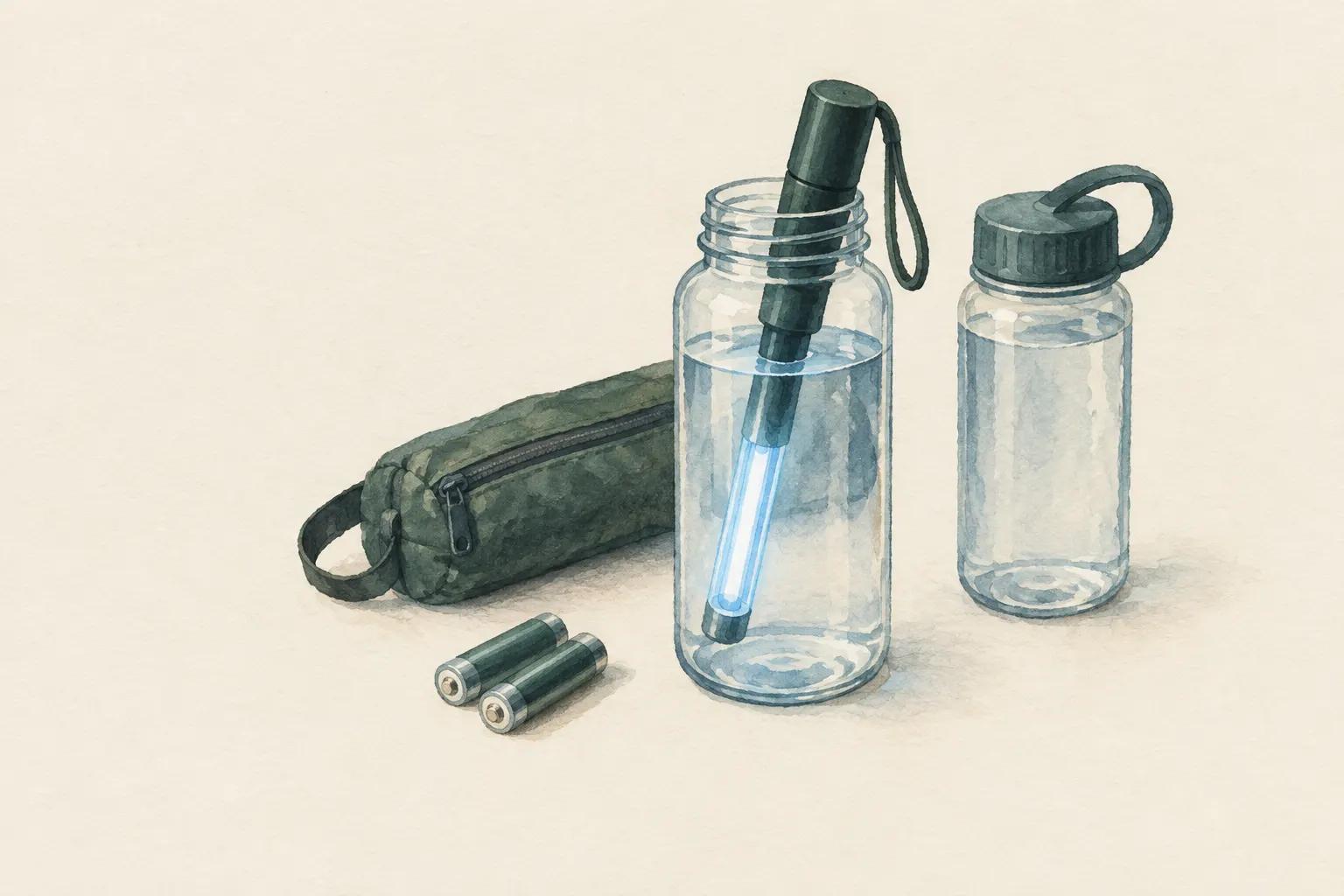
A UV-C pen looks like a thick torch. At the front it has a small lamp that gives off a special, invisible light: UV-C light. You hold the pen in a bottle of clear water and stir. The light damages the genetic information of germs so that they can no longer multiply and cannot make you ill.
For this to work, the water must be clear. If dirt particles float in it, germs can hide behind them – like in the shade of a tree. The pen also needs charged batteries, and you have to wait until the device shows that it has finished.
Important: never look into the glowing lamp, and do not switch it on outside the water. UV-C light harms eyes and skin. And the water only stays clean until dirt gets in again – so drink it soon.
How it works
UV-C is a short-wave part of ultraviolet light. It damages the genetic material of microorganisms – their DNA or RNA. The pathogens do not necessarily die immediately, but they can no longer reproduce and therefore cannot cause an infection. This is called inactivation.
The dose is what matters. It results from the strength of the light and the time the water is irradiated. Every device is designed for a specific volume of water; with more water the dose is not enough. Used correctly, such devices inactivate bacteria, viruses and protozoa according to the manufacturer.
UV light only works where it reaches. Particles in the water cast shadows in which pathogens are protected. Drops on the threads or the bottle rim are outside the water and are not irradiated at all. And unlike chlorine, UV leaves no residual protection: if dirt gets into the water later, it is unsafe again.
What really matters
Clarity first: use only clear water. Let cloudy water settle and pour it through a coffee filter or cloth, or pre-filter it. If the water is clearly coloured or stays cloudy, choose another method such as boiling instead.
Fill exactly the volume the device is designed for into a clean wide-mouth bottle. Keep the threads and rim dry while doing so. Switch the device on, immerse it and stir or swirl as instructed until the cycle is complete. Only if the device indicates success does the water count as treated.
When drinking, it is best to use a clean cup or wipe the threads dry first. Do not top the bottle up with raw water, or everything is untreated again.
Safety: what to watch out for
UV-C light damages eyes and skin. Never operate the lamp outside the water and do not look into it. Store the device so that children do not use it as a toy torch.
If the device shows an error or the cycle stops – for example because of a flat battery – the water counts as untreated. Cold reduces the performance of batteries. If you go into cold regions, keep batteries warm against your body, carry spares or have a second method with you, such as tablets or a stove.
UV does nothing at all against chemicals and salt. If chemical contamination is suspected, you need another source.
When it makes sense – and when not
A UV pen suits travel where tap water is of doubtful quality but clear, and clear spring or stream water. It works quickly, does not change the taste and suits individuals and small volumes.
It is less suitable for cloudy or coloured water without clarification, for large volumes in groups, for water that is to be stored for longer, and for long trips without a way to charge. Some bottles have a UV lamp in the cap; the principle is the same, and the effective dose and duration are given by the manufacturer.
Good to know
UV disinfection is an established process in public water supply. Portable devices transfer this principle to the bottle. Their effectiveness, however, depends heavily on clarity, dose and correct use – and only the manufacturer can specify these values for its device.
The sunlight method SODIS also uses UV radiation, but from the sun and over many hours. A UV-C pen works with much stronger, targeted radiation and therefore needs only a short time. Both need clear water.
Step by step
Ensure clarity
Use only clear water; let cloudy water settle and pour it through a coffee filter or cloth, or pre-filter it.
- 1
Ensure clarity
Use only clear water; let cloudy water settle and pour it through a coffee filter or cloth, or pre-filter it.
- 2
Correct volume
Fill exactly the volume the device is designed for into a clean wide-mouth bottle. Keep the threads and rim dry.
- 3
Irradiate and move
Switch on, immerse and stir or swirl as instructed until the cycle is complete.
- 4
Check the success indicator
Only with a success indicator does the water count as treated. On an error, repeat or use another method.
- 5
Drink cleanly
Drink from a clean cup or wipe the threads dry beforehand; do not top up with raw water.
Common mistakes
- Irradiating cloudy water
- Stopping the cycle early
- Treating more water than specified
- Forgetting wet threads with raw water
- Going into the cold with a weak battery
Quick view
Materials
UV-C purifier
Works only in clear water; check battery level.
PET bottle (clear, max. 2 litres)
Wide-mouth bottle of the size specified for the device
Do not heat or place in a fire.
Spare batteries
Store cool and dry, observe the expiry date; keep button cells out of children's reach.
Coffee filter
For clarifying
Does not disinfect.
Suitable for
- Travel with tap water of doubtful quality
- Clear spring and stream water
- Individuals and small volumes
Not suitable for
- Cloudy or coloured water without clarification
- Large volumes for groups
- Water that is stored for longer
- Long trips without charging
Prerequisites
- Clear water
- Charged battery
- Container of suitable size
Safety
- If the device shows an error or the cycle stops (e.g. flat battery), the water counts as untreated. Cold reduces battery performance – carry spares or keep another method ready.
- UV-C damages eyes and skin. Do not operate the lamp outside water and do not look into it.
How it works
UV-C light damages the genetic material of microorganisms so that they can no longer reproduce. The dose results from light intensity and time; the device is designed for a specific volume of water. Anything shaded by particles or outside the water – such as on the threads – is not reached.
Advantages
- Fast
- No taste
- Effective against viruses and protozoa per manufacturer
Disadvantages
- Needs clear water
- Battery-dependent
- No residual protection
- Small volumes per cycle
Deep knowledge
Background
UV disinfection is established in public water supply; portable devices transfer the principle to the bottle. Their effectiveness depends heavily on clarity, dose and correct use, which only the manufacturer can specify for its device.
Because UV leaves no residual protection, the water should be drunk soon and not stored unprotected.
Variants
- UV bottle caps
- Some bottles have a UV LED in the cap. The principle is the same; the effective dose and duration are given by the manufacturer.
Common mistakes
- Irradiating cloudy water
- Stopping the cycle early
- Treating more water than specified
- Forgetting wet threads with raw water
- Going into the cold with a weak battery
Limits and risks
- No effect on chemicals and salt
- No effect in cloudy water
- No residual protection
Material alternatives
Derived from material properties: a substitute must have all relevant properties. Observe the notes on the substitute.
- Coffee filter
- Cotton cloth / T-shirt (Removes coarse particles only – no disinfection.), Gravel, Charcoal from a campfire (Not activated carbon: adsorption capacity is low and unknown.)
Results come exclusively from structured entries. No improvised instructions are generated.
Sources
Centers for Disease Control and Prevention: CDC Yellow Book: Health Information for International Travel – Water Disinfection
Portable UV devices: effectiveness in clear water, no residual protection
World Health Organization (2022): Guidelines for drinking-water quality, fourth edition incorporating the first and second addenda
UV disinfection and the influence of turbidity
Wilderness & Environmental Medicine (Wilderness Medical Society) (2019): Wilderness Medical Society Clinical Practice Guidelines for Water Disinfection for Wilderness, International Travel, and Austere Situations: 2019 Update
UV devices in the field