Baking without an oven: in a pot and a Dutch oven
Bread, flatbreads, bakes or simple cakes can be baked without an oven: in a heavy pot with a lid on a stove, or in a cast-iron Dutch oven with embers below and on the lid. What matters is even, moderate heat from all sides, a gap above the pot base and patience. Embers and charcoal belong outdoors only.
- 15–30 minutes preparation, baking time considerably longer than in an oven depending on the item
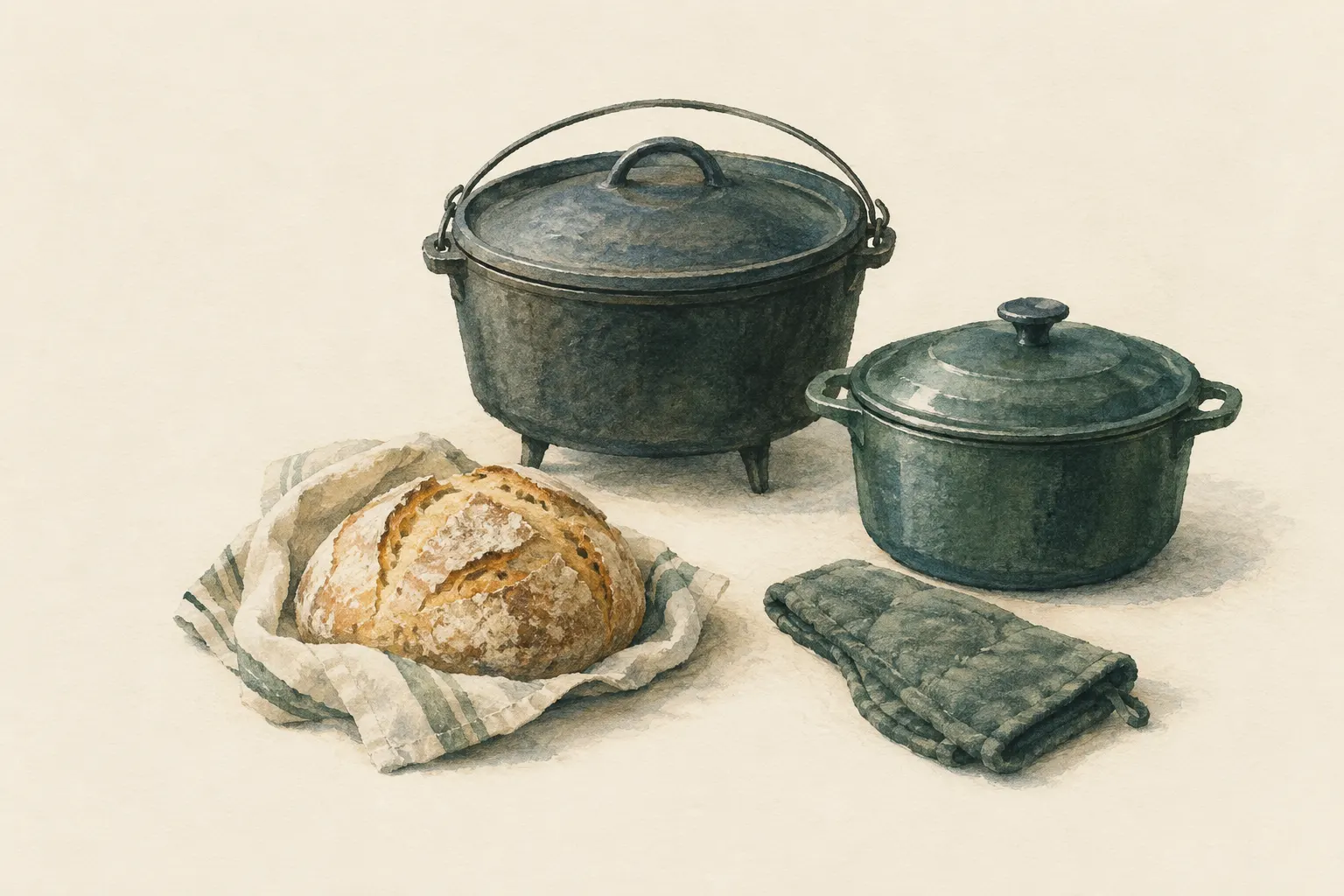
Explained simply
An oven is really just a hot box: the heat comes from all sides and wraps around the bread. You can recreate such a hot box – with a heavy pot with a lid. Inside it gets hot all round, and the bread bakes as if in a small oven.
The most important trick: the bread must not sit directly on the hot base of the pot, or it will burn underneath before it is done inside. So you put, for example, a small rack in the pot and set the bread on it. With a cast-iron Dutch oven, glowing coals are placed under the pot and also on top of the lid – so heat comes from above and below.
Very important: embers, charcoal and camping stoves belong outdoors only. Indoors they produce an invisible, poisonous gas. And cast iron gets so hot that you may only touch it with gloves or a tool.
How it works
In an oven, the baked item is surrounded by hot air and by radiant heat from the walls. That is why it cooks evenly from all sides. A closed pot imitates this: the lid keeps the hot air inside, and the thick walls give off heat inwards. The heavier and thicker the pot, the more evenly it spreads the heat.
On a stove, the heat only comes from below. Without a gap, the dough would burn there. A spacer – a small rack, a metal ring or a few clean, dry stones – lifts the baking tin off the base so that there is a layer of air in between. The hot air then rises around the tin.
With a Dutch oven, a cast-iron pot with legs and a lid with a raised rim, embers under the pot provide the bottom heat and embers on the lid provide the top heat. Because heat rises and the base gets hottest anyway, bread usually gets more embers on the lid than underneath.
What really matters
The most common mistake is too much heat from below: the bread is black underneath and still sticky inside. With a stove, that means the lowest stable flame and preheating the pot. With a Dutch oven: a few embers below, more on the lid. Better to bake a little longer at moderate heat than briefly and too hot.
Open the lid as rarely as possible, because the hot air escapes every time. Instead, turn the pot a little roughly every 10 to 15 minutes, and with a Dutch oven turn the lid the other way too. This evens out hot spots caused by wind or uneven embers. Expect baking to take considerably longer than in an oven.
Whether the item is done is shown by a doneness test: bread sounds hollow when you tap the underside. With cakes and bakes, a wooden skewer pushed in comes out clean. If in doubt, bake a little longer. When very little fuel is available, thin flatbreads in a pan are the more economical choice.
Safety: what to watch out for
Charcoal, embers, grills and camping stoves are never used in a home, tent, garage or basement. They produce carbon monoxide, a gas you cannot smell or see and which can be deadly. Even an open window does not make an indoor space safe. Pot baking with embers is therefore always an outdoor job.
Cast iron, lids and embers cause severe burns, and cast iron stays hot for a long time. Lift the lid with a lid lifter or tongs, wear heat-resistant gloves and sturdy shoes and keep children away. Put the hot pot down only on a heat-resistant surface. Stones from streams or lakes are off-limits as spacers: trapped water can make them burst when heated.
Before any fire, check the local rules on fires and wildfire danger; under a fire ban, the embers stay unlit. Work on non-combustible ground and keep water or sand ready for extinguishing. Embers are put out completely before you leave the site, and ash is disposed of only when it is cold. Non-stick pots are unsuitable, because they should not be heated strongly when empty.
How to practise it
Do not bake for the first time in a real emergency. Try a simple recipe, such as a bread with baking powder or a small bake, on a quiet day in the garden or at a barbecue site. Note how many embers or what flame level worked and how long it took – this depends heavily on pot, wind and fuel.
A good exercise is also to bake the same recipe once in a pot on a stove and once in a Dutch oven. That way you learn how differently the heat behaves. If a fitting lid is missing, several layers of aluminium foil can keep the heat in the pot; it gets very hot, though.
Good to know
Cast-iron pots with legs and a rimmed lid have been in use for centuries and are found in many camp kitchens today. The principle is the same as in the old wood-fired oven: stored, surrounding heat instead of a direct flame. Well-cared-for cast iron lasts for decades.
Far more than bread can be made in a pot: bakes, stews, potatoes or simple cakes. The downside is the weight – a cast-iron pot is usually too heavy for a rucksack and is more something for the house, the garden or a camp reached by car.
Step by step
Prepare the site
Work outdoors on non-combustible ground and keep water or sand ready for extinguishing. With a stove: stable stand, windscreen without trapping heat around the canister.
- 1
Prepare the site
Work outdoors on non-combustible ground and keep water or sand ready for extinguishing. With a stove: stable stand, windscreen without trapping heat around the canister.
- 2
Create a gap
In a pot, put a rack, a metal ring or a few clean, dry stones on the base and place the tin or the dough on baking paper on top. In a Dutch oven the dough can sit directly on the greased base or on baking paper.
Do not use stones from water – trapped water can make them burst when heated.
- 3
Distribute the heat
Stove: lowest stable flame, preheat the pot. Dutch oven: a little embers below, more on the lid. For bread: rather too little bottom heat than too much.
- 4
Rotate instead of opening
Open the lid rarely. Turn the pot a little roughly every 10–15 minutes, and with a Dutch oven turn the lid as well, so that hot spots even out.
- 5
Check doneness
Bread sounds hollow when tapped underneath; with cakes and bakes a wooden skewer comes out clean. If in doubt, bake longer at moderate heat.
- 6
Finish up
Let the pot cool on a heat-resistant surface, extinguish the embers completely and dispose of ash only when cold.
Common mistakes
- Too much bottom heat
- Constantly lifting the lid
- Using a thin-walled pot without a spacer
- Embers or a grill indoors
- Baking for the first time in a real emergency
Quick view
Materials
Cast-iron pot with lid (Dutch oven)
Gets very hot and stays hot for a long time – handle only with gloves or a lid lifter.
Use with charcoal or embers only outdoors (carbon monoxide).
Metal pot (stainless steel, aluminium, titanium)
Hot – scalding risk.
Stove
Never operate inside a tent, shelter or enclosed room – carbon monoxide and fire risk.
Aluminium foil (heavy-duty)
Edges can be sharp; conducts heat and electricity.
Gloves and mittens
Suitable for
- Bread and rolls during a power cut
- Camp kitchen with a fire
- Bakes and braised dishes
Not suitable for
- Indoors with embers or charcoal
- Areas under a fire ban
- Very scarce fuel – then flatbreads in a pan are better
Prerequisites
- A safe fire place or stove outdoors, or an approved cooker
- Heat-resistant gloves
- A basic recipe practised at home
Safety
- Cast iron, lids and embers cause severe burns. Lift the lid with a lid lifter or tongs, keep children away, wear sturdy shoes.
- Check local rules on fires and wildfire danger. Extinguish embers completely before leaving the site.
- Do not heat non-stick pots and pans strongly when empty; for pot baking, cast iron, stainless steel or uncoated aluminium are better.
How it works
An oven surrounds the item with hot air and radiant heat from all sides. A pot imitates this: a spacer (rack, stones, metal ring) lifts the baking tin off the hot base, and the closed lid keeps hot air inside. With a Dutch oven, embers on the lid provide top heat and embers below provide bottom heat. Too much heat from below is the most common mistake: the bottom burns before the inside is cooked.
Advantages
- Fresh bread without electricity
- Versatile: bread, bakes, stews
- Cast iron lasts for decades
Disadvantages
- Needs practice and fuel
- Cast iron is heavy
- Embers usable outdoors only
Deep knowledge
Background
Cast-iron pots with legs and a rimmed lid for embers have been in use for centuries and are common in camp kitchens today. The principle is the same as in a wood-fired oven: stored, surrounding heat instead of a direct flame.
The CDC's carbon monoxide warnings explicitly cover charcoal grills and camping stoves indoors and in tents.
Variants
- Pan bread
- Flat, thinly rolled dough in a covered pan needs much less fuel than a thick loaf.
- Foil as a lid substitute
- If there is no fitting lid, several layers of aluminium foil can hold heat in the pot – it gets very hot.
Common mistakes
- Too much bottom heat
- Constantly lifting the lid
- Using a thin-walled pot without a spacer
- Embers or a grill indoors
- Baking for the first time in a real emergency
Limits and risks
- No temperature or briquette-count tables – they depend heavily on pot, wind and fuel
- Fire rules differ by region – check local rules
Material alternatives
Derived from material properties: a substitute must have all relevant properties. Observe the notes on the substitute.
- Cast-iron pot with lid (Dutch oven)
- Metal pot (stainless steel, aluminium, titanium) (Hot – scalding risk.), Single-wall stainless steel bottle (Heat only single-wall bottles without paint/plastic; remove the lid before heating.), Small metal tin with lid (Burn off coated or painted tins outdoors first.), Fire bowl / fire basket (Only on non-flammable ground.)
- Metal pot (stainless steel, aluminium, titanium)
- Single-wall stainless steel bottle (Heat only single-wall bottles without paint/plastic; remove the lid before heating.)
- Aluminium foil (heavy-duty)
- Emergency blanket (Tears easily once punctured; short-term shelter only.), Signal mirror (Do not flash into the eyes of people nearby or of drivers.), High-visibility vest (Keep within reach inside the cabin, not in the boot/trunk.), Warning triangle (Whether warning triangles are mandatory, or should be placed at all on certain roads (e.g. motorways), differs between countries – check local rules.)
Results come exclusively from structured entries. No improvised instructions are generated.
Sources
Centers for Disease Control and Prevention: Carbon Monoxide Poisoning – Prevention guidance
No charcoal, grills or camping stoves indoors and in tents
World Health Organization (WHO) (2006): Five Keys to Safer Food Manual
Cook food thoroughly
USDA Forest Service / Ad Council / National Association of State Foresters: Campfire Safety (Smokey Bear wildfire prevention campaign)
Attending fires and extinguishing them completely