Freeze-dried meals and ration packs: principles
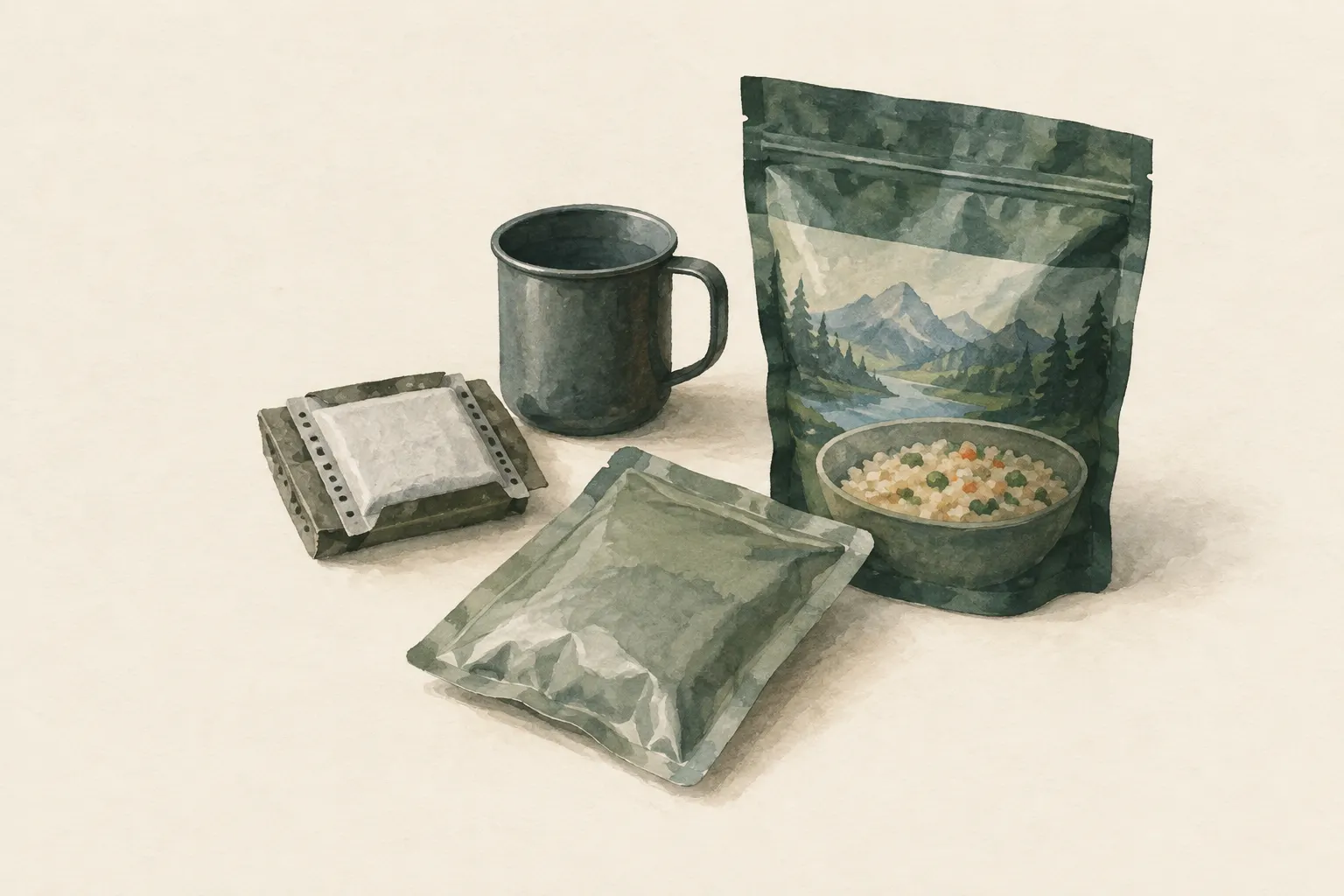
Freeze-dried outdoor meals and military-style ration packs in retort pouches are easy to store and quick to prepare. Freeze-dried food needs water, usually hot water; retort pouches are cooked and can be eaten cold. Flameless heaters release gas and do not belong in enclosed spaces. They supplement a stock but do not replace it.
- 5–15 minutes to prepare
Explained simply
There are two kinds of ready-made emergency food. Freeze-dried food is like a sponge with all the water squeezed out: very light, but only with water does it turn back into a meal – ideally with hot water. Retort pouches, on the other hand, are like a tin made of foil: the food inside is already cooked and can even be eaten cold.
Some packs have a flameless heater. If you add water, it gets very hot by itself. But in the process it gives off a flammable gas. That is why it is only used outdoors or with good ventilation, never in a car or tent.
A swollen, leaking or strange-smelling pouch is not eaten. And such packs supplement the stock – they do not replace a normal stock.
How it works
In freeze-drying, the food is first frozen and then placed in a vacuum chamber. There the ice turns directly into vapour without melting first, and is drawn off. What remains is a very light, porous product that largely keeps its shape. In oxygen-tight packaging it keeps for a long time, but it needs water to prepare, which you have to carry or treat safely on site.
Retort pouches work like a tin in flexible packaging: the food is filled into the pouch, which is sealed and then heat-sterilised together with its contents. The food is fully cooked and needs neither water nor cooking. In return it is heavier than freeze-dried food, because the water is still in it.
Both kinds keep longest when stored cool and dry. Heat shortens shelf life considerably – a car boot in summer is therefore not a good long-term storage place. This entry gives no fixed shelf-life figures; the manufacturer's information applies.
When it makes sense – and when not
Freeze-dried meals are ideal for multi-day tours with a water source, where every gram counts. For emergencies at home, where water or a way to cook might be missing, they are less suitable. There, retort pouches or tins are the better choice, because they can be eaten cold and need no extra water.
Such packs are not intended as the sole diet over a long period. They are expensive, create a lot of packaging waste and are often high in salt. A cheaper alternative is a self-assembled set of instant oats, couscous, instant mashed potato and dried soups – although it usually keeps for a shorter time.
What really matters
Try different varieties in everyday life before you stock them: do you like the taste, do you tolerate them, is the portion enough, which allergens do they contain? Anyone opening a pack for the first time in an emergency often gets unpleasant surprises.
With freeze-dried meals, follow the package instructions: add the stated amount of safe, ideally boiling water, stir, seal, wait for the stated time and stir again. With cold water it takes much longer, and the food often does not become fully soft. Retort pouches can be eaten cold or warmed in hot water according to the instructions.
Count the water: the preparation water for freeze-dried meals and the extra drinking water – many ready meals are salty and make you thirsty – belong in the water stock. Storing freeze-dried food without water is one of the most common mistakes.
Safety: what to watch out for
Flameless heaters react with water, become very hot and release flammable hydrogen in the process. They are used only according to the package instructions, well ventilated and away from open flames – never in closed vehicles, tents or small rooms. Do not touch the heater while it is reacting.
Boiling water in a soft pouch can easily tip over and cause severe scalds. So stand the pouch on firm ground or in a mug and keep children away.
Swollen, leaking, damaged or unusual-smelling pouches are not eaten – not even if the date has not yet passed. A bulge can be a sign that germs have multiplied inside.
Good to know
Freeze-dried outdoor meals and retort pouches come from expedition and military catering and are widely available today. Brands, contents and portion sizes differ greatly; this entry deliberately recommends no brand.
Official preparedness guides such as Ready.gov recommend mainly food for the emergency stock that needs little or no cooking and little water, and name ready-to-eat tinned food as a basis. Ready-made packs are a sensible supplement, especially for the go bag and the car – provided they do not lie there permanently in the heat.
Step by step
Choose the right type
For tours with a water source: freeze-dried (light). For emergencies without cooking or water: retort pouches or tins that can be eaten cold.
- 1
Choose the right type
For tours with a water source: freeze-dried (light). For emergencies without cooking or water: retort pouches or tins that can be eaten cold.
- 2
Try beforehand
Test different varieties in everyday life: taste, tolerance, portion size, allergens.
- 3
Store and rotate
Store cool, dry and protected from heat (not permanently in a hot car), note the date and use in time.
- 4
Prepare
Freeze-dried: add the stated amount of safe, ideally boiling water, stir, seal, wait for the stated time, stir again. Retort pouch: eat cold or warm in hot water according to the instructions.
With cold water it takes much longer and the result is often not fully rehydrated.
- 5
Count the water
Include the preparation water and extra drinking water in the water stock; many ready meals are high in salt.
Common mistakes
- Storing freeze-dried food without a water stock
- Using a flameless heater in the car
- Trying varieties only in an emergency
- Leaving packs in a hot car boot for years
Quick view
Materials
Non-perishable food
Prefer food that can be eaten without cooking; consider allergies and dietary needs; do not forget a can opener.
Stove
Never operate inside a tent, shelter or enclosed room – carbon monoxide and fire risk.
Metal pot (stainless steel, aluminium, titanium)
Hot – scalding risk.
Double-wall insulated bottle
Never heat directly.
Suitable for
- Go-bag and vehicle
- Multi-day tours with weight limits
- Supplementing the household stock for periods without cooking (retort pouches)
Not suitable for
- Situations without water (freeze-dried meals)
- Long-term sole diet
- Using flameless heaters in a tent, car or home without ventilation
Prerequisites
- Safe drinking water for preparation
- Reading and following the package instructions
Safety
- Do not eat from pouches that are swollen, leaking, damaged or smell unusual.
- Boiling water in pouches: stand the pouch on firm ground or in a mug to avoid scalds.
How it works
In freeze-drying, water is removed from the frozen food under vacuum; the product is very light and keeps for a long time in oxygen-tight packaging, but needs water to prepare. Retort pouches contain fully cooked food heat-sterilised in the sealed pouch – like a tin in flexible packaging. Both keep longest when stored cool; heat shortens shelf life.
Advantages
- Light (freeze-dried) or ready to eat (retort pouch)
- Long shelf life
- Little preparation effort
Disadvantages
- Expensive
- Freeze-dried food needs water
- A lot of packaging waste
- Often high in salt
Deep knowledge
Background
Official preparedness guides such as Ready.gov recommend food for the emergency stock that needs little or no cooking and little water, and name ready-to-eat tinned food as a basis.
Freeze-dried outdoor meals and retort pouches come from expedition and military catering and are widely available today; brands and contents differ greatly.
Variants
- Self-assembled
- Instead of ready-made packs, instant oats, couscous, instant mashed potato and dried soups can be combined – cheaper, but usually with a shorter shelf life.
Common mistakes
- Storing freeze-dried food without a water stock
- Using a flameless heater in the car
- Trying varieties only in an emergency
- Leaving packs in a hot car boot for years
Limits and risks
- No brand recommendations
- No fixed shelf-life figures – manufacturer information applies
- No instructions for home freeze-drying
Material alternatives
Derived from material properties: a substitute must have all relevant properties. Observe the notes on the substitute.
- Metal pot (stainless steel, aluminium, titanium)
- Single-wall stainless steel bottle (Heat only single-wall bottles without paint/plastic; remove the lid before heating.)
- Double-wall insulated bottle
- Single-wall stainless steel bottle (Heat only single-wall bottles without paint/plastic; remove the lid before heating.), PET bottle (clear, max. 2 litres) (Do not heat or place in a fire.), Food-grade water container (Only use containers that never held chemicals or fuel.), Airtight food-grade storage container (Fill only when clean and completely dry; never use containers that previously held chemicals.), Collapsible water container or bag (Protect from sharp objects.), Food-grade water bag (Use only for drinking water, never for chemicals or fuel.), Fermentation jar or crock (Use only food-grade containers of glass, food-safe glazed stoneware or food-grade plastic – no metal containers for acidic food.), Resealable food bags (Use only bags intended for food; do not use with boiling water unless the manufacturer explicitly allows it.)
Results come exclusively from structured entries. No improvised instructions are generated.
Sources
Ready.gov – U.S. Federal Emergency Management Agency (FEMA): Build A Kit
Food needing little cooking and water for the emergency kit
United States Department of Agriculture – Food Safety and Inspection Service (USDA FSIS): Keeping Food Safe During an Emergency
Do not use damaged or swollen packaging
Bundesamt für Bevölkerungsschutz und Katastrophenhilfe (BBK), Deutschland: Ratgeber für Notfallvorsorge und richtiges Handeln in Notsituationen
Emergency stock and food without cooking