Emergency food for hikes: energy density and packaging
On walks and tours, what counts is food that provides a lot of energy per gram, can be eaten without cooking, tolerates heat and cold and does not get crushed. In addition to the planned food, a reserve belongs in the pack that is only opened in an emergency – for example a delay, a change in the weather or an injury.
- A few minutes when packing
Explained simply
When you hike, your body is like a car that needs fuel. The fuel is your food. Fat contains the most energy – one gram of fat provides about twice as much as one gram of sugar or protein. That is why nuts, cheese or chocolate are good hiking companions: lots of energy, little weight.
Besides your normal food, a small emergency ration belongs in your pack. It is like a spare tyre: you only use it when something goes wrong – when you get lost, the weather changes or someone is hurt and it takes longer.
Important: dry, salty food makes you thirsty. Without water, even the best food does not help. Water always comes first.
How it works
Fat provides about 9 kilocalories per gram, carbohydrate and protein about 4 each. Dry, fat-rich foods therefore deliver a lot of energy for little weight – such as nuts, nut butter, hard cheese, chocolate or dried fruit with nuts. Water in food, on the other hand, adds weight but no energy. A fresh apple is lovely, but relative to its weight it is no powerhouse.
Carbohydrates are available to the body more quickly than fat. They help when you get tired or face a steep climb. Fat lasts longer. A mix of both therefore makes sense – for example dried fruit together with nuts, or crispbread with cheese.
How much energy you need is individual. Cold, altitude, a heavy pack and long climbs increase needs considerably. People who eat too little often notice it gradually: strength and concentration fade, they get cold more quickly and make worse decisions.
What really matters
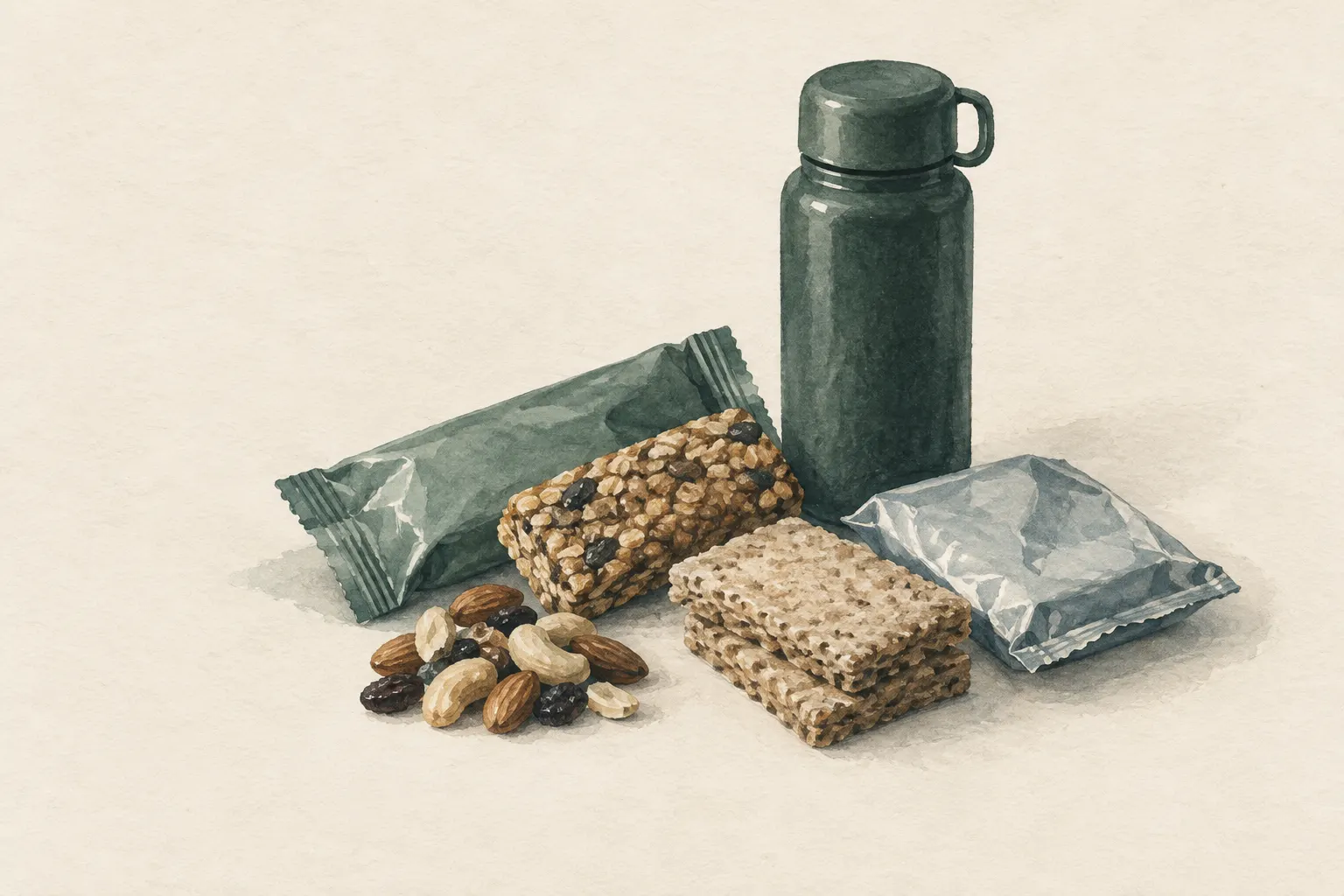
Good trail food is long-lasting, edible without cooking and robust. Nuts, dried fruit, cereal bars, hard cheese, wholemeal biscuits, crispbread and nut butter in tubes meet these needs well. Above all, pack things you know and tolerate from everyday life – a tour is not the place for experiments with your stomach. Only sweets is not a good idea, because they fill you up quickly but not for long.
Remove unnecessary cardboard and portion food into resealable bags. Label them with contents and, if needed, preparation. When repacking, take the ingredient and allergen information along, for example as a cut-out label – especially on group tours. Snacks go in a hip-belt or lid pocket so that you eat on the move without taking off the pack. Small amounts often are better than large meals rarely.
The emergency ration is packed separately and clearly marked. It is only opened if the tour lasts unexpectedly longer – not at the first break because you happen to be very hungry. After every tour you check it and replace anything old or eaten, so it does not lie forgotten in the pack for years.
Safety: what to watch out for
Dry, salty or protein-rich food increases water needs. Without water it is therefore better to eat less and prioritise water. Plan enough drinking water or a way to treat water safely on the way – food does not replace water.
Sandwiches with meat, fish, egg or dairy spoil without cooling. Eat them preferably on the first day, sooner in the heat. Fatty food such as chocolate can melt in the heat and eventually go rancid; so pack it in the middle of the pack, away from the sunny outside.
Smells of food and rubbish can attract wildlife. Carry packaging and leftovers back out and store food the way local rules require.
Typical situations
In frost, bars and chocolate turn rock hard. Carry them close to your body, for example in an inside pocket, or break them into small pieces beforehand. In the cold the body needs more energy anyway to stay warm – eating regularly helps with that.
In the car, too, a small emergency ration makes sense in winter, in case you get stuck in a traffic jam or snow. Heat and frost alternate there; so choose food that tolerates this and replace it regularly. The same principle applies to the go bag at home: long-lasting, edible without cooking, checked regularly.
Good to know
The mountaineering standard work “Mountaineering: The Freedom of the Hills” counts extra food among the “Ten Essentials” – the things that belong on every tour. The idea behind it: tours often take longer than planned, and a reserve buys time and calm to make good decisions.
The energy values of fat, carbohydrate and protein are standard values in nutrition science. This entry deliberately gives no fixed calorie targets per person, because needs depend on body, pace, terrain and weather.
Step by step
Plan needs
For each stage, eat foods that are tolerated in everyday life; cold, altitude and exertion increase needs. Eat small amounts often rather than infrequent large meals.
- 1
Plan needs
For each stage, eat foods that are tolerated in everyday life; cold, altitude and exertion increase needs. Eat small amounts often rather than infrequent large meals.
- 2
Choose foods
Durable, edible without cooking, robust: nuts, dried fruit, cereal bars, hard cheese, wholemeal biscuits, crispbread, nut butter in tubes. In the heat, pack chocolate and cheese in the middle of the pack.
- 3
Repack
Remove unnecessary cardboard, portion food into resealable bags and label contents and any preparation. Carry rubbish back out.
- 4
Set a reserve
Pack an additional emergency ration separately and mark it. It is only opened if the tour lasts unexpectedly longer, and is checked and replaced after the tour.
- 5
Within reach
Keep snacks in a hip-belt or lid pocket so that food is eaten on the move without taking off the pack.
Common mistakes
- Packing only sweets
- Eating the emergency ration at the first break
- No water for dry food
- Eating too little until strength and concentration fade
- Forgetting the reserve in the pack for years
Quick view
Materials
Resealable food bags
Use only bags intended for food; do not use with boiling water unless the manufacturer explicitly allows it.
Backpack
Labels and permanent marker
Suitable for
- Day and multi-day tours
- Go-bag
- Winter car journeys
Not suitable for
- A substitute for enough water
- Perishable food without cooling over several days
Prerequisites
- Route planning with a realistic duration
- Enough drinking water or a way to treat water
Safety
- Dry, salty or protein-rich emergency food increases water needs. Without water, eat less and prioritise water.
- Eat sandwiches with meat, fish, egg or dairy without cooling preferably on the first day; sooner in the heat.
- When repacking, take ingredient and allergen information along (e.g. a cut-out label), especially on group tours.
How it works
Fat provides about 9 kcal per gram, carbohydrates and protein about 4 kcal each. Dry, fat-rich foods (nuts, nut butter, hard cheese, chocolate, dried fruit with nuts) therefore provide a lot of energy for little weight. Carbohydrates are available more quickly, so a mix makes sense. Water in food adds weight but no energy.
Advantages
- A lot of energy for little weight
- No cooking needed
- A reserve buys time in delays
Disadvantages
- Dry food needs water
- Monotonous over several days
- Fatty food can melt or go rancid in the heat
Deep knowledge
Background
"Mountaineering: The Freedom of the Hills" lists extra food as a fixed part of the "Ten Essentials" and covers energy needs and food on tours.
The energy values of fat, carbohydrate and protein are standard values in nutrition science, as also used in the FAO/WHO/UNU report on energy requirements.
Variants
- In the cold
- Bars and chocolate become hard in frost: carry them close to the body or pre-break them into small pieces.
- In the car
- In a vehicle, choose food that tolerates alternating heat and frost, and replace it regularly.
Common mistakes
- Packing only sweets
- Eating the emergency ration at the first break
- No water for dry food
- Eating too little until strength and concentration fade
- Forgetting the reserve in the pack for years
Limits and risks
- No calorie targets per person – needs are individual
- No nutrition for high-performance or expedition conditions
Material alternatives
Derived from material properties: a substitute must have all relevant properties. Observe the notes on the substitute.
- Resealable food bags
- Single-wall stainless steel bottle (Heat only single-wall bottles without paint/plastic; remove the lid before heating.), Double-wall insulated bottle (Never heat directly.), PET bottle (clear, max. 2 litres) (Do not heat or place in a fire.), Food-grade water container (Only use containers that never held chemicals or fuel.), Airtight food-grade storage container (Fill only when clean and completely dry; never use containers that previously held chemicals.), Collapsible water container or bag (Protect from sharp objects.), Food-grade water bag (Use only for drinking water, never for chemicals or fuel.), Fermentation jar or crock (Use only food-grade containers of glass, food-safe glazed stoneware or food-grade plastic – no metal containers for acidic food.)
- Backpack
- Sleeping pad, Dry leaves, grass or conifer boughs (Collect only where allowed; no protected plants. Check for ticks and insects.), Dry spare clothing (Carry it in waterproof packaging – wet clothing barely insulates.), Wool blanket / duvet (Keep away from candles, stoves and heaters.), Insulated cool box (Keeps cold only for a limited time; without ice packs or ice it is not a fridge.), Sleeping bag (Do not store compressed long-term; do not pack away damp.), Newspaper and cardboard (Flammable – keep away from candles, stoves, heaters and embers.), Insulated cooking box (hay box, thermal cooker) (Never put open flame or embers inside – only the hot, closed pot.)
Results come exclusively from structured entries. No improvised instructions are generated.
Sources
The Mountaineers Books (2017): Mountaineering: The Freedom of the Hills, 9th edition
Extra food as part of the Ten Essentials; food on tours
Food and Agriculture Organization of the United Nations (FAO) (2004): Human energy requirements – Report of a Joint FAO/WHO/UNU Expert Consultation
Energy needs depend on activity; energy values of nutrients