Small balcony and garden solar systems: what they can do and what to check
Plug-in solar systems ("balcony power plants") feed electricity into the home's circuits and reduce what is drawn from the grid. During a power cut, grid-tied units generally deliver no power for safety reasons. For backup power you need an off-grid setup or a portable power station with a solar panel. Permission, registration, mounting and connection are regulated regionally – check local rules and ask professionals when in doubt.
- A few hours of research; installation per manufacturer instructions
Explained simply
A solar panel is a flat plate that turns sunlight into electricity. A small system on the balcony or in the garden – often called a “balcony power plant” – sends this electricity into the home's sockets. Then the fridge, for example, runs partly on solar power, and you have to buy less electricity.
Many people think: “Great, then I'll have power during a power cut too.” That is usually not true! Such systems deliberately switch off during a power cut. The reason: otherwise electricity could flow back into the lines in the street, where people are working to fix the fault. For backup power you need something else, for example a portable battery – a so-called power station – with its own solar panel.
Important for safety: panels are heavy and the wind pushes hard against them. They must be fixed exactly as the manufacturer specifies. You never tinker with cables or the home's wiring yourself – fixed wiring is installed only by a qualified electrician. And first you find out what is allowed and whether the system has to be registered.
How it works
Solar cells are usually made of silicon. When light falls on them, it sets electrical charges moving in the material – producing direct current, meaning current that always flows in the same direction. The home's circuits, however, work with alternating current. A device called an inverter therefore converts the direct current so it can be used in the home.
With a grid-tied plug-in solar unit, this electricity flows into the home's circuits. Appliances that are running use it first, and correspondingly less is drawn from the public grid. Without storage, solar power is only used while the sun shines. How much a panel delivers depends heavily on orientation, tilt, season, weather and shade – even partial shading can reduce output noticeably.
If the public grid fails, grid-tied inverters shut down. This is a deliberate protective function: no voltage may flow back into a de-energised grid where professionals are working. So such a unit is generally not a source of backup power during a power cut.
Two different goals
For preparedness this is the key insight: cutting electricity costs and having backup power are two different goals that need different systems. A balcony system reduces grid consumption in everyday life. For backup power – charging a phone, a lamp, a radio – you need an off-grid system that works independently of the grid, or a portable power station that can be charged with a solar panel.
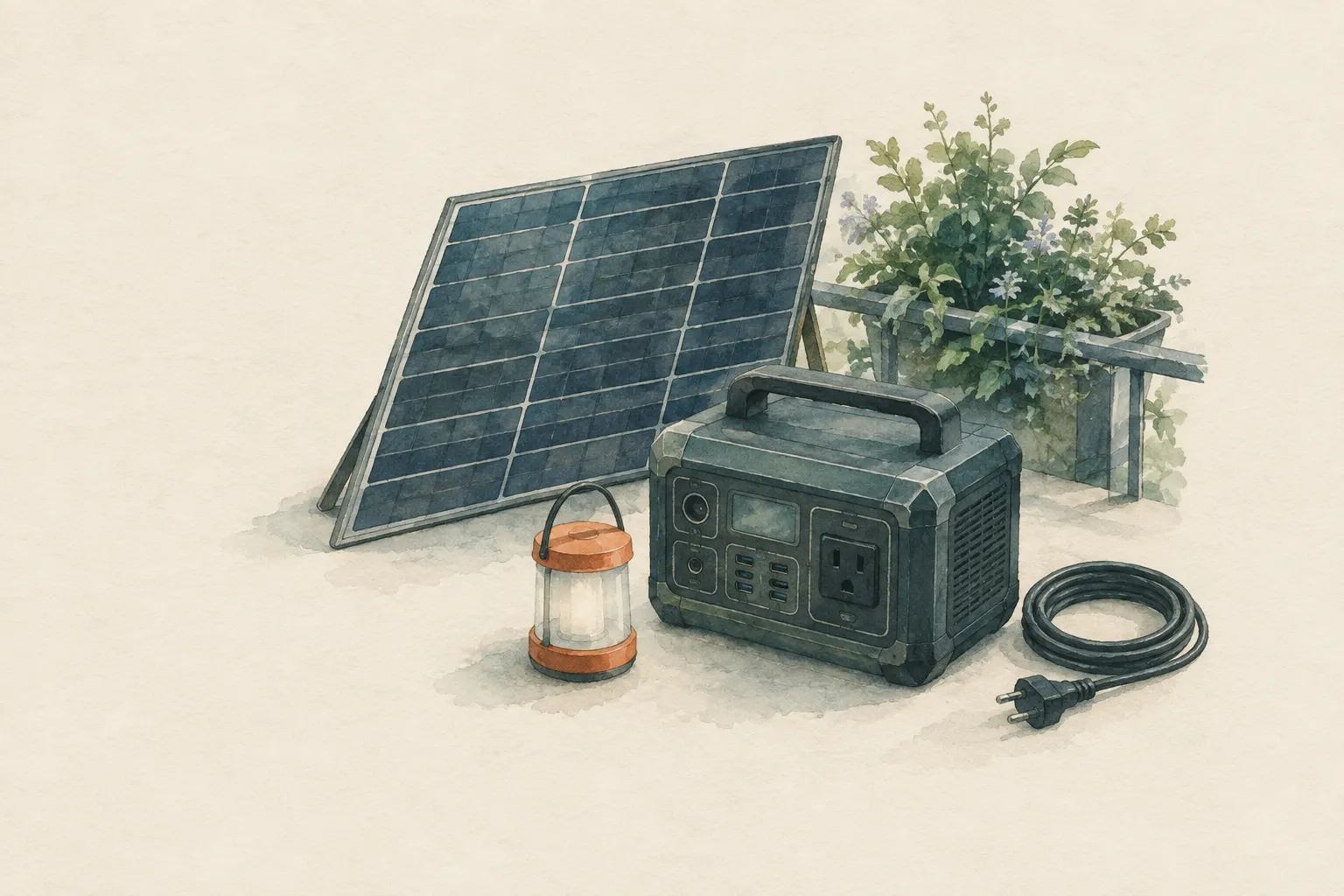
For most households, a power station with a folding panel is the simpler emergency solution: it is a ready-made device, is not connected to the home's wiring and supplies small devices through its own outlets. Its battery is limited, though. Large loads such as fan heaters, cookers or kettles drain it quickly or overload it. The manufacturer's information shows which devices it can supply.
Self-built battery systems or arrangements that somehow feed a system into the home's wiring during a power cut are dangerous and belong exclusively in the hands of qualified electricians.
Rules, registration and consent
Plug-in solar units have spread widely in some countries. But the rules differ considerably between countries and keep changing: whether and where the system must be registered, what power is allowed, which plug and which meter are required. That is why this text deliberately gives no figures or legal positions.
Before buying, therefore, find out the current local requirements, for example from the grid operator or official bodies. In rented homes and owners' associations, the consent of the landlord or association is often needed, especially if something is fixed to the facade or railing. Comply with any notification and registration duties.
For mounting and connection: use only complete kits with manufacturer instructions, follow them exactly, and connect only as locally permitted. If a fixed cable, a special socket or a change to the home's installation is needed, a qualified electrician does it.
Safety: what to watch out for
The biggest danger is often not the electricity but the wind. Panels are heavy and present a large surface for gusts to push against. A falling panel can seriously injure people. It is fixed only with mounts designed for the purpose, according to the manufacturer's instructions, and the fixing must be suitable for the load. Nothing is mounted above walkways or entrances without a verified installation. Check the mounting after storms.
As for electricity: no DIY wiring, no tampering with inverters or the home installation. Solar panels produce voltage as soon as light falls on them – you cannot simply switch them off. Damaged cables or plugs are not patched up but replaced by professionals.
Batteries in power stations and storage systems hold a lot of energy. Charge and store them only per the manufacturer's instructions, do not use damaged or swollen units, and do not place them in escape routes such as hallways or stairwells.
Typical situations
One household wants to save on electricity costs and has a sunny south-facing balcony: here a plug-in solar unit can make sense – after checking the rules, with consent and secure mounting. For a power cut, the same household also plans torches, power banks or a power station.
Another household lives on the ground floor with a shady courtyard: a fixed panel there often brings little. A power station with a folding panel that can be put in a sunny spot when needed can still be useful for preparedness. The honest question at the start is always: what do I want to achieve – saving or preparing?
Step by step
Clarify the goal
Cut costs (grid-tied) or backup power for small devices (off-grid or power station)? These are different systems.
- 1
Clarify the goal
Cut costs (grid-tied) or backup power for small devices (off-grid or power station)? These are different systems.
- 2
Check the rules
Clarify requirements on registration, power limits, plugs and meters, and consent from landlord or owners' association – check local rules.
- 3
Site
A sunny place with little shade, safely accessible, with load-bearing mounting. Nothing above walkways without a verified installation.
- 4
Install per instructions
Only use complete kits with manufacturer instructions and follow them exactly; connect only as locally permitted.
- 5
Check regularly
Check the mounting after storms, inspect cables for damage, occasionally clean panels carefully from a safe position.
Common mistakes
- Assuming a balcony system provides power during an outage
- Hanging panels unsecured on the railing
- Improvising your own wiring
- Ignoring rules and consent
Quick view
Materials
Portable power station (battery with inverter)
Do not use lithium batteries that are damaged, swollen or overheated.
Charge, operate and store only according to the manufacturer's instructions.
Folding solar charger
Do not let phones and power banks overheat in direct sun while charging.
Output depends strongly on sun, orientation and season.
Suitable for
- Reducing electricity costs
- Charging small devices via a power station
- Getting started with solar
Not suitable for
- Backup power during a grid outage with grid-tied units
- DIY wiring, battery systems or connections to the home's installation
Prerequisites
- Clarification with landlord, owners' association and grid operator where required
- A safe mounting place with enough sun
Safety
- Charge and store battery storage and power stations only per manufacturer instructions, do not use damaged units, do not place them in escape routes.
How it works
Solar panels produce direct current when light falls on them. An inverter converts it so it can be used in the home's circuits. Grid-tied inverters shut down during a grid outage so no voltage flows back into the de-energised grid and endangers people working on it. Without storage, power is only used while the sun shines.
Advantages
- Reduces grid consumption
- Possible without building work where permitted
Disadvantages
- No backup power when grid-tied
- Regional rules and consent required
- Yield depends on weather and site
Deep knowledge
Background
Plug-in solar units have spread widely in some countries; however, the rules on registration, power and connection differ considerably and change over time. This entry therefore deliberately gives no figures or legal positions.
For preparedness the key insight is that feeding the grid and backup power are two different goals.
Variants
- Power station with solar panel
- For backup power for phone, lamp and radio a portable power station with a folding panel is often the simpler solution – see power banks and power stations.
Common mistakes
- Assuming a balcony system provides power during an outage
- Hanging panels unsecured on the railing
- Improvising your own wiring
- Ignoring rules and consent
Limits and risks
- No wiring or connection instructions
- No legal advice – check local rules
- No yield calculation
Sources
–