Coagulation and flocculation: clearing cloudy water
Coagulants make fine suspended particles that barely settle on their own clump into larger flocs that sink. This makes very cloudy water clear enough for disinfection. Flocculation alone does not make water drinkable – unless an approved combined product containing a disinfectant is used exactly according to the manufacturer's instructions.
- A few minutes of stirring, then settling time per product instructions
Explained simply
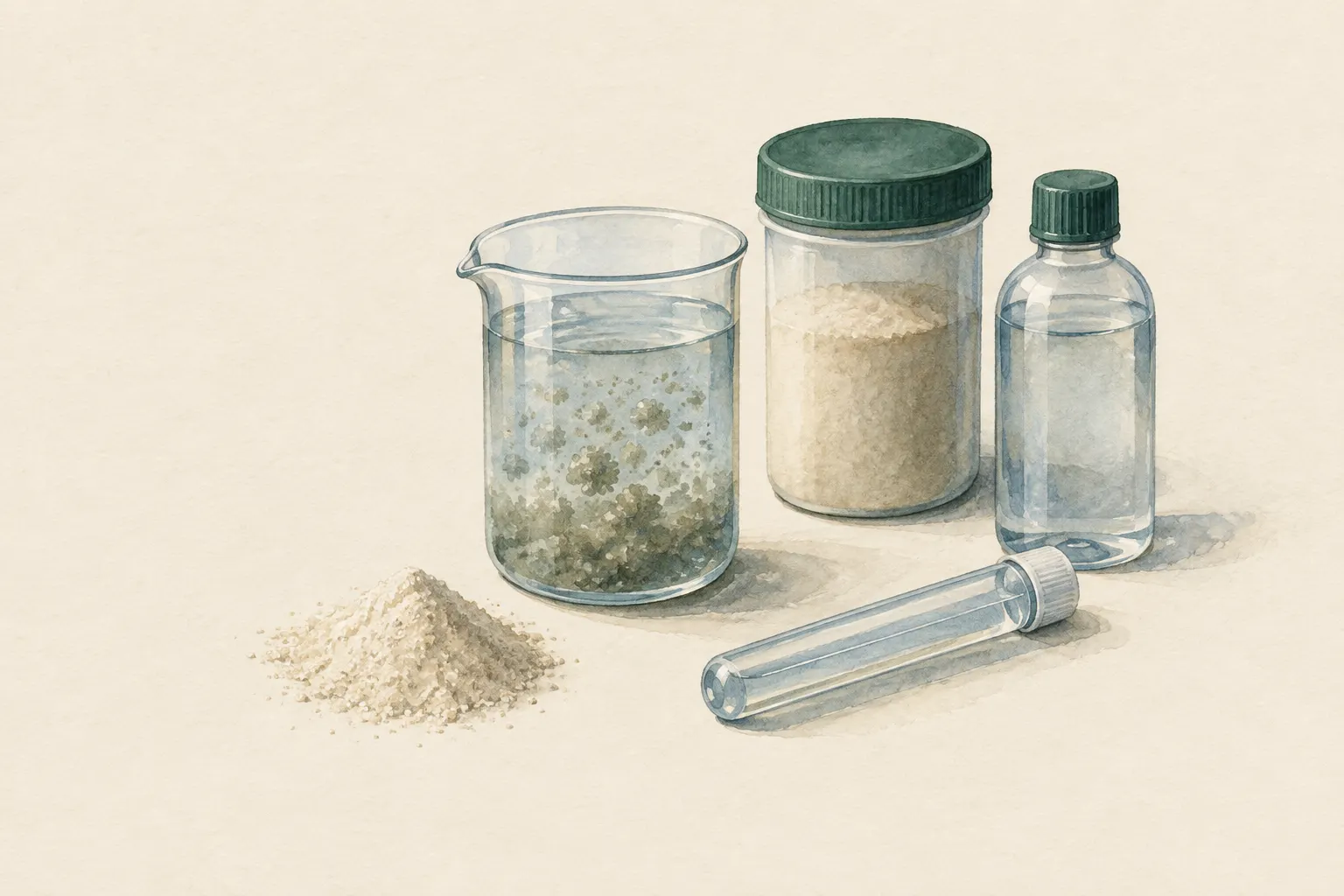
Some water is as cloudy as cocoa. Tiny bits of soil float in it, so small that they do not sink for days. A coagulant is a powder that makes these bits stick together – a bit like dust balling up into fluff under the bed. The big clumps are called flocs. They are heavy enough to sink to the bottom, and clearer water is left on top.
But clear does not mean clean. The clear water can still contain germs that you cannot see. That is why the water must always be disinfected afterwards, for example by boiling. The only exception is special sachets that contain both a coagulant and a disinfectant – and even those only when used exactly as instructed.
Use only products made specifically for drinking water and follow the pack instructions exactly. Self-mixed chemicals from the household or a hardware store do not belong in water.
How it works
The finest clay and dirt particles in cloudy water carry the same kind of electrical charge on their surface. Like charges repel each other – like two magnets held together with the same pole. So the particles never get close enough to stick together and stay suspended for a long time. This cloudiness can last for days.
A coagulant cancels this repulsion. In water supply, aluminium or iron salts are used for this, for example. Then comes the actual flocculation: during slow stirring the particles bump into each other, stick and grow into visible flocs. These sink and drag further suspended matter and part of the germs down with them.
Waterworks have long used this step as a preliminary stage: first coagulate and settle, then filter, finally disinfect. So flocculation does not replace disinfection; it prepares for it.
When it makes sense – and when not
Flocculation is worthwhile when water is very cloudy and there is no better source. Cloudy water weakens other methods: dirt particles can shield germs from chlorine, UV light passes poorly through cloudy water, and filters clog quickly. Clarified water, on the other hand, can be disinfected far more reliably.
Flocculation is not suitable for water containing oil, fuel or industrial chemicals, because dissolved substances are not reliably removed. Salt stays in the water as well; seawater or brackish water does not become drinkable through flocculation. If the water is only slightly cloudy, simply letting it settle and pouring it through a clean cloth is often enough before disinfection.
What really matters
The product sets the procedure. The instructions say how much water one sachet or dose is meant for, how long and how vigorously to stir, and how long the water must then stand. These details are matched to each other. Typically you first stir briefly and vigorously so the agent spreads, then slowly so the flocs grow and are not broken up again.
After that the vessel needs to rest. Only when the flocs have collected as a layer at the bottom and the water above is clear do you pour it carefully through a clean cloth into a second vessel. The sediment must not be stirred up; better to leave a little water behind.
Then comes the most important step: disinfection, meaning boiling or chemical disinfection according to the instructions. Only with an explicitly approved combined product containing a disinfectant, used exactly as the manufacturer states, is this already included. When in doubt, boil as well.
Safety: what to watch out for
Clear water looks trustworthy – that is the biggest trap. Many germs are so small that they stay in the clear water. Without a disinfection step, clarified water is therefore not safe drinking water.
Do not use self-estimated amounts of household or hardware-store chemicals, even if they sound similar to substances used at waterworks. Purity and dose are unknown, and too much or the wrong agent can harm the body. Only approved products for drinking water, exactly as instructed.
The sludge at the bottom contains everything that was held back, germs included. It does not belong in drinking water and is disposed of away from water bodies and water sources. Wash the vessels thoroughly afterwards.
Good to know
In humanitarian aid, sachets combining flocculation and disinfection are used so that families can treat even very cloudy river water at home. They only work if water volume, stirring time and waiting time are followed exactly.
For your own preparedness, flocculation is more of a supplementary tool. Knowing how it works also helps you understand why waiting, settling and careful pouring make disinfection much easier even without any agent.
Step by step
Prepare
Read the product's instructions. Fill the stated volume of water into a clean vessel; pour it through a cloth first to remove coarse matter.
- 1
Prepare
Read the product's instructions. Fill the stated volume of water into a clean vessel; pour it through a cloth first to remove coarse matter.
- 2
Add and stir
Add the agent as instructed. Typically, stir vigorously first and then slowly so that flocs form.
- 3
Let it settle
Leave the vessel undisturbed until the flocs have collected at the bottom and the water above is clear.
- 4
Decant
Carefully pour the clear water through a clean cloth into a second vessel without stirring up the sediment.
- 5
Disinfect
Disinfect the clarified water by boiling or chemically – unless the product is explicitly an approved combined coagulant-disinfectant and was used exactly as instructed.
When in doubt, boil as well.
Common mistakes
- Drinking clarified water without disinfection
- Guessing amounts instead of following the instructions
- Pouring off the sediment too
- Decanting too early, before the flocs have settled
- Assuming flocculation is enough when chemicals are suspected
Quick view
Materials
Coagulant or flocculant-disinfectant sachet
Only products approved for drinking water
Use only products approved for drinking water.
Amount and waiting time strictly per manufacturer instructions.
Store out of children's reach.
Galvanised bucket
Or another clean, food-grade bucket
Do not heat: the zinc coating can release harmful fumes when heated.
Cotton cloth / T-shirt
For decanting the clarified water
Removes coarse particles only – no disinfection.
Food-grade water container
Clean container for the clarified water
Only use containers that never held chemicals or fuel.
Suitable for
- Very cloudy river water when there is no better source
- Preparing water for chlorine, UV or filters that need clear water
- Household-scale treatment of larger volumes
Not suitable for
- Chemically contaminated water (oil, fuel, industry)
- Seawater and brackish water
- Improvised agents with unknown dosing
Prerequisites
- An approved coagulant with instructions
- Two clean vessels
- A subsequent disinfection method
Safety
- Amount, stirring time and settling time strictly per manufacturer or authority instructions. Do not use self-estimated amounts of household or hardware-store chemicals.
- The settled sludge contains the retained dirt and pathogens. Do not pour it off with the water, and dispose of it away from water sources.
How it works
The finest clay and dirt particles carry similar electrical charges and repel each other, which is why they stay suspended for a long time. A coagulant (in water supply e.g. aluminium or iron salts) cancels this repulsion; during slow stirring the particles grow into flocs that sink and take part of the pathogens with them. Waterworks use this step as a stage before filtration and disinfection.
Advantages
- Clears even very cloudy water
- Improves the effect of subsequent disinfection
- Protects filters from clogging
Disadvantages
- Needs suitable agents and instructions
- Waiting time
- Not reliable disinfection on its own
- Sludge must be disposed of
Deep knowledge
Background
Coagulation and flocculation are among the classic processes of drinking-water treatment and in waterworks usually come before filtration and disinfection. For households in crisis areas, products have been developed that combine both steps in one sachet.
In the field, flocculation is mainly useful when water is so cloudy that chlorine, UV or filters would otherwise not work reliably.
Variants
- Combined products with disinfectant
- There are sachets that combine a coagulant and a disinfectant. They are used in humanitarian aid. They are only effective if water volume, stirring time and waiting time are followed exactly as stated by the manufacturer.
Common mistakes
- Drinking clarified water without disinfection
- Guessing amounts instead of following the instructions
- Pouring off the sediment too
- Decanting too early, before the flocs have settled
- Assuming flocculation is enough when chemicals are suspected
Limits and risks
- Does not remove salt
- Dissolved chemicals are not reliably removed
- No reliable disinfection without a disinfection step
- Effect depends on water quality and product
Material alternatives
Derived from material properties: a substitute must have all relevant properties. Observe the notes on the substitute.
- Galvanised bucket
- Single-wall stainless steel bottle (Heat only single-wall bottles without paint/plastic; remove the lid before heating.), Double-wall insulated bottle (Never heat directly.), PET bottle (clear, max. 2 litres) (Do not heat or place in a fire.), Food-grade water container (Only use containers that never held chemicals or fuel.), Used chemical or fuel container (Never for drinking water or food – residues cannot be reliably removed.), Waterproof case or bag, Airtight food-grade storage container (Fill only when clean and completely dry; never use containers that previously held chemicals.), Wildlife-resistant food container (Where specific containers are required, use only approved models – check local rules.), Small metal tin with lid (Burn off coated or painted tins outdoors first.), Collapsible water container or bag (Protect from sharp objects.), Food-grade water bag (Use only for drinking water, never for chemicals or fuel.), Fermentation jar or crock (Use only food-grade containers of glass, food-safe glazed stoneware or food-grade plastic – no metal containers for acidic food.), Resealable food bags (Use only bags intended for food; do not use with boiling water unless the manufacturer explicitly allows it.)
- Food-grade water container
- Single-wall stainless steel bottle (Heat only single-wall bottles without paint/plastic; remove the lid before heating.), Double-wall insulated bottle (Never heat directly.), PET bottle (clear, max. 2 litres) (Do not heat or place in a fire.), Airtight food-grade storage container (Fill only when clean and completely dry; never use containers that previously held chemicals.), Collapsible water container or bag (Protect from sharp objects.), Food-grade water bag (Use only for drinking water, never for chemicals or fuel.), Fermentation jar or crock (Use only food-grade containers of glass, food-safe glazed stoneware or food-grade plastic – no metal containers for acidic food.), Resealable food bags (Use only bags intended for food; do not use with boiling water unless the manufacturer explicitly allows it.)
Results come exclusively from structured entries. No improvised instructions are generated.
Sources
World Health Organization (2022): Guidelines for drinking-water quality, fourth edition incorporating the first and second addenda
Coagulation and flocculation as pre-treatment before filtration and disinfection
Wilderness & Environmental Medicine (Wilderness Medical Society) (2019): Wilderness Medical Society Clinical Practice Guidelines for Water Disinfection for Wilderness, International Travel, and Austere Situations: 2019 Update
Clarification techniques such as sedimentation and flocculation improve subsequent disinfection but do not replace it
Centers for Disease Control and Prevention: Making Water Safe in an Emergency
Disinfecting cloudy water after clarifying