Light without electricity: fat lamp and tallow light
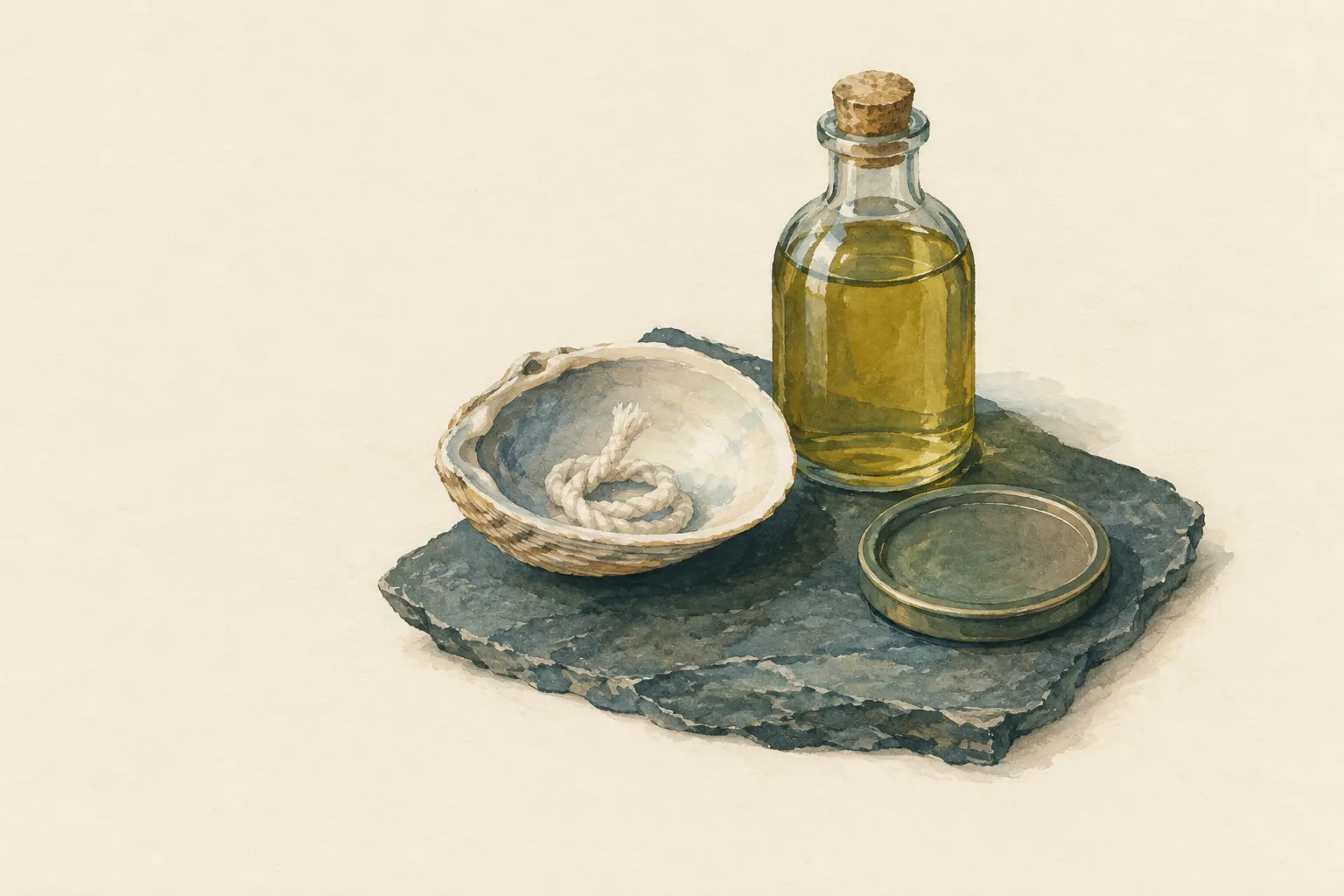
A fat lamp is a shallow, fireproof dish holding cooking oil or fat and a cotton wick. The wick draws the fat upwards, where it burns with a small, steady flame. The lamp stands firmly on stone or earth, never in a tent and never unattended. It is put out by smothering – never put water on burning fat.
- 10–15 minutes
Explained simply
Before there was electricity, people made light with fat. Long ago this was a shell or a stone with a hollow, holding animal fat and a wick. It still works today: with cooking oil from the kitchen and a piece of cotton cloth.
The wick is like a drinking straw. It sucks the oil upwards to its tip. There the flame makes the oil so hot that it turns into vapour – and this vapour burns. That is why the oil does not all burn at once, only a small, steady little flame.
But a fat lamp is real fire. It never goes in a tent, never next to the sleeping bag and is never left alone. And when fat burns, you never pour water on it – it spatters dangerously. Instead you put a lid on it, and the flame goes out.
How it works
Liquid fat hardly burns while it lies cold in a dish. Only when it vaporises can it mix with air and burn. The wick solves this problem: its fine fibres form tiny channels in which the oil creeps upwards – just as water does in a piece of kitchen paper. At the tip the flame heats the oil, it vaporises, and the flame keeps itself alive.
The size of the flame depends on how much wick sticks out of the fat. A short piece gives a small, steady, yellow flame. A long piece releases more fuel than can burn cleanly with the air – the flame grows, flickers and smokes. That is why you adjust the flame with the length of the wick.
Solid fat such as tallow or lard melts near the wick from the heat of the flame. That is why in solid fat the wick can stand upright like in a candle. Liquid oil needs a wick that lies at the rim and is held in place.
What really matters
The dish must be fireproof, shallow and stable: a shell, a tin or tin lid, a stone with a hollow, a clay dish. It stands on a flat stone or bare earth, not on leaves, wood or fabric. You pour in only a little fat – so the amount that could burn in the worst case stays small.
The wick must be pure cotton or another natural material. Synthetic fibres melt and drip. A strip from an old cotton T-shirt, twisted tightly, works well. Soak it fully in the oil before lighting it. At a pinch cattail fluff or dry moss will do, but they burn less steadily.
If the flame smokes, the wick is too long: pull it back a little with a twig, or trim it after you have put the lamp out. If the flame is too small or goes out, push out a little more wick. You refill only when the lamp is out and has cooled.
Safety: what to watch out for
An open flame in a tent is life-threatening. Tent fabric, sleeping bags and clothing can burn in seconds. In small, enclosed spaces any flame can also produce carbon monoxide, which you can neither see nor smell. So: never in a tent, never in a bivvy bag, never next to the sleeping place. In huts or shelters only with an open side or a real smoke outlet and with a CO alarm.
Burning fat is never put out with water. The water sinks under the hot fat, turns to steam in an instant and throws burning fat out. The right way is to put on a lid, a tin lid or a flat stone and take away the air. Have this lid ready before you light the lamp.
The dish gets hot, and so does the fat. Do not touch or carry it while the lamp is burning or warm. Children stay at a safe distance and light it only with an adult. Before sleeping the lamp is always put out.
When it makes sense – and when not
A fat lamp makes sense when light is needed outdoors in camp and no batteries are left, or when you want to show how people made light in the past. It gives a warm, faint light – enough to see something at a table, not enough for a path in the dark.
A headlamp or torch is brighter, safer and also works in a tent. It therefore remains the first choice. In homes during a power cut, battery lamps are much safer than any open flame. The fat lamp is knowledge for outdoors and for emergencies.
Good to know
Stone lamps with fat are among humanity's oldest light sources. Archaeologists found such lamps in the Lascaux cave in France. Until the 19th century, tallow lights and oil lamps were the usual light in many homes.
A simple variant is the tin lamp: a hole is punched in the lid of a small tin, the wick is pulled through and the tin is filled with oil. The lid holds the wick in place and protects the oil.
Oil you burn in the lamp is used up afterwards and does not go back into food. So plan oil for cooking and oil for light separately.
Step by step
Choose a safe place
Outdoors or under an open tarp, sheltered from wind, on a flat stone or bare earth. Well away from the tent, sleeping bag, leaves and clothing.
Caution: Never in a tent.
- 1
Choose a safe place
Outdoors or under an open tarp, sheltered from wind, on a flat stone or bare earth. Well away from the tent, sleeping bag, leaves and clothing.
Never in a tent.
- 2
Prepare the dish
Use a shallow, fireproof dish: a shell, a tin or tin lid, a hollowed stone, a clay dish. It must stand firmly and must not tip over.
- 3
Add fuel
Pour in cooking oil or fat such as tallow or lard only shallowly. Solid fat will melt later from the flame. No petrol, no spirit.
- 4
Twist a wick
Twist a strip of pure cotton tightly into a wick and soak it in the oil. At a pinch cattail fluff or dry moss will do, but they burn less steadily. Synthetic fibre melts – do not use it.
- 5
Position the wick
The wick lies in the fat with only the tip sticking out over the rim by about a fingernail's width. A pebble or a piece of wire holds it. In solid tallow the wick stands upright like a candle.
- 6
Light it and adjust the flame
Light the tip of the wick. The flame should be small and steady, about like a candle flame. If it smokes or flickers, pull the wick back a little or trim it.
- 7
Keep watch
Never leave the lamp alone and keep children away. Refill only when it is out and has cooled. The dish gets hot.
- 8
Put it out by smothering
Push the wick into the fat with a twig or put a lid or flat stone on it. Never put water on burning fat. Let it cool before moving the lamp.
Never water on burning fat.
Common mistakes
- Lamp in the tent or next to the sleeping bag
- Wick too long – the flame smokes and grows
- Wick of synthetic fibre
- Refilling or carrying a hot lamp
- Putting out burning fat with water
Quick view
Materials
Cooking oil or cooking fat (tallow, lard)
Never put out burning fat with water – cover it with a lid to smother it.
Do not mix with petrol, spirit or other highly flammable liquids.
Cotton cloth / T-shirt
Pure cotton for the wick, no synthetics
Removes coarse particles only – no disinfection.
Small metal tin with lid
Or a shell, a hollowed stone, a clay dish
Burn off coated or painted tins outdoors first.
Gets very hot in a fire.
Lighter, matches or ferro rod
Observe local fire bans.
Water for extinguishing (bucket, canister or pot)
For the surroundings, never for burning fat
Have several litres ready before lighting.
Suitable for
- Light in camp when batteries are flat
- Showing and understanding traditional techniques
- Emergency light outdoors during a power cut
Not suitable for
- Tents, bivvy bags and sleeping places
- Rooms without a smoke outlet and without a CO alarm
- Wind, dry leaves, fire bans
- Children without supervision
Prerequisites
- A safe, sheltered spot outdoors or under an open tarp
- A lid or flat stone to smother the flame
Safety
- Never leave it unattended; put it out before sleeping. The dish gets hot: let it cool before touching or refilling it.
How it works
Fat does not burn as a pool but only as vapour. The wick draws liquid fat upwards through fine capillaries, the heat of the flame vaporises it at the tip of the wick, and that vapour burns. A short wick gives a small, steady flame; a wick that is too long smokes and flickers.
Advantages
- Fuel is often already in the kitchen
- Small, steady flame
- No batteries needed
Disadvantages
- Open flame with fire risk
- Little light compared with a headlamp
- Smokes if the wick length is wrong
Deep knowledge
Background
Stone lamps burning fat are among the oldest light sources; archaeologists have found such lamps in places like the Lascaux cave. Until paraffin arrived, tallow lights and oil lamps were common in many households.
Today a headlamp is safer and brighter. The fat lamp is knowledge for when no batteries are left – and a lesson in why open flames never belong in tents.
Variants
- Tin lamp with lid
- Punch a hole in the lid of a small tin, pull the wick through and fill the tin with oil. The lid holds the wick and also helps to put it out.
- Rushlight
- In the past people dipped the peeled pith of rushes in fat and burned it in a holder. It gives only weak light and takes a lot of practice.
Common mistakes
- Lamp in the tent or next to the sleeping bag
- Wick too long – the flame smokes and grows
- Wick of synthetic fibre
- Refilling or carrying a hot lamp
- Putting out burning fat with water
Limits and risks
- No figures for burning time or brightness
- No replacement for smoke and CO alarms in buildings
- For indoors see the entries on safe light without an open flame
Material alternatives
Derived from material properties: a substitute must have all relevant properties. Observe the notes on the substitute.
- Cooking oil or cooking fat (tallow, lard)
- Dry firewood (Collect only where permitted.), Tinder (Carry in waterproof packaging.), Char cloth (charred cotton) (Store dry in a tin.), Finest-grade steel wool (Store separately from batteries – fire risk.), Fatwood (resin-rich wood) (Collect only dead wood where permitted.), Stove fuel (canister, liquid fuel, alcohol) (Store fuels apart from food and in original containers or bottles intended for them.), Petroleum jelly cotton balls (Use only pure cotton.), Tree resin (spruce, pine) (Resin is flammable and sticks to the skin when hot – melt it only slowly over low heat.), Birch bark (from dead, fallen wood) (Never peel from living trees.)
- Small metal tin with lid
- Single-wall stainless steel bottle (Heat only single-wall bottles without paint/plastic; remove the lid before heating.)
- Lighter, matches or ferro rod
- Ferro rod (Practise before you need it.), Fire striker and hard stone (Carbon steel, not stainless.), Bow drill set (bow, spindle, hearth board, bearing block) (Use only dry wood.), Burning lens / magnifier (Never leave lying in the sun – fire risk.), Fire piston (Maintain the seal.), Pump drill (spindle, flywheel, crossbar, cord) (Fix the flywheel firmly and centrally – a loose disc can fly off.)
Results come exclusively from structured entries. No improvised instructions are generated.
Sources
National Fire Protection Association (NFPA): Candle safety tips
Never leave open flames unattended, keep away from flammables, stable base
National Fire Protection Association (NFPA): Cooking safety tips (including what to do with a grease fire)
Smother burning grease with a lid, never use water
Centers for Disease Control and Prevention: Carbon Monoxide Poisoning – Prevention guidance
Carbon monoxide from combustion in enclosed spaces
Mors L. Kochanski – Lone Pine Publishing: Bushcraft: Outdoor Skills and Wilderness Survival
Light and fire in camp