Fire inside a hut: building a hearth, smoke exit and stone stove safely
A fire inside a hut gives warmth, but it can burn the hut down and kill with invisible carbon monoxide. It only becomes safe with a hearth of dry stones, plenty of distance from everything that burns, a real smoke exit at the very top, fresh air from below, a small fire, constant supervision and water for putting it out right beside it. Headache, dizziness or nausea mean: everyone out into the fresh air at once.
- A few hours for hearth and smoke exit, a clay chimney several days
Explained simply
A fire inside a hut is wonderfully warm. But it is also dangerous, for two reasons: the hut itself can catch fire, and every fire makes an invisible gas called carbon monoxide. You cannot see it, smell it or taste it – and yet it can make people very ill or even kill them.
For a fire inside to be safe, it needs three things: an exit for the smoke at the very top of the roof, an entrance for fresh air low in the wall and plenty of distance between the fire and everything that can burn. The fire stays small, and someone awake is always with it. Water for putting it out stands beside it.
If you get a headache in the hut, feel dizzy or sick – especially if others feel the same – then everyone goes outside into the fresh air at once. Do not quickly fetch anything first. Outside, call for help on 112.
How it works
A fire burns wood with oxygen from the air. If it gets enough air and the wood is dry, it produces mainly water vapour and carbon dioxide, and the fire smokes little. If air is lacking or the wood is wet, it burns incompletely: a lot of smoke and more carbon monoxide form. Smouldering, covered embers in particular are a strong source of carbon monoxide.
Hot smoke is lighter than the cool air in the room and rises. But it can only escape if fresh air flows in at the bottom at the same time – like a chimney. Without an air inlet, smoke builds up under the roof, the smoke layer thickens and sinks to head height. Then it is high time to open the air inlet or make the fire smaller.
Carbon monoxide is dangerous because in the blood it occupies the places that normally carry oxygen. The body then gets too little oxygen even though you breathe normally. The first signs – headache, dizziness, nausea, tiredness – are easily mistaken for exhaustion. In sleep you do not notice them at all.
What really matters
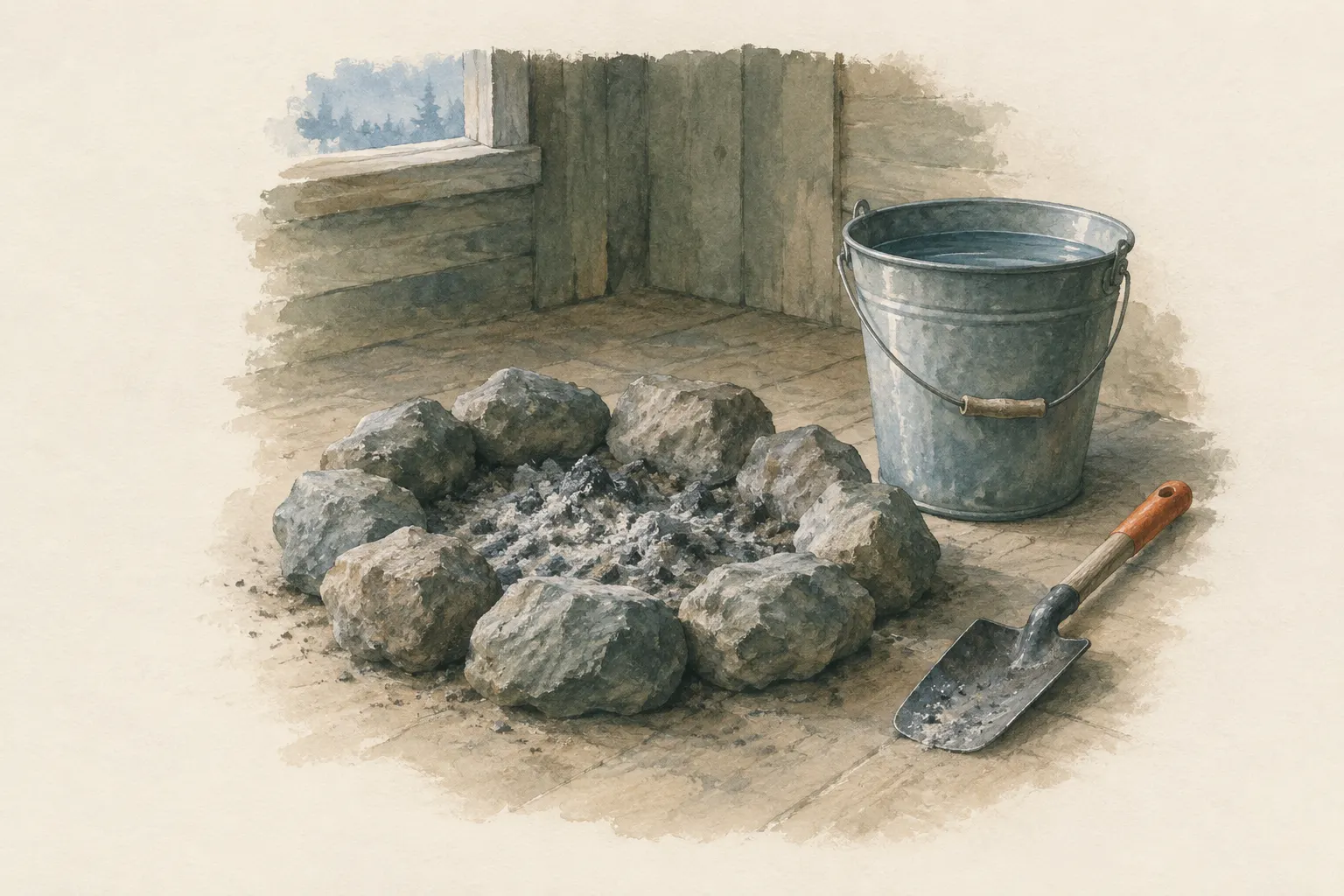
The hearth is in the middle, far from walls, roof and sleeping place, in a shallow hollow lined with dry stones and surrounded by a stone ring. All round it there is at least about a metre of bare ground: no leaves, no bedding, no firewood stack. The roof must be high enough that the flames never reach it.
The smoke hole sits at the highest point of the roof, above the hearth. Its edges are protected against sparks with clay or stones, and a small offset cover above keeps out rain without holding back the smoke. A chimney of wattle, plastered thickly with clay inside and out, on a stone base and reaching above the roof, is better. Low in the wall an air inlet always stays open.
The fire stays small and is fed with dry, thin wood – a few pieces often rather than a lot at once. Conifer wood likes to throw sparks, so use only a little of it. Before sleeping the fire is put out completely, or someone stays awake. Embers are never covered to keep them overnight while people sleep in the hut.
Safety: what to watch out for
Carbon monoxide is the invisible danger. With headache, dizziness, nausea, great tiredness or confusion – all the more if several people are affected at once – everyone goes outside into the fresh air at once, the door stays open, nobody goes back. Call 112 (in Austria also 144). Only pull an unconscious person out if you do not put yourself in danger, and put them in the recovery position outside. A battery-powered CO alarm warns before you notice anything.
Stones from streams, rivers or wet ground often hold water in fine pores and cracks. If this water heats up quickly in the fire, the stone can burst and throw sharp fragments. Use only dry stones from dry ground for hearth and stove, and warm new stones only slowly at first.
If the hut is burning, only getting out counts. A small patch of embers on the floor can be put out with water or sand; once flames have reached a wall or the roof, do not try to fight them. That is why the way to the exit always stays clear, everyone knows it, and water, sand and shovel stand ready next to the fire.
When it makes sense – and when not
A fire inside a hut only makes sense in a solid, sufficiently large long-term hut with a high roof that is not made of dry leaves, grass, cloth or tarp, in a cold region and when someone can always stay awake. Even then, a fire outside in front of the open entrance with a reflector is often the better choice: warmth without smoke and without carbon monoxide in the room.
Never a fire in tents, under tarps, in debris huts, snow caves or small emergency shelters – not a small one, not a stove, not a barbecue and not a bowl of embers. During a fire ban or high forest fire danger there is no fire, not even in a hut, because sparks fly out of the smoke hole.
Good to know
Open hearth fires with a smoke hole in the roof were common in huts and longhouses for thousands of years. The World Health Organization points out that smoke from open fires indoors strains eyes and lungs heavily and releases carbon monoxide. So what was once taken for granted was never harmless.
A simple stone stove with a flue through the roof stores heat in the stones and releases it long after the fire, and it holds sparks back better than an open hearth. For that it must be tight: after every fire, joints and clay are checked for cracks, because a cracked stove lets smoke and carbon monoxide into the room.
Step by step
First check: may a fire burn in here?
A fire inside is only allowed in a solid, sufficiently large hut with a high roof that is not made of dry leaves, grass, cloth or tarp. Never in tents, tarps, debris huts, snow caves or small emergency shelters. Often a fire outside in front of the entrance with a reflector is the safer choice. Also check whether a fire ban is in force.
Caution: Tent, debris hut or tarp: no fire inside – not even a small one.
- 1
First check: may a fire burn in here?
A fire inside is only allowed in a solid, sufficiently large hut with a high roof that is not made of dry leaves, grass, cloth or tarp. Never in tents, tarps, debris huts, snow caves or small emergency shelters. Often a fire outside in front of the entrance with a reflector is the safer choice. Also check whether a fire ban is in force.
Tent, debris hut or tarp: no fire inside – not even a small one.
- 2
A hearth of dry stones
Put the hearth in the middle of the hut, far from walls and sleeping place. Dig a shallow hollow and line it with dry stones that do not come from a stream, river or wet ground. Set a ring of stones around it. Leave at least about a metre of bare ground all round: no leaves, no bedding, no wood pile. The roof must be well above the flame.
Wet stones or river stones can burst when heated.
- 3
Smoke exit at the very top
Cut a smoke hole at the highest point of the roof, above the hearth, about the size of a head or larger. The edges of the hole must be free of dry leaves and grass – protect them with clay or stones. A small offset cover above it keeps rain out without trapping the smoke. A chimney is better: wattle of branches, plastered thickly with clay inside and out, on a stone base, reaching above the roof.
A wooden chimney without a thick layer of clay catches fire.
- 4
Fresh air from below
Leave an air inlet low in the wall, as close to the ground as possible and towards the fire, or leave the door open a crack. Cold air flows in at the bottom, the fire gets oxygen and the warm smoke leaves at the top. Without an air inlet no smoke goes out, however big the smoke hole. Never close all openings to keep warmer.
Smoke at head height means too little air or too big a fire – change it at once.
- 5
Keep it small with dry wood
Make only a small fire of dry, thin wood. Wet or smouldering wood smokes heavily and produces more carbon monoxide. The flames must never reach anywhere near the roof. Conifer wood such as spruce often throws sparks – use only a little of it. Add a few pieces often rather than a lot at once, and keep firewood outside the bare ground around the hearth.
- 6
Never unattended, never while sleeping
As long as the fire burns or smoulders, someone awake stays with it. Whoever wants to sleep puts the fire out completely first: water on, stir, more water, until nothing is warm. Never cover embers with soil or ash and then sleep inside – covered embers smoulder and produce a lot of carbon monoxide. In groups, set a fire watch in turns.
No sleeping with glowing embers in the hut.
- 7
Recognise carbon monoxide and get out at once
Watch for headache, dizziness, nausea, great tiredness or confusion – especially when several people feel it at once. Then everyone out into the fresh air at once, leave the door open, do not go back. Call 112 (in Austria also 144). Only pull an unconscious person out if you do not put yourself in danger, then put them in the recovery position outside. A battery-powered CO alarm warns earlier than you notice.
Do not “just put the fire out quickly” – get out first.
- 8
Keep extinguishing means and escape route ready
Next to the hearth there is always a full container of water, a pile of sand or soil and a shovel. The way to the exit stays clear, and everyone knows where it is. Check smoke hole, chimney and clay for cracks and soot build-up every day and repair them. When you leave the hut, the fire is put out completely and checked with your hand that nothing is warm any more.
Common mistakes
- Fire in a tent, debris hut or under a tarp
- Stones from the stream for the hearth
- Smoke hole without an air inlet below
- Closing all openings because of the cold
- Big fire with flames reaching the roof
- Falling asleep with covered embers
- Mistaking headache and dizziness for exhaustion
- No extinguishing water next to the fire
Quick view
Materials
Water for extinguishing (bucket, canister or pot)
Always full, next to the hearth
Have several litres ready before lighting.
Small shovel / folding spade
For digging the fire pit and for sand or soil to smother the fire
Carbon monoxide alarm
Battery-powered CO alarm whenever possible
Does not replace the rule never to run combustion devices indoors. Choose battery-powered or with battery backup.
Clay (clay–sand mix)
For a clay chimney or to seal the stones
Clay is no guaranteed stove material: check for cracks after every fire and repair them at once.
Only take clay where you are allowed to dig.
Dry firewood
Dry, thin wood – little smoke
Collect only where permitted.
Suitable for
- Solid long-term huts of wood, clay or stone with a high roof
- Cold regions where a fire outside is not enough
- Groups where someone can always stay awake
Not suitable for
- Tents, tarps, bivy bags and emergency blankets
- Debris huts, grass huts and small emergency shelters
- Snow caves and tightly closed rooms
- Times of fire bans or high forest fire danger
- When nobody can stay awake
Prerequisites
- A hut that is big enough and not made of dry leaves, grass or tarp
- Safe fire lighting and complete extinguishing outdoors
- Knowledge about carbon monoxide
- Permission from the landowner for fire and building
How it works
Hot smoke rises. It needs an exit at the top and an entrance for fresh air at the bottom, otherwise it builds up under the roof and sinks down to you. A fire that gets enough air and burns dry wood smokes less and produces less carbon monoxide than a smouldering one. Stones and clay protect burnable parts from heat and sparks – but only when they are dry and there is enough distance all round.
Advantages
- Warmth, light and a cooking place out of the rain
- Dries clothing and hut
- Smoke keeps insects away
Disadvantages
- Carbon monoxide and fire risk
- Smoke irritates eyes and lungs
- Needs constant supervision and plenty of wood
- Only possible in solid, large huts
Deep knowledge
Background
Open hearths in huts with a smoke hole in the roof were common for thousands of years. The World Health Organization describes carbon monoxide as a gas formed by incomplete combustion that is dangerous even in small amounts; smoke from open fires also strains eyes and lungs.
Military survival manuals warn against putting wet or porous stones in a fire because they can burst, and stress ventilation in shelters with a fire.
Variants
- Simple stone stove with flue
- Build a small fire chamber with an opening at the front from dry, flat stones, seal the joints with clay and connect a built or clay-plastered flue at the back that leads through the roof to the open air. The stones store heat and release it for a long time. Check for cracks after every fire; a cracked stove lets smoke and CO into the hut.
- Fire outside with a reflector
- Build the fire in front of the entrance with a wall of logs or stones behind it that throws the heat into the open hut. No smoke and no CO in the room – usually the better choice.
Common mistakes
- Fire in a tent, debris hut or under a tarp
- Stones from the stream for the hearth
- Smoke hole without an air inlet below
- Closing all openings because of the cold
- Big fire with flames reaching the roof
- Falling asleep with covered embers
- Mistaking headache and dizziness for exhaustion
- No extinguishing water next to the fire
Limits and risks
- No instructions for stoves with metal pipes, gas, kerosene or wood gasifiers
- No substitute for a CO alarm
- First aid at lay level only – always call emergency services if CO poisoning is suspected
Material alternatives
Derived from material properties: a substitute must have all relevant properties. Observe the notes on the substitute.
- Dry firewood
- Tinder (Carry in waterproof packaging.), Char cloth (charred cotton) (Store dry in a tin.), Finest-grade steel wool (Store separately from batteries – fire risk.), Fatwood (resin-rich wood) (Collect only dead wood where permitted.), Stove fuel (canister, liquid fuel, alcohol) (Store fuels apart from food and in original containers or bottles intended for them.), Petroleum jelly cotton balls (Use only pure cotton.), Cooking oil or cooking fat (tallow, lard) (Never put out burning fat with water – cover it with a lid to smother it.), Tree resin (spruce, pine) (Resin is flammable and sticks to the skin when hot – melt it only slowly over low heat.), Birch bark (from dead, fallen wood) (Never peel from living trees.)
Results come exclusively from structured entries. No improvised instructions are generated.
Sources
World Health Organization, Regional Office for Europe (2010): WHO guidelines for indoor air quality: selected pollutants (carbon monoxide chapter)
Carbon monoxide forms from incomplete combustion, is invisible and odourless; symptoms such as headache, dizziness, nausea
Centers for Disease Control and Prevention: Carbon Monoxide Poisoning – Prevention guidance
Symptoms of CO poisoning, get to fresh air at once, call for help; CO alarms
Headquarters, Department of the Army (USA) (2002): FM 3-05.70 Survival
No wet or porous stones by the fire – they can burst; ventilation of shelters with a fire
Mors L. Kochanski – Lone Pine Publishing: Bushcraft: Outdoor Skills and Wilderness Survival
Fires in long-term shelters, smoke exit
Leave No Trace Center for Outdoor Ethics: The Seven Principles of Leave No Trace (Principle 5: Minimize Campfire Impacts)
Keep fires small, put them out completely