Raised bed: a sleeping platform of poles
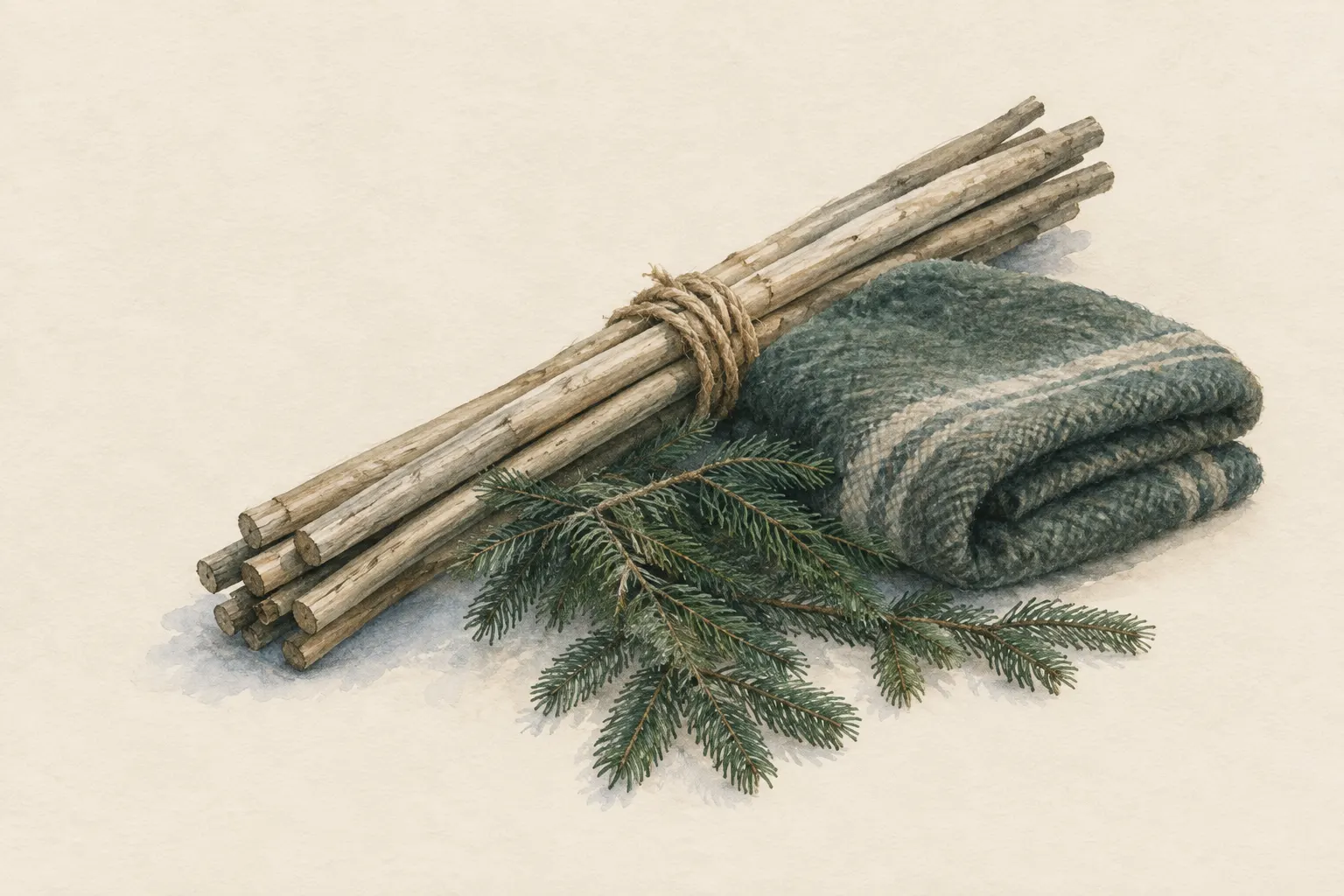
The cold, wet ground draws more warmth out of your body at night than the air does. A bed of poles lifts you about knee-high off the ground: four forked posts and two side rails lashed into a frame, topped with a surface of closely laid poles and a thick layer of spruce boughs, leaves or grass. Before the first night its strength is tested step by step.
- 2–4 hours with material at hand
Explained simply
Have you ever sat on cold ground and noticed how quickly you get cold? The ground draws the warmth out of your body, especially when it is wet. At night while you sleep this goes on for hours. A raised bed is a simple bed of poles that lifts you up off the cold ground.
The bed stands on four posts with forks at the top. Two long poles lie in the forks, and many thin poles go across them as the sleeping surface. Everything is held together with cord tied tightly around the poles. This is called a lashing.
The bedding on top is important: lots of spruce boughs and dry leaves. They trap air, and that air keeps you warm. Before you lie down for the first time, check carefully that the bed holds you – sit first, then lie down.
How it works
Heat always flows from warm to cold. If you lie directly on the ground, your weight compresses the insulation beneath you, and the cold, often damp ground conducts the heat away well. Wet ground conducts even better than dry ground. That is why people sleeping outdoors often get cold mainly from below.
The raised bed creates distance from the ground. Wet no longer soaks into bedding and sleeping bag, and crawling creatures find it harder to get into bed. But it does not warm you on its own: cold air flows under a surface of poles, and thin poles hardly insulate. Only the thick bedding of boughs, leaves and grass, which holds a lot of still air, makes the bed warm.
The frame holds through lashings, that is, wraps of cord pulled tight with frapping turns. Frapping turns run crosswise between the poles around the wraps and tighten them further. The forks in the posts take the weight, and the lashings stop the poles from slipping.
What really matters
The side rails carry the whole weight. They must be sound, straight and strong – wrist- to forearm-thick, depending on length. Every pole is bent and tapped: rotten wood sounds dull and can be dented with a fingernail. A pole with a crack or a soft spot is not used, even if it otherwise looks good.
The forks of all four posts must be at the same height, and the posts must stand firmly in the ground. A hole about one spade deep, well stamped-down soil and the fork openings running lengthwise – then nothing slips. If you cannot or may not dig, lay two thick logs as a base and peg them.
The bedding is what actually gives warmth. Spruce or fir boughs are laid like roof tiles, thick ends down towards the foot end, with dry leaves or grass on top. Pressed down, at least a hand's thickness should remain. Every day it is fluffed up and flattened or damp material replaced.
Safety: what to watch out for
A raised bed is tested step by step: first press with your hands, then sit in the middle, then at the edges, then lie down carefully. If something creaks, a pole sags or a lashing slips, it is repaired. You do not jump on a raised bed or stand on it – it is a bed, not a ladder.
Dry conifer boughs, leaves and grass burn like tinder. So the bed does not belong next to the hearth, and embers or candles do not come near it. In a hut with a fire, there is a clear area all round the hearth without bedding or wood pile.
Boughs are only taken when fallen or cut with the forest owner's permission; young trees are not stripped bare. Before using them, shake the boughs out and look for ticks and insects. And after the camp everything is dismantled: remove the cord, scatter wood and boughs.
When it makes sense – and when not
A raised bed is worth it as soon as you sleep several nights in the same place, especially on wet, cold or stony ground and in areas with many crawling creatures. In a solid hut it makes sleep much drier and more comfortable, and there is space for gear underneath.
For a single emergency night the effort is too great. Then a thick layer of leaves, boughs or a sleeping pad directly on the ground is better – several hands high. Low debris huts have no room for a raised bed anyway; there the floor is padded thickly.
Good to know
Survival manuals have long warned against sleeping directly on cold or wet ground and recommend a bed raised off the ground or a thick insulating layer. In bushcraft books, pole beds are part of the equipment of long-term camps, often together with a fire and a reflector.
A natural cord such as jute or sisal, which rots if a scrap is left in the woods, is enough for the lashings. Square, shear and diagonal lashings are explained in their own entries. If you practise the lashings at home on broom handles first, you build much faster outdoors.
Step by step
Choose the place and size
Put the bed on a level, dry spot in the hut, away from the fire. Lie on the ground and mark head, feet and shoulders with sticks: the sleeping surface should be a little longer than you and a good shoulder width wider. About knee height is enough – high enough against ground cold and wet, low enough that nothing tips over.
- 1
Choose the place and size
Put the bed on a level, dry spot in the hut, away from the fire. Lie on the ground and mark head, feet and shoulders with sticks: the sleeping surface should be a little longer than you and a good shoulder width wider. About knee height is enough – high enough against ground cold and wet, low enough that nothing tips over.
- 2
Choose and check the poles
You need four forked posts, two strong side rails, two cross bars for head and foot end and many thin, straight poles for the surface. Use fallen, sound dead wood or cut only with permission. Check every pole: bend it, tap it, look for cracks and soft, rotten wood. Rotten wood sounds dull and can be dented with a fingernail.
Never use poles with cracks or soft spots as side rails.
- 3
Set the posts
Dig a hole about one spade deep at each of the four corners, or drive in sharpened posts with a wooden mallet. The forks must all be at the same height, with the openings running lengthwise. Stamp the soil down firmly around each post. It also works without digging: lay two thick logs lengthwise on the ground as a base and peg them so they cannot roll.
- 4
Lash the frame
Lay the two side rails into the forks. At the head and foot end lash a cross bar across the side rails with a square lashing. Pull each lashing tight with frapping turns. Check that the frame is square: both diagonals should be the same length. If the frame wobbles sideways, lash a diagonal pole between two posts as a brace.
- 5
Lay the sleeping surface
Lay thin, straight poles close together across the side rails, with gaps no wider than a finger. Cut branch stubs off smoothly so nothing presses into you. Tie the poles at both ends with a continuous cord or notch them slightly so they cannot slip. The surface should give a little but not sag.
- 6
A thick bedding layer
Lay spruce or fir boughs overlapping like roof tiles: thick ends down towards the foot end, tips up, row by row from the foot to the head end. Dry leaves or grass go on top. The layer should be several hands high and still at least a hand thick when pressed down. On top a tarp or blanket, then sleeping pad and sleeping bag.
Only use fallen boughs or cut them with permission; check for ticks and insects.
- 7
Test the strength
Load the bed step by step: first press with your hands, then sit in the middle, then at the edges, then lie down carefully. Watch for creaking, sagging and slipping lashings. Tighten lashings and replace weak poles. Check the bed every day, fluff up the bedding and replace flattened or damp material.
Do not jump or stand on the bed.
Common mistakes
- Side rails too thin or rotten
- Lashings without frapping turns – they loosen
- Too thin a bedding layer on the poles
- Bed right next to the fire
- Branch stubs not cut off
- Never re-tightening and no fresh bedding
Quick view
Materials
Sturdy sticks / poles
4 forked posts, 2 side rails about wrist- to forearm-thick, many thin straight poles
Do not cut live wood where prohibited.
Jute or sisal twine (bought)
Or paracord for the lashings
Low strength, absorbs water and rots – light loads and practice only.
Folding saw
Fold or cover the blade after use; saw teeth are very sharp.
Spruce or fir boughs as bedding
Only use fallen boughs or cut them with the forest owner's permission.
Dry conifer boughs burn very easily – keep them away from the fire.
Dry leaves, grass or conifer boughs
Dry leaves or grass as a second bedding layer
Collect only where allowed; no protected plants. Check for ticks and insects.
Tarp
As a cover over the bedding
Sleeping pad
Suitable for
- Huts and shelters for several nights
- Wet, cold or stony ground
- Areas with many crawling animals or insects on the ground
Not suitable for
- A single emergency night – a thick insulating layer directly on the ground is enough then
- Low debris huts with no room above
- Places where wood may not be used
Prerequisites
- Able to tie square and shear lashings
- Permission to use or cut wood
- Safe use of saw and knife
Safety
- Rotten or cracked poles break without warning. Bend and tap every pole before using it. Load the finished bed step by step – sit first, then kneel, then lie – and tighten the lashings.
- Dry conifer boughs, leaves and grass burn like tinder. Never build the bed right next to the fire and never bring embers near it.
- Cold comes from below on a raised bed too. Without a thick bedding layer you get cold faster on a surface of poles than on the ground, because cold air flows underneath.
How it works
The ground draws heat away, especially when it is wet. A raised bed puts distance between you and the cold, wet ground so no moisture rises. But what keeps you warm is the air trapped in the bedding: boughs, leaves and grass hold a lot of still air. Only distance and bedding together make the bed warm.
Advantages
- Dry and away from ground cold and wet
- Fewer crawling creatures in bed
- Storage space under the bed
- Easier to get up and sit on
Disadvantages
- Cold air flows underneath – bedding is essential
- Needs plenty of suitable wood and cord
- Only worth it for several nights
Deep knowledge
Background
Survival manuals repeatedly warn against sleeping directly on cold or wet ground and recommend raising yourself off it or insulating thickly. Bushcraft textbooks describe pole beds as a regular part of long-term camps.
Why still air insulates so well is explained in the entry on insulation against ground cold. For a single emergency night, a thick layer of leaves directly on the ground usually makes more sense than a raised bed.
Variants
- Log box bed
- Lay two thick logs parallel on the ground, peg them and fill the space between them high with boughs and leaves. No lashing needed, but closer to the ground.
- Tarp stretcher between two poles
- Wrap a strong tarp or two buttoned-up jackets around two side rails like a stretcher. The poles rest in the forks. Light and quick, but it also needs insulation from below.
Common mistakes
- Side rails too thin or rotten
- Lashings without frapping turns – they loosen
- Too thin a bedding layer on the poles
- Bed right next to the fire
- Branch stubs not cut off
- Never re-tightening and no fresh bedding
Limits and risks
- No load ratings – test every bed yourself
- No bunk beds or structures for people at greater height
Material alternatives
Derived from material properties: a substitute must have all relevant properties. Observe the notes on the substitute.
- Jute or sisal twine (bought)
- Rope (Never use unknown or damaged rope for life-safety purposes.), Paracord (Not a climbing or safety rope.), Thin twine (Low breaking strength – light loads only.), Accessory cord (Use only certified cord after training for life-safety purposes.), Webbing (tubular webbing) (Inspect knotted webbing before every use.), Tree straps (Load only within the manufacturer's limits.), Monofilament fishing line (Never leave scraps of line behind: birds and other animals get tangled in them and die slowly. Wind up scraps and take them with you.), Thin, soft wire (brass or galvanised steel) (Wire ends are sharp – protect eyes and fingers when bending), Tow rope or tow strap (Attach only to the towing eyes provided by the manufacturer; never stand next to it under load.)
- Dry leaves, grass or conifer boughs
- Sleeping pad, Backpack, Dry spare clothing (Carry it in waterproof packaging – wet clothing barely insulates.), Wool blanket / duvet (Keep away from candles, stoves and heaters.), Insulated cool box (Keeps cold only for a limited time; without ice packs or ice it is not a fridge.), Sleeping bag (Do not store compressed long-term; do not pack away damp.), Newspaper and cardboard (Flammable – keep away from candles, stoves, heaters and embers.), Insulated cooking box (hay box, thermal cooker) (Never put open flame or embers inside – only the hot, closed pot.), Long-stemmed thatch (reed, grass, rushes) (Extremely flammable – no open fire and no sparks nearby.)
- Tarp
- Plastic sheet / large bin bag (Tears easily; never pull over the head (suffocation risk).), Emergency blanket (Tears easily once punctured; short-term shelter only.), Document folder (waterproof) (Store securely – contains sensitive personal data.), Rain poncho (When used as a shelter, it no longer protects your body from rain.), Bivy bag (Never fully close off the face.), Tent (Do not cook or heat inside the tent (fire and carbon monoxide danger).), Heavy-duty bin bag (large) (Suffocation risk: never pull plastic bags over the head or face and keep them away from small children.), Group shelter bag (Airtight – ventilate regularly.)
- Sleeping pad
- Dry leaves, grass or conifer boughs (Collect only where allowed; no protected plants. Check for ticks and insects.), Backpack, Dry spare clothing (Carry it in waterproof packaging – wet clothing barely insulates.), Wool blanket / duvet (Keep away from candles, stoves and heaters.), Insulated cool box (Keeps cold only for a limited time; without ice packs or ice it is not a fridge.), Sleeping bag (Do not store compressed long-term; do not pack away damp.), Newspaper and cardboard (Flammable – keep away from candles, stoves, heaters and embers.), Insulated cooking box (hay box, thermal cooker) (Never put open flame or embers inside – only the hot, closed pot.), Long-stemmed thatch (reed, grass, rushes) (Extremely flammable – no open fire and no sparks nearby.)
Results come exclusively from structured entries. No improvised instructions are generated.
Sources
Headquarters, Department of the Army (USA) (2002): FM 3-05.70 Survival
Do not sleep directly on cold, wet ground; insulate and raise the bed off the ground
Mors L. Kochanski – Lone Pine Publishing: Bushcraft: Outdoor Skills and Wilderness Survival
Beds and platforms in long-term camps, bough bedding
Ray Mears – Hodder & Stoughton (2002): Bushcraft
Protection from ground cold, sleeping place in camp
Boy Scouts of America: Scouts BSA Handbook
Square lashing and lashed camp structures